Built for Dry Liners
RAMS, CPP & Site Documents for Dry Liners
Drylining means working at height on stilts or platforms, cutting plasterboard all day, and handling metal stud framing. Your RAMS need to cover dust, manual handling, and working at height across large commercial fit-outs.
No card needed · Used by UK dry liners · Structured around CDM 2015
Built for Dry Liners
Real work, real hazards. Pick the job closest to yours to start a free job pack with the scope already filled in:
Metal stud partitions
Steel stud framing and plasterboard lining for office and commercial partitions — covers manual handling, metal cutting, working at height for full-height walls, and coordination with M&E trades.
Start with this job →Ceiling systems and bulkheads
Suspended ceiling grid and plasterboard installation — covers working at height on stilts, trestles, or scaffolding, overhead manual handling, and dust from cutting boards.
Start with this job →Fire-rated enclosures and shaft walls
Fire-rated plasterboard systems for risers, lift shafts, and escape routes — covers heavy multi-layer boarding, fire stopping, and ensuring tested system specifications are followed precisely.
Start with this job →Domestic plasterboard and insulated lining
Dot-and-dab or battened plasterboard over masonry walls — covers adhesive handling, insulation board cutting, dust, and working in occupied domestic properties.
Start with this job →What You Get
Job-specific RAMS
Describe your job and get professional risk assessments covering dust from cutting plasterboard and other trade-specific hazards.
Construction Phase Plans
CPP first drafts structured around CDM 2015 requirements and your job details, ready for competent review. Covers management arrangements, risk control, welfare, and emergency procedures.
COSHH Assessments
Smart substance search and SDS upload. Pre-loaded with common dry liner substances like gypsum dust (from cutting plasterboard), jointing compounds, pva adhesives, dot-and-dab adhesive.
Site Inductions
Digital induction sign-offs for every worker on site. Linked to your CPP and site rules. Works on any phone or tablet.
Worker & subcontractor tracking
Track certifications, insurance, and CSCS cards. Get alerts before documents expire. One view for all your workers.
Digital document sharing
Share your full document pack with clients, principal contractors, or inspectors via a secure read-only link. No login needed on their end.
Common Hazards We Cover
These are the real risks dry liners face on site every day. Your RAMS will address each one with specific control measures.
- Dust from cutting plasterboard — gypsum dust irritates the respiratory system and eyes during prolonged cutting operations
- Manual handling — full sheets of plasterboard (standard 12.5mm board weighs 22kg, fire-rated boards are heavier) must be carried and lifted overhead
- Working at height — ceiling work, full-height partitions, and bulkheads require stilts, hop-ups, trestles, or mobile scaffolding
- Sharp edges and lacerations — metal stud framing, track cutting, and plasterboard edges cause cuts, particularly to hands and forearms
- Noise exposure — metal stud cutting, screw guns, and board cutting tools generate sustained noise above action levels
- Musculoskeletal injury — repetitive overhead work, carrying boards through doorways, and prolonged stilt use cause back, shoulder, and knee injuries
Key Regulations & Standards
BS 8212 (Drylining and Partitioning) and Work at Height Regulations 2005
Drylining work must comply with the Work at Height Regulations 2005 for all ceiling and high-level work. Fire-rated systems must be installed in accordance with the tested specification and BS 8212 for partitioning. Manual handling assessments are required under the Manual Handling Operations Regulations 1992 given the weight and awkward size of plasterboard. CDM 2015 applies to all drylining work, and COSHH assessments are required for dust exposure during sustained cutting operations.
What's included at each tier
Starter
£0- Risk Assessments (RAMS)
- Construction Phase Plans (CPP)
- Site inductions
- Worker document signing (no per-signature charge)
Pro
£39/mo or £360/yr- Risk Assessments (RAMS)
- Construction Phase Plans (CPP)
- Site inductions
- COSHH assessments (standalone doc, SDS upload, site-specific register)
- Worker cert tracking and expiry alerts
- Right-to-work evidence records
- Subcontractor tracking
- Toolbox talks
- Worker document signing (no per-signature charge)
- Integrations (Drive, Xero, Zapier)
Business
£199/mo- Risk Assessments (RAMS)
- Construction Phase Plans (CPP)
- Site inductions
- COSHH assessments (standalone doc, SDS upload, site-specific register)
- Worker cert tracking and expiry alerts
- Right-to-work evidence records
- Subcontractor tracking
- Toolbox talks
- Worker document signing (no per-signature charge)
- Integrations (Drive, Xero, Zapier)
- Up to 10 internal team logins
- Site Supervisor: a field-only login for whoever runs the site
- Up to 50 active site portal users
- Site attendance check-in/check-out
- Multilingual worker inductions (9 languages)
- Optional 4-digit PIN for shared-link document sign-off
- Plant & equipment register with project assignment, certificates, inspections and defects
- Slack Site Ready readiness checks
Site Control
£675/site/mo- Risk Assessments (RAMS)
- Construction Phase Plans (CPP)
- Site inductions
- COSHH assessments (standalone doc, SDS upload, site-specific register)
- Worker cert tracking and expiry alerts
- Right-to-work evidence records
- Subcontractor tracking
- Toolbox talks
- Worker document signing (no per-signature charge)
- Integrations (Drive, Xero, Zapier)
- Up to 10 internal team logins
- Site Supervisor: a field-only login for whoever runs the site
- Up to 50 active site portal users
- Site attendance check-in/check-out
- Multilingual worker inductions (9 languages)
- Optional 4-digit PIN for shared-link document sign-off
- Plant & equipment register with project assignment, certificates, inspections and defects
- Slack Site Ready readiness checks
- Permanent entrance QR: guest sign-in and contractor self-join
- CSCS credential capture, review and expiry alerts
- Digital induction gating before check-in
- Live people-on-site, attendance and audit-grade exports
- Single sign-on (SSO) with Okta or Microsoft Entra
- Public REST API with scoped account keys
- Signed real-time webhooks into your own systems
Running live sites with subcontractors? Site Control is the per-site enterprise tier above Business — entrance QR sign-in, CSCS checks, induction gating, live attendance and audit-grade exports. From £675/site per month, plus £5,000 setup.
Frequently Asked Questions
- Do dry liners need RAMS?
- Yes. Drylining involves working at height, manual handling of heavy and awkward boards, sustained dust exposure, and use of power tools — all significant risk activities under CDM 2015. On commercial sites, the principal contractor will require your RAMS before you start. Your RAMS should cover dust control, working at height method (stilts, scaffold, MEWP), and manual handling procedures.
- How does The Site Book draft RAMS for drylining?
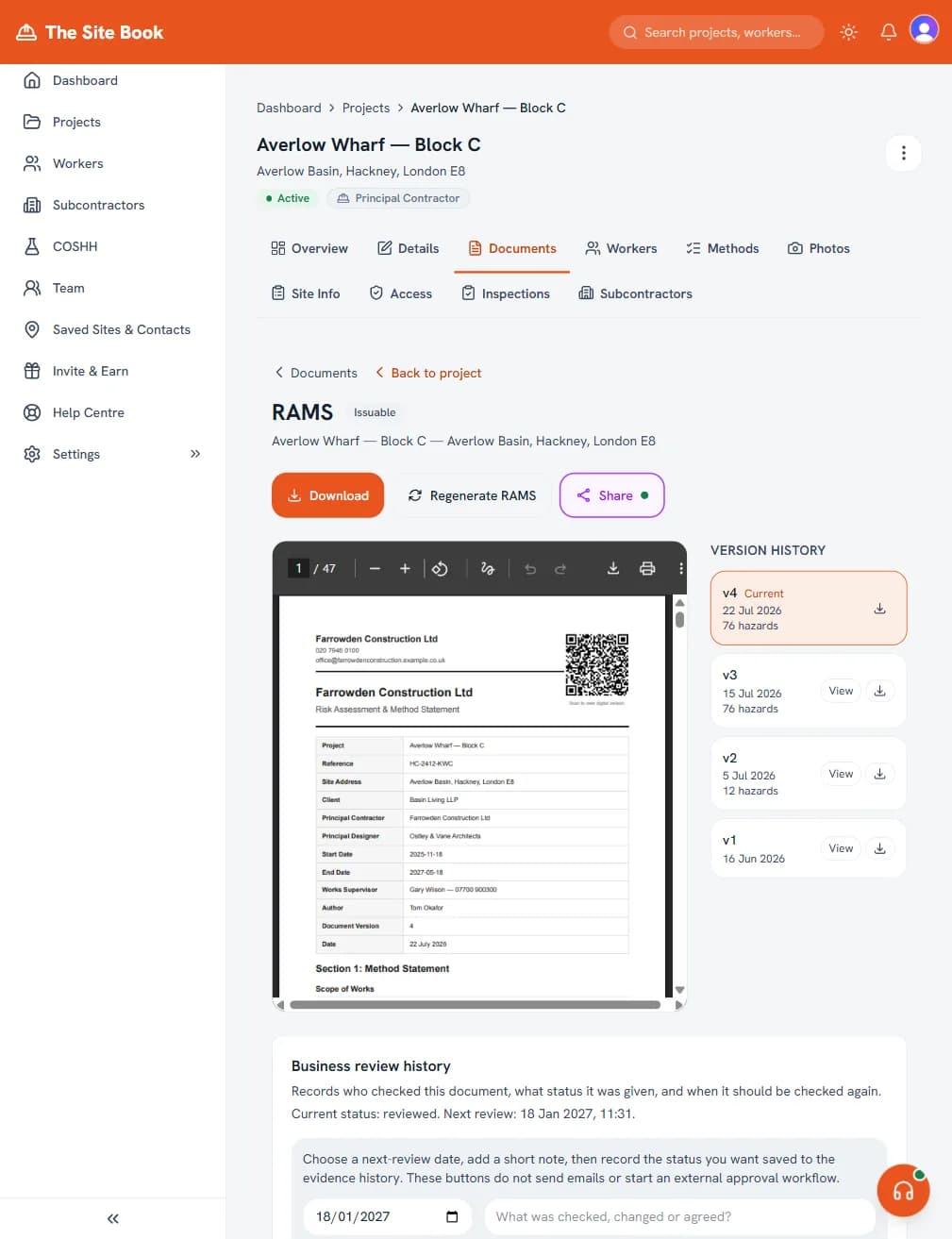
- The Site Book creates a first draft for your competent review. Describe the job — for example, 'metal stud partitions and suspended ceilings for a 500m2 office fit-out' — and the AI generates RAMS covering manual handling, dust control, working at height, fire-rated system installation, and coordination with other trades.
- Does The Site Book cover fire-rated drylining systems?
- Yes. The Site Book generates RAMS that reference the importance of installing fire-rated plasterboard systems to the exact tested specification. It covers the requirement for correct board type, number of layers, fixing centres, and fire stopping — deviating from the tested detail invalidates the fire rating.
Why The Site Book
- UK construction compliance tool that ships RAMS + CPP + COSHH + inductions (readable and acknowledgeable in 9 worker languages on Business, with the language audit-recorded) + worker sign-off, including optional 4-digit shared-link PIN evidence on Business, plus site attendance, portal users, site files, document reviews, subcontractor evidence and inspections/actions.
- Generate a site-specific RAMS first draft from a natural-language brief, ready for competent-person review - not a template library you hand-fill.
- Controlled document workflow without an enterprise contract: version history and a recorded issue confirmation before a document is shared with a client or downloaded in the app on every plan, re-sign on revision with superseded signatures preserved plus PCPP import, cert tracking and document checking from the £39/month Pro plan - and on Business, optional named-approver routing (a designated approver accepts or rejects each version, with recorded reasons, before it can be issued) plus client approve/reject/request-changes via share links.
- Transparent pricing: Starter £0, Pro £39/month or £360/year, Business £199/month with 10 management logins and 50 active site portal users. Worker document signing has no per-signature charge; project workers count as active portal users while assigned.
- Build RAMS for any trade - add your own work types and method statements alongside the built-in library, reusable across projects, including a ready-made Commercial Solar PV group. Save a finished job as a reusable project template, or clone it, so the next job of the same shape starts from your own setup.
- COSHH goes deep: a standalone COSHH assessment document, upload-a-Safety-Data-Sheet extraction, a site-specific substance register and an expert-reviewed library - plus per-worker RAMS sign-off and a one-click Audit Pack covering documents, sign-offs, worker evidence, attendance, incidents, COSHH, permits and up to the latest 500 live Site Diary entries.
Ready to stop writing RAMS by hand?
Describe your job, get professional RAMS, a CPP and a site induction. No credit card required.