Built for Electricians
RAMS for Electricians, CPPs & Site Documents
Stop spending your evenings writing RAMS. Create professional risk assessments, method statements, and CPPs for electrical work.
No card needed · Used by UK electricians · Structured around CDM 2015
Trade preset
Start with the electrician pack.
The first draft opens with a electrician scope so the user can check the job details instead of starting from a blank page.
- Electrical RAMS
- Construction Phase Plan
- Site induction
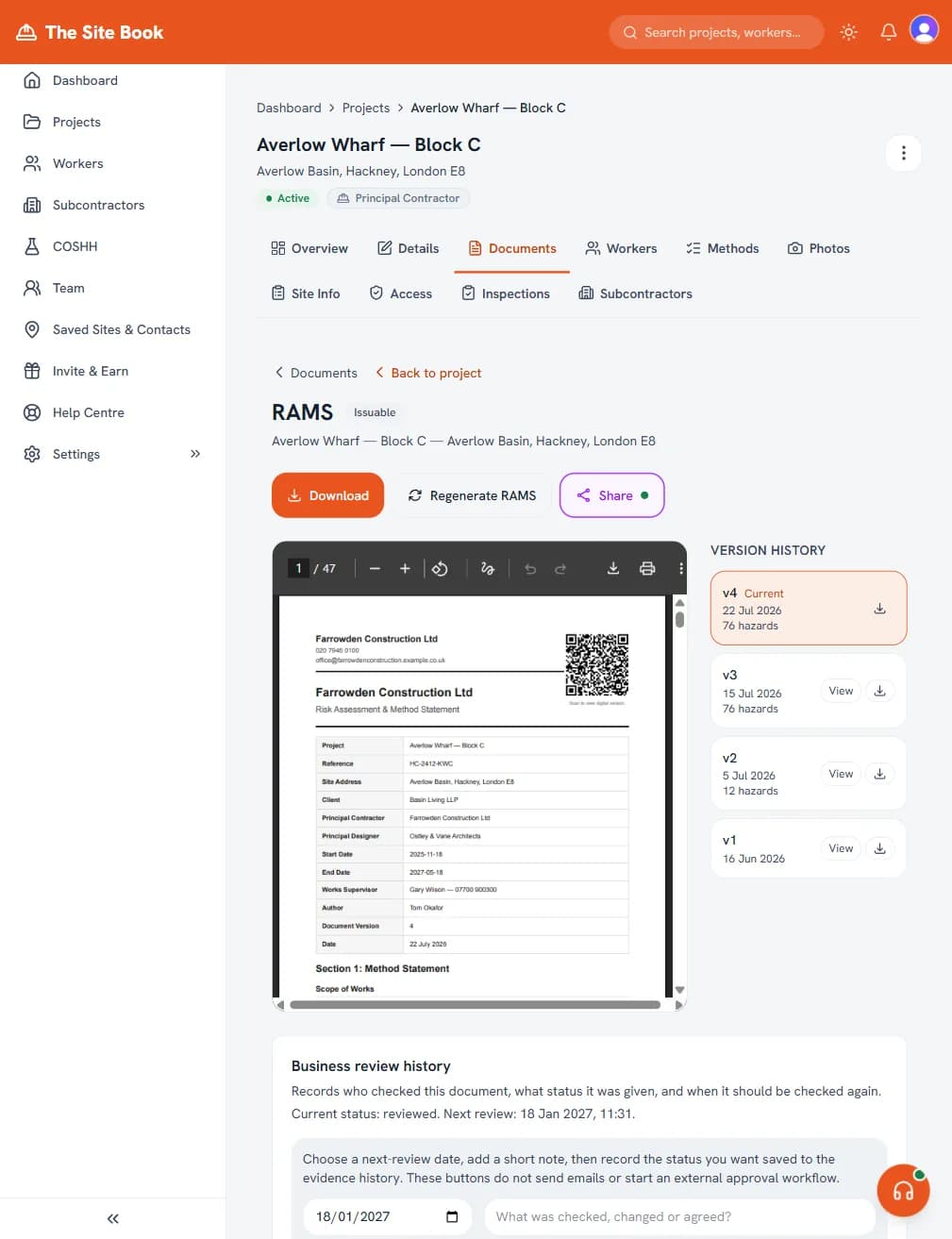
Built for Electricians
Real work, real hazards. Pick the job closest to yours to start a free job pack with the scope already filled in:
First fix wiring
Cable routing through timber and steel frames, notching joists, fire stopping at compartment walls — covers cable damage, service strikes, and fire spread risks.
Start with this job →Consumer unit upgrades
Isolation procedures, live testing requirements, asbestos risk in older consumer unit backboards — covers arc flash, electric shock, and asbestos exposure.
Start with this job →Commercial rewires
Phased isolation in occupied buildings, temporary supplies, containment installation at height — covers working at height, live working, and coordination with other trades.
Start with this job →EV charger installations
External cable routing, ground-level excavation for ducting, mounting at height — covers buried services, manual handling of charger units, and wet weather working.
Start with this job →CDM 2015 Compliance for Electricians
CDM 2015 applies to all electrical construction work, including domestic installations, commercial rewires, and industrial maintenance. Electricians may hold the duty of contractor under Regulation 15, or principal contractor under Regulation 13 if they are managing a project with multiple trades. Notifiable electrical work under Part P of the Building Regulations adds a separate compliance layer for domestic installations, but this does not replace CDM duties — both apply simultaneously. Risk assessments must specifically cover electrical isolation procedures, arc flash hazards during live testing, cable routing through occupied spaces, and coordination with other services. BS 7671 (18th Edition Wiring Regulations) sets the technical standard for safe installation, while the Electricity at Work Regulations 1989 impose a legal duty to maintain all electrical systems to prevent danger. Every electrical RAMS should reference both standards and detail the safe system of work for isolation, testing, and energisation.
What You Get
Job-specific RAMS
Describe your job and get professional risk assessments covering electric shock and arc flash during live testing and fault finding and other trade-specific hazards.
Construction Phase Plans
CPP first drafts structured around CDM 2015 requirements and your job details, ready for competent review. Covers management arrangements, risk control, welfare, and emergency procedures.
COSHH Assessments
Smart substance search and SDS upload. Pre-loaded with common electrician substances like pvc cement and cable lubricant.
Site Inductions
Digital induction sign-offs for every worker on site. Linked to your CPP and site rules. Works on any phone or tablet.
Worker & subcontractor tracking
Track certifications, insurance, and CSCS cards. Get alerts before documents expire. One view for all your workers.
Digital document sharing
Share your full document pack with clients, principal contractors, or inspectors via a secure read-only link. No login needed on their end.
Common Hazards We Cover
These are the real risks electricians face on site every day. Your RAMS will address each one with specific control measures.
- Electric shock and arc flash during live testing and fault finding
- Cable routing through walls and floors — risk of striking hidden services (gas, water, existing cables)
- Working in confined spaces such as risers, ceiling voids, and plant rooms
- Asbestos exposure in older buildings — consumer unit backboards, cable trunking routes, ceiling tiles
- Working at height for containment runs, ceiling fixtures, and external installations
- Manual handling of cable drums, distribution boards, and heavy switchgear
Key Regulations & Standards
BS 7671 (IET Wiring Regulations) and Electricity at Work Regulations 1989
BS 7671 18th Edition covers safe isolation procedures, circuit protection design, earthing requirements, and RCD selection. The Electricity at Work Regulations 1989 require all electrical systems to be constructed, maintained, and operated to prevent danger — imposing duties on employers and self-employed alike. The Work at Height Regulations 2005 apply to containment runs and ceiling-level installations. The Control of Asbestos Regulations 2012 are relevant for older buildings where cable routes pass through asbestos-containing materials. NICEIC and NAPIT operate as competent person schemes for domestic electrical work under Part P of the Building Regulations.
What's included at each tier
Starter
£0- Risk Assessments (RAMS)
- Construction Phase Plans (CPP)
- Site inductions
- Worker document signing (no per-signature charge)
Pro
£39/mo or £360/yr- Risk Assessments (RAMS)
- Construction Phase Plans (CPP)
- Site inductions
- COSHH assessments (standalone doc, SDS upload, site-specific register)
- Worker cert tracking and expiry alerts
- Right-to-work evidence records
- Subcontractor tracking
- Toolbox talks
- Worker document signing (no per-signature charge)
- Integrations (Drive, Xero, Zapier)
Business
£199/mo- Risk Assessments (RAMS)
- Construction Phase Plans (CPP)
- Site inductions
- COSHH assessments (standalone doc, SDS upload, site-specific register)
- Worker cert tracking and expiry alerts
- Right-to-work evidence records
- Subcontractor tracking
- Toolbox talks
- Worker document signing (no per-signature charge)
- Integrations (Drive, Xero, Zapier)
- Up to 10 internal team logins
- Site Supervisor: a field-only login for whoever runs the site
- Up to 50 active site portal users
- Site attendance check-in/check-out
- Multilingual worker inductions (9 languages)
- Optional 4-digit PIN for shared-link document sign-off
- Plant & equipment register with project assignment, certificates, inspections and defects
- Slack Site Ready readiness checks
Site Control
£675/site/mo- Risk Assessments (RAMS)
- Construction Phase Plans (CPP)
- Site inductions
- COSHH assessments (standalone doc, SDS upload, site-specific register)
- Worker cert tracking and expiry alerts
- Right-to-work evidence records
- Subcontractor tracking
- Toolbox talks
- Worker document signing (no per-signature charge)
- Integrations (Drive, Xero, Zapier)
- Up to 10 internal team logins
- Site Supervisor: a field-only login for whoever runs the site
- Up to 50 active site portal users
- Site attendance check-in/check-out
- Multilingual worker inductions (9 languages)
- Optional 4-digit PIN for shared-link document sign-off
- Plant & equipment register with project assignment, certificates, inspections and defects
- Slack Site Ready readiness checks
- Permanent entrance QR: guest sign-in and contractor self-join
- CSCS credential capture, review and expiry alerts
- Digital induction gating before check-in
- Live people-on-site, attendance and audit-grade exports
- Single sign-on (SSO) with Okta or Microsoft Entra
- Public REST API with scoped account keys
- Signed real-time webhooks into your own systems
Running live sites with subcontractors? Site Control is the per-site enterprise tier above Business — entrance QR sign-in, CSCS checks, induction gating, live attendance and audit-grade exports. From £675/site per month, plus £5,000 setup.
Frequently Asked Questions
- Do I need RAMS as an electrician?
- Yes, particularly on commercial sites and when working under a principal contractor. CDM 2015 requires risk assessments for all construction work, and most principal contractors will not let you on site without trade-specific RAMS. Even on domestic work, RAMS demonstrate that you have thought through the risks — especially important for notifiable electrical work under Part P of the Building Regulations.
- How does The Site Book draft RAMS for electrical work?
- With The Site Book, you can generate a site-specific RAMS first draft, ready for competent-person review. Describe the job — for example, 'consumer unit upgrade in a 1970s semi' — and the draft covers electrical isolation, live testing, asbestos risk in older properties and relevant control measures for you to check and adapt.
- Does The Site Book cover BS 7671 and Part P requirements?
- The Site Book covers the health and safety aspects of electrical work under CDM 2015, including references to BS 7671 safe isolation procedures and the Electricity at Work Regulations 1989. It does not replace your electrical certification (EICRs, minor works certificates) — those are separate compliance documents. What it does is ensure your RAMS and CPP properly address electrical hazards and reference the correct standards.
- What should electricians include in a Construction Phase Plan?
- Your CPP should cover management arrangements for the electrical installation, emergency procedures for electrical incidents including arc flash and electric shock, coordination requirements with other trades working in the same zones, and isolation procedures for phased work in occupied buildings. The CPP must be proportionate to the risks — reg 12(2) sets what it must cover, and reg 15(6) applies that same content standard where you are the only contractor — for complex electrical projects, this means detailed sequencing of isolation, testing, and energisation stages.
- Do I need COSHH assessments for electrical work?
- Yes, for specific substances. PVC cement used for conduit joining, cable lubricant for pulling through containment, lead solder on older installations, and cleaning solvents for switchgear all require COSHH assessment under the Control of Substances Hazardous to Health Regulations 2002. The Site Book generates COSHH assessments that cover exposure routes, control measures, and PPE requirements for these substances.
- What CDM duties apply to electrical contractors?
- In Great Britain, CDM 2015 regulation 15 requires contractors to plan, manage and monitor the work under their control, provide appropriate supervision and information, check the skills and training needed for the tasks, and provide suitable welfare arrangements. Where there is more than one contractor, each contractor must follow relevant directions and the applicable parts of the construction phase plan. Where there is only one contractor, that contractor must draw up or arrange the construction phase plan under regulation 15(5). On a domestic project with only one contractor, client duties pass to that contractor under regulation 7(1)(a); the regulation 7(1)(c) written-agreement route needs a principal designer, who is only appointed where there is more than one contractor. Regulation 15(8) concerns supervision, instructions and information for workers; it is not a domestic-duty transfer provision. Northern Ireland has separate CDM 2016 rules.
Where it helps and where it doesn't
Pros
- RAMS pre-filled with live-working, arc-flash and isolation controls
- Consumer-unit / EV-charger templates ready to customise
- Part-P notifiable checker built into the project wizard
- Worker sign-off on-site with CSCS card photo on file
Cons
- No 18th Edition inspection & test certificate (EICR) generation yet
- NICEIC / NAPIT compliance certificate templates still on roadmap
- CIS-linked payroll / invoicing not shipped — documents only
Why The Site Book
- UK construction compliance tool that ships RAMS + CPP + COSHH + inductions (readable and acknowledgeable in 9 worker languages on Business, with the language audit-recorded) + worker sign-off, including optional 4-digit shared-link PIN evidence on Business, plus site attendance, portal users, site files, document reviews, subcontractor evidence and inspections/actions.
- Generate a site-specific RAMS first draft from a natural-language brief, ready for competent-person review - not a template library you hand-fill.
- Controlled document workflow without an enterprise contract: version history and a recorded issue confirmation before a document is shared with a client or downloaded in the app on every plan, re-sign on revision with superseded signatures preserved plus PCPP import, cert tracking and document checking from the £39/month Pro plan - and on Business, optional named-approver routing (a designated approver accepts or rejects each version, with recorded reasons, before it can be issued) plus client approve/reject/request-changes via share links.
- Transparent pricing: Starter £0, Pro £39/month or £360/year, Business £199/month with 10 management logins and 50 active site portal users. Worker document signing has no per-signature charge; project workers count as active portal users while assigned.
- Build RAMS for any trade - add your own work types and method statements alongside the built-in library, reusable across projects, including a ready-made Commercial Solar PV group. Save a finished job as a reusable project template, or clone it, so the next job of the same shape starts from your own setup.
- COSHH goes deep: a standalone COSHH assessment document, upload-a-Safety-Data-Sheet extraction, a site-specific substance register and an expert-reviewed library - plus per-worker RAMS sign-off and a one-click Audit Pack covering documents, sign-offs, worker evidence, attendance, incidents, COSHH, permits and up to the latest 500 live Site Diary entries.
Ready to stop writing RAMS by hand?
Describe your job, get professional RAMS, a CPP and a site induction. No credit card required.
Related guides
Free RAMS Generator for Electricians
Start a free RAMS draft for electrician work, then review the job details and controls before sharing it.
Electrical Safety on Construction Sites
HSE requirements for electrical work, isolation procedures, and safe systems of work on construction sites.
Working at Height Guide
Regulations, hierarchy of controls, and practical guidance for containment runs and ceiling-level installations.
Asbestos Awareness for Builders
Identifying asbestos in consumer unit backboards, cable routes, and ceiling tiles in pre-2000 buildings.
Confined Spaces in Construction
Safe working in risers, ceiling voids, and plant rooms — common environments for electrical contractors.