CDM 2015 doesn’t have to be confusing. Here are the questions small builders ask us most.
Do I need a Construction Phase Plan (CPP) for a domestic extension?
A Construction Phase Plan is required for every construction project under CDM 2015, including domestic extensions, loft conversions, and kitchen or bathroom refits. Domestic projects do not need to be notified to the HSE unless they last more than 30 working days with more than 20 workers on site at once, or exceed 500 person-days total. The Site Book's Lightweight CPP wizard is designed specifically for this: answer 4 simple questions and get a professional 1–2 page CPP.
What is CDM 2015 and does it apply to me?
CDM 2015 (Construction Design and Management Regulations 2015) is the main UK law covering health and safety on construction sites, and it applies to virtually all construction work — including domestic projects. As a sole trader or small builder, CDM 2015 almost certainly applies to you. Your duties depend on your role: if you are the only contractor on a domestic job, you are the 'Only Contractor' and your main duty is to produce a Construction Phase Plan and manage site safety throughout the project.
Do I need RAMS for a small job?
There is not one CDM rule that says every small job must have a document called RAMS. You do need to assess and control the risks, and HSE guidance says contractors must plan, manage and monitor their work. In practice, RAMS are the normal written proof for higher-risk work, principal contractor checks, and client handovers. The Site Book creates a site-specific RAMS using a guided wizard.
What documents do I need for a construction project?
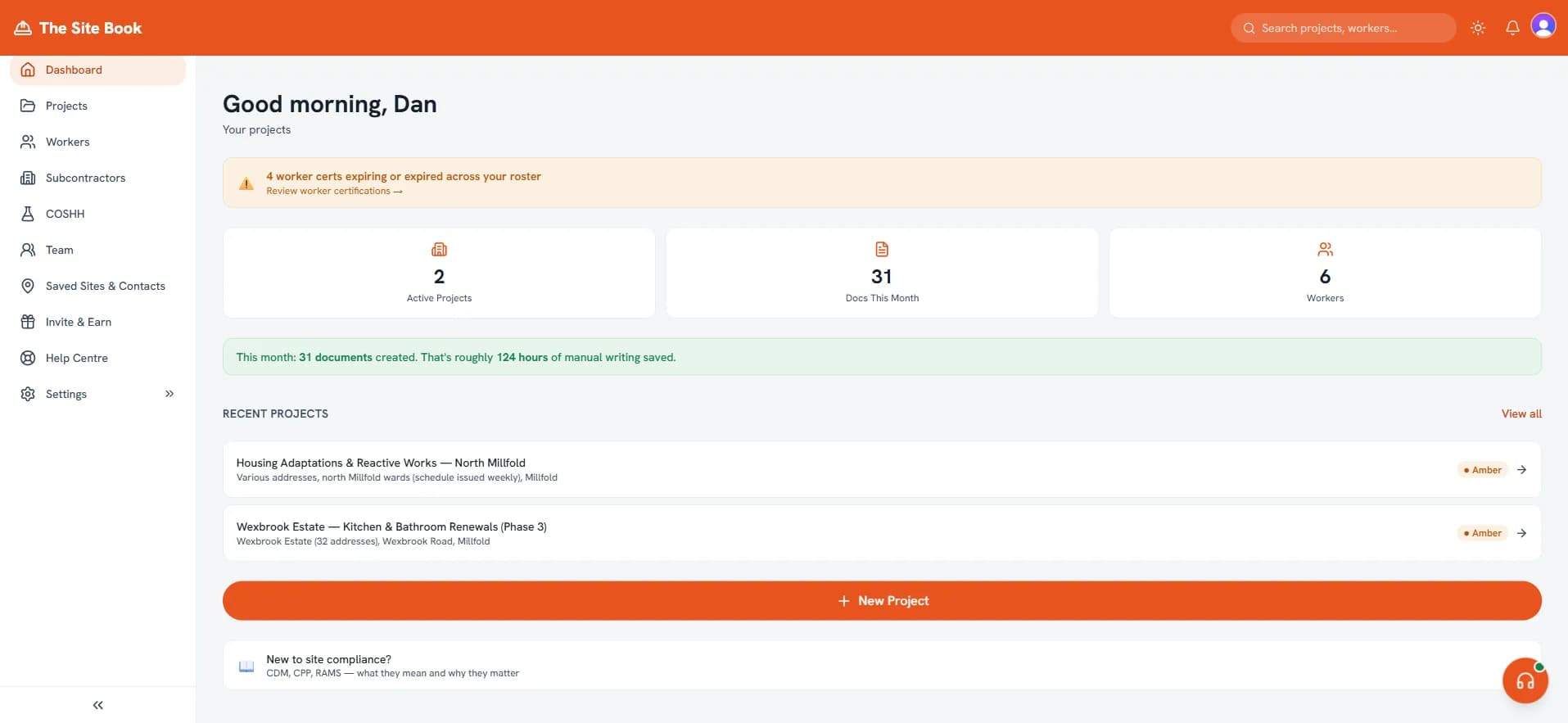
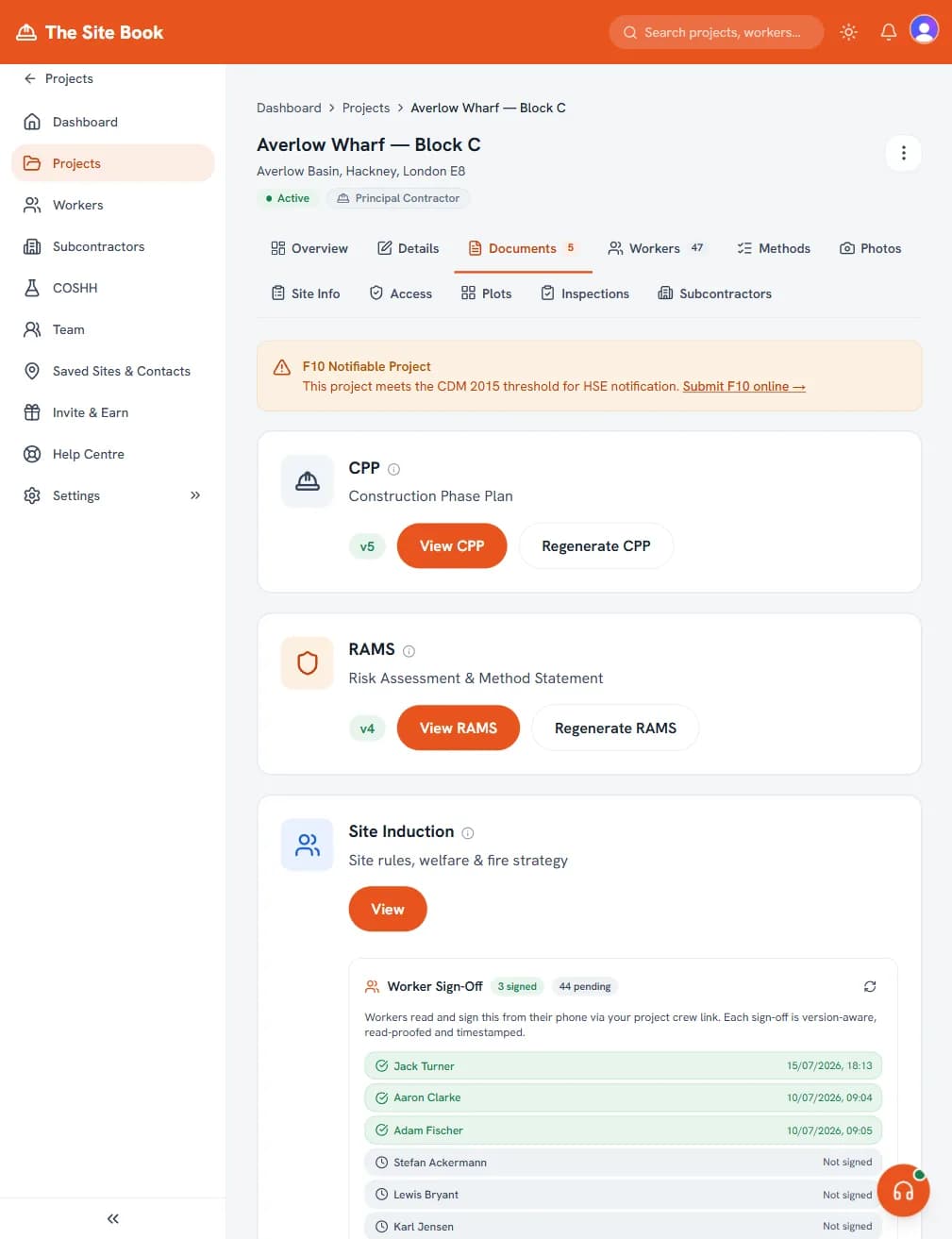
At minimum, every construction project needs a Construction Phase Plan before work starts. Depending on the job, you may also need RAMS, induction records, emergency arrangements, COSHH records, and an F10 notification if the project is notifiable. The Site Book creates the builder-run firm's document pack from a single project description - no blank forms, no guessing.
How much does The Site Book cost?
Starter is £0 for a first project with watermarked PDFs. Pro is £39/month or £360/year and includes unlimited projects, RAMS, CPPs, COSHH, site inductions, toolbox talks and worker sign-off. Business is £199/month for up to 10 internal team logins, assigned-site Site Supervisors, 50 active site portal users, optional worker sign-off PINs, site attendance, site files, document review evidence, subcontractor evidence records and inspections/actions. The optional setup service is a £249 one-off service, not a subscription.
Can I do my own RAMS as a sole trader?
Sole traders can and should write their own Risk Assessment and Method Statement — you do not need to hire a consultant. The RAMS must be suitable and sufficient for the actual risks on your site, not just a generic template. The Site Book guides you through a step-by-step wizard and pre-fills your RAMS with site-specific hazards, control measures, and your team details — ready to download and hand over.
What is a Lightweight CPP?
A Lightweight CPP is a simplified Construction Phase Plan for domestic projects where the contractor is acting alone — no principal designer, no other firms on site. It covers the essential CDM 2015 requirements in 1–2 pages instead of the full commercial CPP format. The Site Book's Lightweight CPP wizard asks you 4 plain-English questions about your job and creates a professional, project-specific document, ready for your review.
Do I need a site induction for domestic work?
Anyone working on site needs the right information and instruction before they start. A site induction is the normal way to cover site rules, emergency procedures, welfare facilities, and key hazards. The Site Book creates a site induction from your project data, and workers sign digitally on their phones - no paper forms, no chasing signatures.
What is a RAMS generator?
A RAMS generator is software that helps you create Risk Assessment and Method Statements from a structured prompt - without staring at a blank page. It guides you through the usual sections: hazard identification, control measures, method of work, PPE requirements, and emergency procedures. The Site Book's RAMS generator pre-fills answers from your job description, so you start from a structured first draft rather than a blank page.