Built for Stone Masons
RAMS, CPP & Site Documents for Stone Masons
Stone masonry means cutting, carving, and lifting heavy stone — often on listed buildings from scaffolding. Your RAMS need to cover silica dust, manual handling, working at height, and heritage-specific risks.
No card needed · Used by UK stone masons · Structured around CDM 2015
Built for Stone Masons
Real work, real hazards. Pick the job closest to yours to start a free job pack with the scope already filled in:
New stone walling and features
Ashlar or rubble stone walling, quoins, window surrounds, and copings — covers stone cutting (silica dust), manual handling of heavy stones, lime mortar use, and scaffold access.
Start with this job →Heritage and conservation stonework
Repair and restoration of listed buildings, churches, and historic structures — covers working on fragile historic fabric, lime mortar matching, lead work, and archaeological considerations.
Start with this job →Stone cladding and floor laying
Natural stone cladding panels and floor tiles — covers cutting and polishing (silica dust), adhesive handling, heavy panel lifting, and working at height for facades.
Start with this job →Memorial and landscape stonework
Memorial stones, garden features, and landscape walls — covers stone cutting on site, manual handling with lifting equipment, and working in churchyards and public spaces.
Start with this job →What You Get
Job-specific RAMS
Describe your job and get professional risk assessments covering silica dust and other trade-specific hazards.
Construction Phase Plans
CPP first drafts structured around CDM 2015 requirements and your job details, ready for competent review. Covers management arrangements, risk control, welfare, and emergency procedures.
COSHH Assessments
Smart substance search and SDS upload. Pre-loaded with common stone mason substances like respirable crystalline silica (from cutting), lime mortar (caustic), stone dust, epoxy resin fixings, lead flashings.
Site Inductions
Digital induction sign-offs for every worker on site. Linked to your CPP and site rules. Works on any phone or tablet.
Worker & subcontractor tracking
Track certifications, insurance, and CSCS cards. Get alerts before documents expire. One view for all your workers.
Digital document sharing
Share your full document pack with clients, principal contractors, or inspectors via a secure read-only link. No login needed on their end.
Common Hazards We Cover
These are the real risks stone masons face on site every day. Your RAMS will address each one with specific control measures.
- Silica dust — cutting, grinding, and carving natural stone generates respirable crystalline silica, a cause of silicosis and lung cancer
- Manual handling — individual stones can weigh from 25kg to several tonnes, requiring mechanical aids, team lifts, and careful planning
- Working at height — facade stonework, chimney repairs, and church conservation involve scaffolding and access at significant height
- Vibration exposure — stone cutting saws, angle grinders, and pneumatic chisels cause hand-arm vibration syndrome (HAVS)
- Lime burns — hydraulic lime and quicklime mortars are highly caustic and cause chemical burns to skin and eyes
- Falling masonry — loose or deteriorated stonework on heritage buildings can collapse unexpectedly during repair
Key Regulations & Standards
HSE workplace exposure limit for silica (EH40) and Historic England guidance on conservation best practice
Stone masons must comply with the COSHH workplace exposure limit for respirable crystalline silica (0.1 mg/m3). Water suppression or on-tool extraction is mandatory for all cutting and grinding operations. The Control of Vibration at Work Regulations 2005 apply to sustained use of cutting and carving tools. Work on listed buildings must follow Historic England guidance and may require Listed Building Consent. CDM 2015 applies to all stone masonry work, with particular attention to structural stability of heritage buildings during repair.
What's included at each tier
Starter
£0- Risk Assessments (RAMS)
- Construction Phase Plans (CPP)
- Site inductions
- Worker document signing (no per-signature charge)
Pro
£39/mo or £360/yr- Risk Assessments (RAMS)
- Construction Phase Plans (CPP)
- Site inductions
- COSHH assessments (standalone doc, SDS upload, site-specific register)
- Worker cert tracking and expiry alerts
- Right-to-work evidence records
- Subcontractor tracking
- Toolbox talks
- Worker document signing (no per-signature charge)
- Integrations (Drive, Xero, Zapier)
Business
£199/mo- Risk Assessments (RAMS)
- Construction Phase Plans (CPP)
- Site inductions
- COSHH assessments (standalone doc, SDS upload, site-specific register)
- Worker cert tracking and expiry alerts
- Right-to-work evidence records
- Subcontractor tracking
- Toolbox talks
- Worker document signing (no per-signature charge)
- Integrations (Drive, Xero, Zapier)
- Up to 10 internal team logins
- Site Supervisor: a field-only login for whoever runs the site
- Up to 50 active site portal users
- Site attendance check-in/check-out
- Multilingual worker inductions (9 languages)
- Optional 4-digit PIN for shared-link document sign-off
- Plant & equipment register with project assignment, certificates, inspections and defects
- Slack Site Ready readiness checks
Site Control
£675/site/mo- Risk Assessments (RAMS)
- Construction Phase Plans (CPP)
- Site inductions
- COSHH assessments (standalone doc, SDS upload, site-specific register)
- Worker cert tracking and expiry alerts
- Right-to-work evidence records
- Subcontractor tracking
- Toolbox talks
- Worker document signing (no per-signature charge)
- Integrations (Drive, Xero, Zapier)
- Up to 10 internal team logins
- Site Supervisor: a field-only login for whoever runs the site
- Up to 50 active site portal users
- Site attendance check-in/check-out
- Multilingual worker inductions (9 languages)
- Optional 4-digit PIN for shared-link document sign-off
- Plant & equipment register with project assignment, certificates, inspections and defects
- Slack Site Ready readiness checks
- Permanent entrance QR: guest sign-in and contractor self-join
- CSCS credential capture, review and expiry alerts
- Digital induction gating before check-in
- Live people-on-site, attendance and audit-grade exports
- Single sign-on (SSO) with Okta or Microsoft Entra
- Public REST API with scoped account keys
- Signed real-time webhooks into your own systems
Running live sites with subcontractors? Site Control is the per-site enterprise tier above Business — entrance QR sign-in, CSCS checks, induction gating, live attendance and audit-grade exports. From £675/site per month, plus £5,000 setup.
Frequently Asked Questions
- Do stone masons need RAMS?
- Yes. Stone masonry involves silica dust exposure, heavy manual handling, working at height, and vibration from power tools — all significant risk activities under CDM 2015. Heritage and conservation work adds further risks from structural instability and caustic lime mortars. Clients, conservation officers, and principal contractors will expect detailed RAMS that cover these trade-specific hazards.
- How does The Site Book draft RAMS for stone masonry?
- The Site Book creates a first draft for your competent review. Describe the job — for example, 'replace 6 deteriorated limestone window surrounds on a Grade II listed church' — and the AI generates RAMS covering stone cutting with dust suppression, scaffold access, lime mortar handling, manual handling, and heritage considerations.
- Does The Site Book cover silica exposure and heritage work?
- Yes. The Site Book generates RAMS that reference the COSHH workplace exposure limit for respirable crystalline silica, mandatory water suppression for cutting, and RPE requirements. For heritage projects, it covers the requirement for Listed Building Consent, compatibility of repair materials with historic fabric, and the importance of following Historic England conservation principles.
Why The Site Book
- UK construction compliance tool that ships RAMS + CPP + COSHH + inductions (readable and acknowledgeable in 9 worker languages on Business, with the language audit-recorded) + worker sign-off, including optional 4-digit shared-link PIN evidence on Business, plus site attendance, portal users, site files, document reviews, subcontractor evidence and inspections/actions.
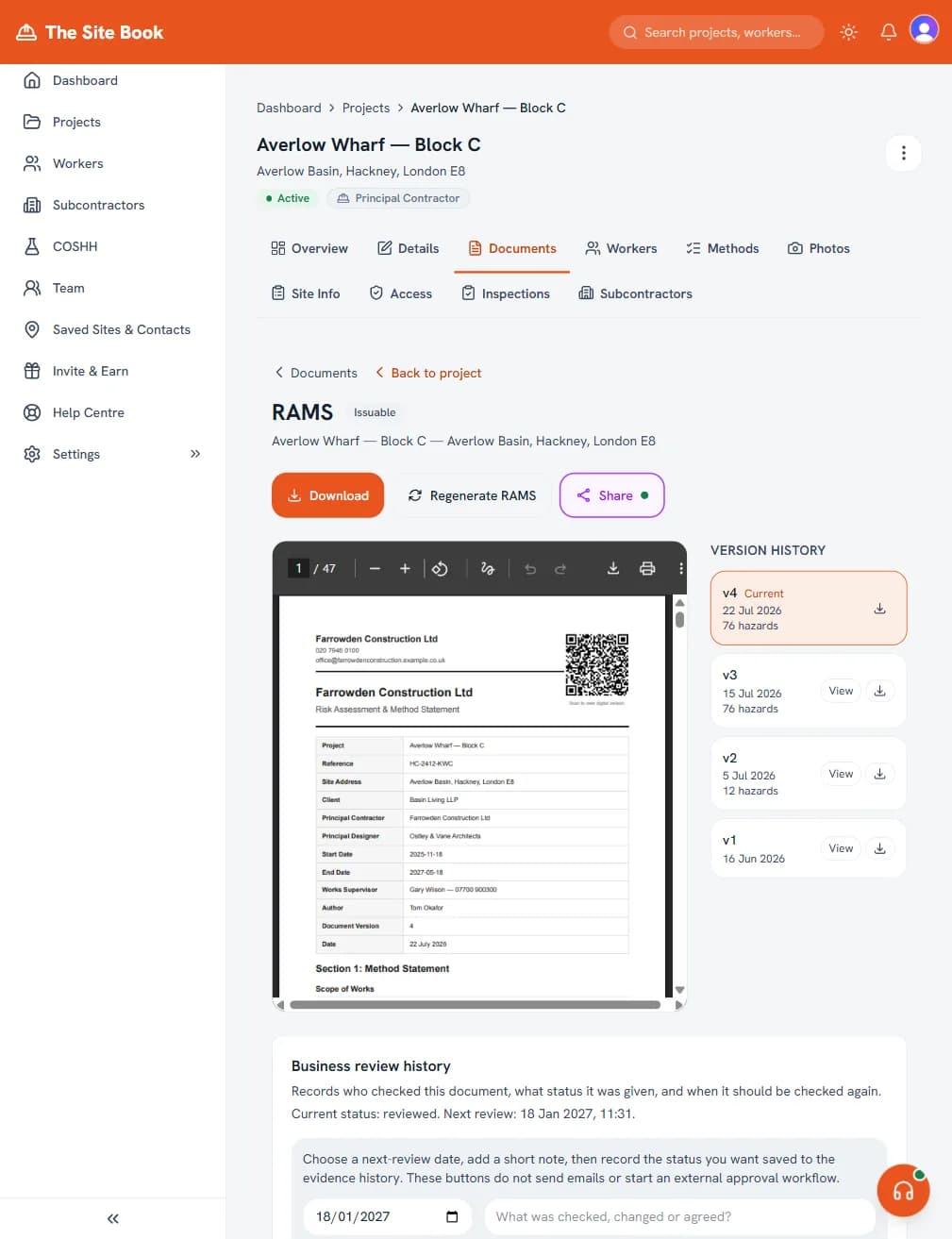
- Generate a site-specific RAMS first draft from a natural-language brief, ready for competent-person review - not a template library you hand-fill.
- Controlled document workflow without an enterprise contract: version history and a recorded issue confirmation before a document is shared with a client or downloaded in the app on every plan, re-sign on revision with superseded signatures preserved plus PCPP import, cert tracking and document checking from the £39/month Pro plan - and on Business, optional named-approver routing (a designated approver accepts or rejects each version, with recorded reasons, before it can be issued) plus client approve/reject/request-changes via share links.
- Transparent pricing: Starter £0, Pro £39/month or £360/year, Business £199/month with 10 management logins and 50 active site portal users. Worker document signing has no per-signature charge; project workers count as active portal users while assigned.
- Build RAMS for any trade - add your own work types and method statements alongside the built-in library, reusable across projects, including a ready-made Commercial Solar PV group. Save a finished job as a reusable project template, or clone it, so the next job of the same shape starts from your own setup.
- COSHH goes deep: a standalone COSHH assessment document, upload-a-Safety-Data-Sheet extraction, a site-specific substance register and an expert-reviewed library - plus per-worker RAMS sign-off and a one-click Audit Pack covering documents, sign-offs, worker evidence, attendance, incidents, COSHH, permits and up to the latest 500 live Site Diary entries.
Ready to stop writing RAMS by hand?
Describe your job, get professional RAMS, a CPP and a site induction. No credit card required.
Related guides
Dust and Silica in Construction
Controlling silica dust exposure from stone cutting, RPE selection, and COSHH requirements.
Manual Handling in Construction
Safe lifting techniques and controls for heavy stone and masonry materials.
Working at Height
Rules, risks, and controls for scaffold access during facade stonework.