Can You Wear a Bump Cap Instead of a Hard Hat on Site?
Can a bump cap replace a hard hat on a building site? Check the impact risk, the route to the work area and who can agree a change to the site rule.
5 min read

TL;DR
Can a bump cap replace a hard hat on a building site? Check the impact risk, the route to the work area and who can agree a change to the site rule.
Listen to the audio summary
3 min · AI narration — the article below stays the full, up-to-date source. Also available on the podcast page.
Transcript
Open: This is Site Safety in Five, from The Site Book. One question from site, answered in about five minutes. Today: can a fitter use a bump cap instead of a hard hat in a service cupboard?
Story: Picture a fitter reading a valve label under a fixed pipe. The cupboard's low. The worry is standing up too soon and catching your head. For that, a bump cap can be suitable. It's made for knocking your head against a fixed object. But look at the journey in. The same fitter walks back through a corridor. A second trade is fitting brackets above it. A loose fitting could fall, even if the fitter stands completely still. That's a different risk entirely. That's why this matters. One fitter passes through several risks to reach one low cupboard. The cap that suits the cupboard doesn't suit the walk under overhead work.
Answer: So, bump cap or helmet? It depends on what could hit the head. A bump cap is for the risk of knocking your head on a fixed object. Where tools, fittings or materials could fall onto you, you need a suitable safety helmet. HSE says that on almost all construction sites a risk of head injury remains after other controls. So the starting point is usually a helmet. There's an exemption HSE sets out for turban-wearing Sikhs. Beyond that, the question is whether the chosen protection is designed to take the impact that's actually there.
Order: Work through it in order. First, organise the work to remove the risk. Move the access position, keep loose items under control, or separate people from overhead work. Next, for what's left, select suitable PPE. Read the label and the manufacturer's intended use for that exact product. Then check the route, not just the workface. A space isolated for commissioning on Friday may be open to a ceiling contractor on Monday. Finally, agree who controls the boundary. Say what the fitter does if the agreed conditions have changed.
Doing it properly: Do the selection properly. Read the manufacturer's instructions. Check the limits on use and which accessories the item accepts. A catalogue photo shows colour and shape. It can't tell you if the item suits a dropped tool or fits the wearer. Give the wearer time to try the combination. Check the fit with the ear and eye protection they'll actually wear. If the helmet lifts when they look up, speak to the supplier. Avoid improvised alterations to the shell or harness. Damaged head protection needs replacing.
If you run the site: If you run the site, set a rule the crew can act on. A general note saying head protection as required leaves the fitter guessing at the point of use. Name the live ceiling-work corridor. Say who controls access while overhead work is on, and where to stop if a barrier has moved. If your induction requires helmets throughout the area, a subcontractor can't just swap to a bump cap at the cupboard. Ask them to raise the clearance problem with the supervisor. Put the agreed rule into the induction, so someone arriving mid-job gets the same information as the first crew.
Close: So, bump cap for knocking your head on something fixed, helmet where things could fall, and check the whole route, not just the cupboard. This covers Great Britain, and it's general guidance, not legal advice. The full article, with a worked handover record and how to brief two trades sharing a space, is on our website, The Site Book dot co dot U K. This has been Site Safety in Five.
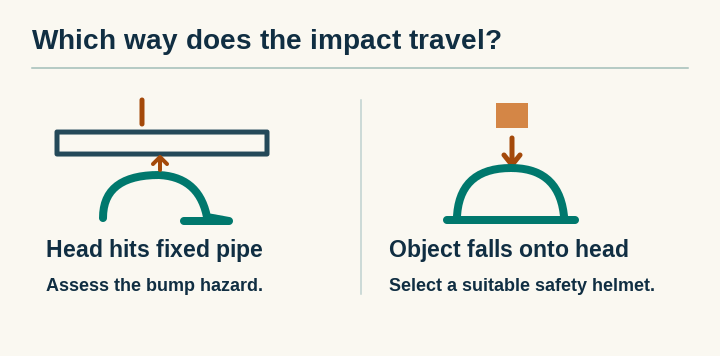
For a fitter choosing a bump cap, start by looking up as well as ahead. A bump cap can be suitable for the risk of knocking your head against a fixed object. Where tools, fittings or materials could fall onto you, choose a suitable safety helmet. On a building site the distinction matters at the doorway as much as at the workface. A fitter may pass through several different risks to reach one low cupboard.
What could hit the fitter’s head?
Picture a fitter reading a valve label under a fixed pipe. Standing up too soon could bring their head into the pipe. Now picture the same fitter walking back through a corridor while a second trade installs brackets above it. A loose fitting could fall even if the fitter stands completely still. Ask which of those impacts the proposed head protection is designed to take.
First organise the work to remove the risk where possible. Move the access position, keep loose items under control or separate people from overhead work. For the residual risk, select suitable PPE and check the manufacturer’s intended use. A cap with a stiff insert can resemble a helmet from the other end of a corridor. Appearance tells the supervisor very little. HSE on choosing head protection
Who can agree to a bump cap in the service cupboard?
Check the site rule and the assessment for that task and route. If the induction says helmets are required throughout the work area, a subcontractor cannot simply swap to a bump cap at the cupboard. Raise the clearance problem with the supervisor. Establish whether access can be changed and which protection remains suitable once the job and surrounding work have been assessed.
Look at the journey in and out, neighbouring work and the chance that the area changes during the shift. A space that was isolated for commissioning on Friday may be open to a ceiling contractor on Monday. Agree who controls the boundary and what the fitter should do if the agreed conditions have changed.
What if the helmet keeps catching on things?
Treat that as information about access and fit. Stop and check whether the valve can be reached from a better position or whether a different, suitable helmet fits the work. Check compatibility with eye and hearing protection. Altering a helmet or taking it off to squeeze through creates another decision for which the original assessment gives no answer.
HSE says that on almost all construction sites a risk of head injury remains after other controls. It also sets out the exemption for turban-wearing Sikhs. Include relevant risks and controls in the briefing and check the site arrangements with the person managing the work. HSE construction head-protection questions
What should you check on the item itself?
Read the label and the manufacturer’s instructions for the exact product. Look up the hazards it is designed to protect against, any limits on use and which accessories it accepts. A catalogue photograph shows the colour and shape. It cannot establish whether the product is suitable for a dropped tool, fits the wearer or works with the ear defenders needed for the task. Keep the product information available to the person selecting it.
Give the wearer time to try the combination. Check the fit with the hearing and eye protection they will actually wear. If the helmet lifts when the fitter looks up, or the ear defenders move when the helmet is adjusted, speak to the supplier about a compatible combination. Avoid improvised alterations to the shell, harness or attachments. Damaged head protection needs replacement in line with the manufacturer’s instructions.
How would you brief two trades sharing the same space?
Suppose the fitters have agreed a period of exclusive access to a service area. A delivery delay brings the ceiling installers back early. Someone now wants to stand on a platform in the same area to finish a run of pipework. Stop the conflicting activity, agree who controls access and reassess the falling-object risk before reopening the area. The words “same room” on yesterday’s paperwork tell you nothing about who is working above the fitter today.
Give visiting workers a point of contact. If the supervisor cannot be reached, the safe default is to stay outside the restricted area until the arrangement is clear. It is much easier to settle the question at the barrier than after someone has crawled into a space where turning around is difficult.
At handover, record the task, the location, the hazards considered and the protection selected. Say what change would bring the decision back for review. A photo of the route can help a new supervisor recognise it, provided the briefing also explains what work was taking place above it at the time.
What should a useful site rule actually say?
Give the crew a location and an action they can recognise. For example, identify the live ceiling-work corridor, who controls access while overhead work is in progress, and where to stop if a barrier has moved. Brief any separately assessed task in its own terms. A general note saying “head protection as required” leaves the fitter guessing at the point of use.
Use our construction PPE guide when selecting the equipment. Put the agreed site rule into the site induction so a worker arriving mid-job gets the same information as the original crew.
Create the first job pack free
Start with one real job: RAMS, CPP, site induction and sign-off evidence. No card required. Review everything before you use it.
Create my free job pack →