RAMS vs Method Statement — What's the Difference?
What's the difference between a RAMS and a method statement? When do you need each? A builder's guide to risk assessments and safe working procedures.
4 min read
TL;DR
What's the difference between a RAMS and a method statement? When do you need each? A builder's guide to risk assessments and safe working procedures.
The Simple Version
A RAMS combines two documents:
- Risk Assessment — identifies hazards and scores the risks
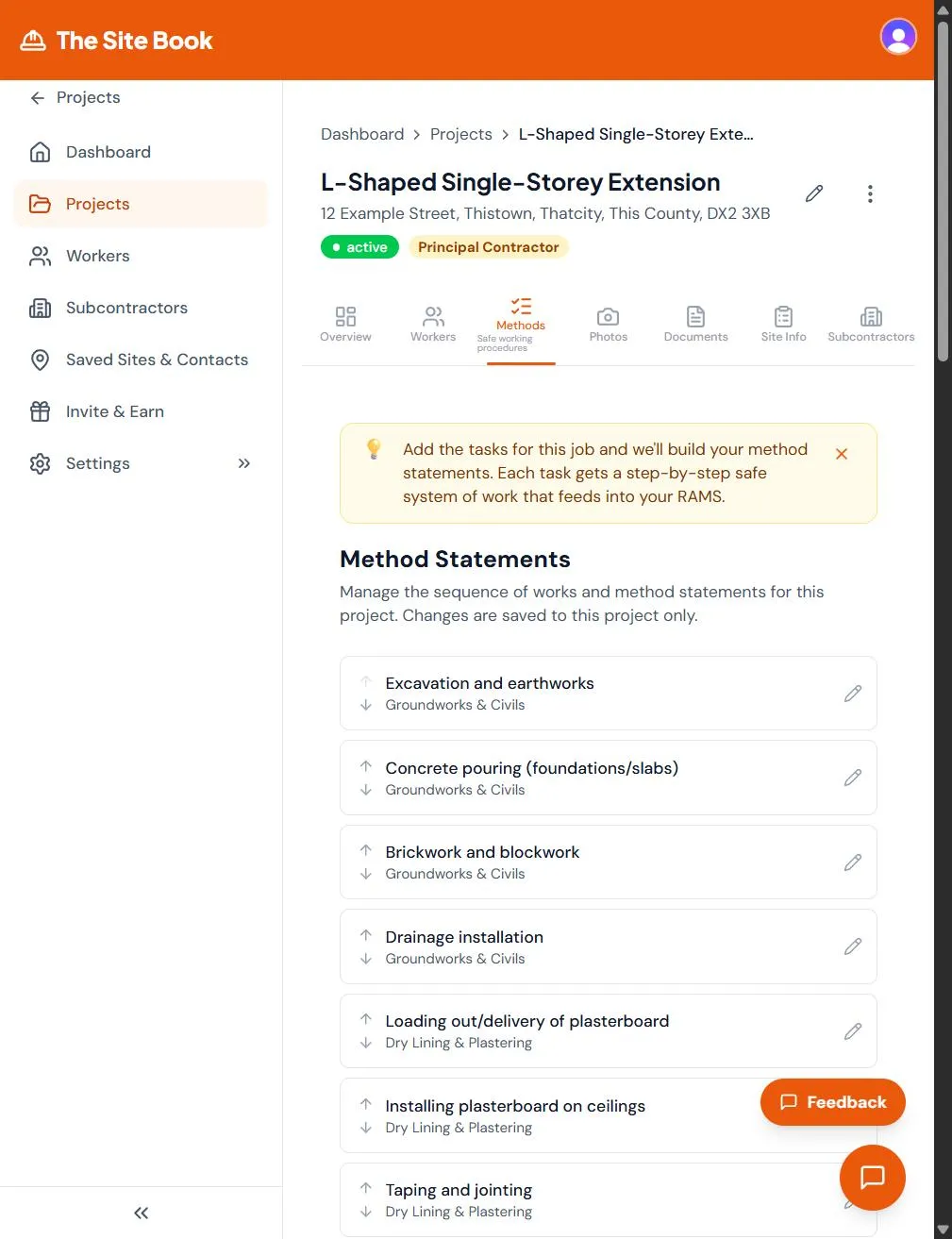
- Method Statement — describes how you'll do the work safely
So RAMS = Risk Assessment + Method Statement.
Risk Assessment
A risk assessment answers:
- What could go wrong? (hazards)
- Who could get hurt?
- How likely is it? (1-5 scale)
- How bad would it be? (1-5 scale)
- What controls will reduce the risk?
It's about identifying dangers and deciding if the risk is acceptable.
Method Statement
A method statement answers:
- What are we doing? (scope of work)
- How will we do it? (sequence of operations)
- What equipment do we need?
- What PPE is required?
- Who's responsible for what?
It's a step-by-step plan for getting the work done safely.
Do You Always Need Both?
For high-risk work (working at height, confined spaces, hot works), yes — you need both.
For low-risk work (decorating, tiling), a simple risk assessment might be enough.
Most commercial clients and main contractors expect a RAMS (both combined) before you start on site.
Example
Task: Installing scaffolding for a two-storey extension.
Risk Assessment identifies:
- Falls from height (high risk)
- Scaffold collapse (medium risk)
- Struck by falling materials (medium risk)
Method Statement describes:
- Site survey and foundation check
- Delivery and unloading procedure
- Base plate installation on solid ground
- Tube and fitting assembly sequence
- Tie-in to building at correct intervals
- Inspection and handover
Together, they form a RAMS.
When Do You Need Both?
In practice, most construction work requires both a risk assessment and a method statement — combined into a single RAMS document. But there are situations where one part carries more weight than the other.
When a Risk Assessment Alone Might Be Enough
For genuinely simple tasks with obvious controls, a standalone risk assessment can suffice. Think of things like:
- Painting an internal wall at ground level — the hazards (fumes, slips from spills) are straightforward and the controls (ventilation, dust sheets) are well understood.
- Hanging a door in an existing frame — low-risk, familiar task for a competent joiner.
- Laying carpet tiles in a finished room — no height, no power tools beyond a stanley knife.
Even here, many main contractors will still ask for a full RAMS — it's become the expected standard on commercial sites.
When You Always Need Both
Any work that falls under the Work at Height Regulations 2005, the Confined Spaces Regulations 1997, or involves hot works, demolition, or excavation requires both parts without exception. Specifically:
- Working at height — scaffolding, roof work, ladder access, MEWPs. You must detail the hierarchy of controls in your method statement and assess fall risks formally.
- Hot works — welding, cutting, grinding near combustibles. The method statement must cover fire watch periods, permit procedures, and extinguisher placement.
- Confined spaces — manholes, tanks, ducts. You need a method statement covering atmospheric testing, rescue procedures, and communication protocols alongside a detailed risk assessment.
- Lifting operations — crane lifts, heavy plant. The method statement must detail lift plans, exclusion zones, and banksman arrangements.
- Asbestos removal — licensed removal always requires full RAMS plus a separate plan of work under CAR 2012.
If you're unsure, default to writing a full RAMS. No one has ever been criticised on site for being too thorough with their paperwork.
How The Site Book Handles This
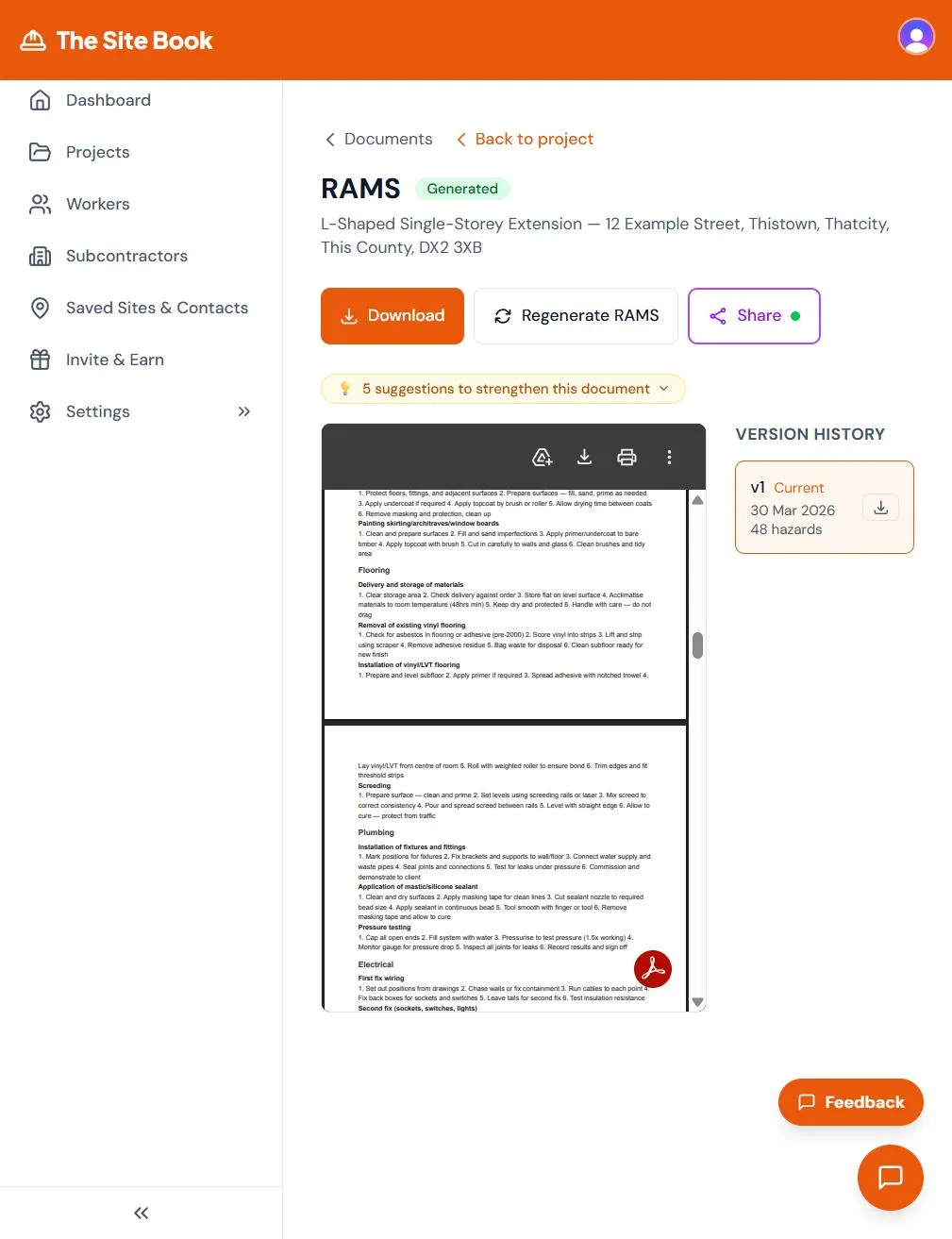
The Site Book creates both the risk assessment and method statement together as a single RAMS document. You describe the task, and the tool generates properly scored risk matrices alongside a step-by-step method statement — all formatted to the standard that main contractors expect. No need to write them separately and try to align them afterwards.
What About COSHH Assessments?
A common source of confusion is where COSHH assessments fit in. COSHH (Control of Substances Hazardous to Health) assessments are a specific type of risk assessment required under the COSHH Regulations 2002. They cover exposure to hazardous substances — dust, fumes, chemicals, biological agents.
If your work involves hazardous substances (and most construction work does, even if it's just cement dust or silica from cutting blocks), you'll need a COSHH assessment in addition to your general risk assessment. Many contractors include COSHH data within their RAMS, which is perfectly acceptable — just make sure you're covering the specific COSHH requirements: what the substance is, its hazard classification, exposure routes, control measures, health surveillance needs, and emergency procedures.
Who Needs to See Your RAMS?
Your RAMS isn't just a document you write and file away. Under CDM 2015, the following people need access to it:
- The Principal Contractor — they'll review it before allowing you on site. Most will reject vague or generic RAMS.
- Your workers — everyone carrying out the work must read the method statement and understand the risk controls. A toolbox talk briefing is good practice.
- HSE inspectors — if an inspector visits site, they'll ask to see your RAMS. Having one that's clearly written and site-specific shows competence.
- Your client — commercial clients increasingly request copies as part of their own CDM compliance records.
Make sure your RAMS is accessible on site — either printed and kept in the site welfare facility or available digitally on a phone or tablet. There's no point having a beautifully written RAMS sitting on a server that no one on the tools can access.
## Further reading - [The best RAMS software for UK builders — compared](/compare/best-rams-software-uk)Create the first job pack free
Start with one real job: RAMS, CPP, site induction and sign-off evidence. No card required. Review everything before you use it.
Create my free job pack →