Built for Cladding Contractors
RAMS, CPP & Site Documents for Cladding Contractors
Cladding installation means sustained working at height, handling large panels, and navigating fire safety requirements that have transformed the industry since Grenfell. Your RAMS must be watertight.
No card needed · Used by UK cladding contractors · Structured around CDM 2015
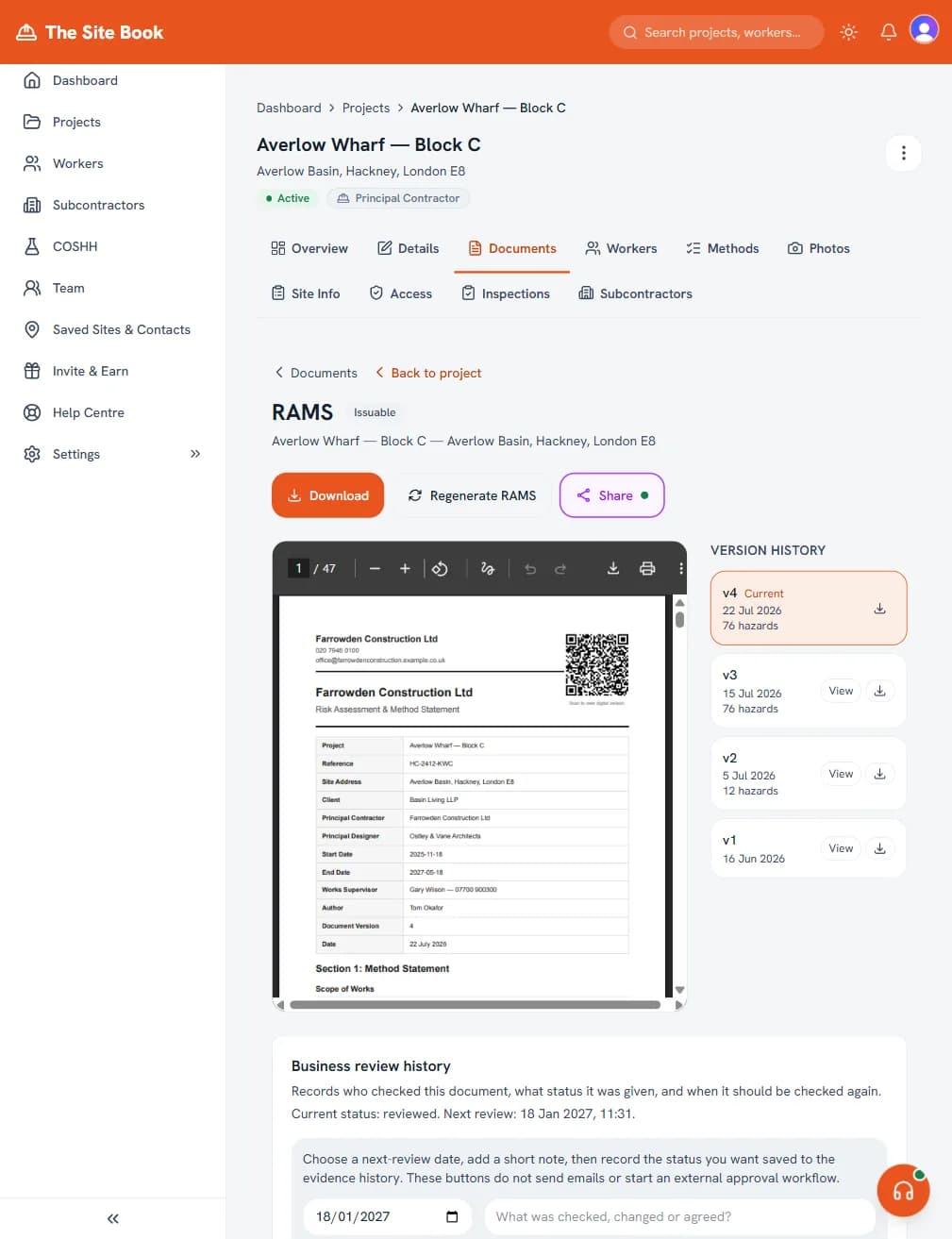
Built for Cladding Contractors
Real work, real hazards. Pick the job closest to yours to start a free job pack with the scope already filled in:
Rainscreen cladding installation
Aluminium, zinc, or composite panel systems on support rails — covers working at height, panel handling in wind, fixing to structural frames, and fire barrier installation.
Start with this job →Timber cladding
External timber boarding or panel systems — covers scaffold access, power tool use, manual handling of long boards, and fire classification considerations.
Start with this job →Brick slip and masonry cladding systems
Mechanically fixed brick slip or stone cladding over insulation — covers heavy panel handling, adhesive application, scaffold loading limits, and coordination with EWI contractors.
Start with this job →Cladding remediation and replacement
Removal and replacement of non-compliant cladding under Building Safety Act requirements — covers working at height, ACM panel handling and disposal, fire safety during works, and occupied building considerations.
Start with this job →What You Get
Job-specific RAMS
Describe your job and get professional risk assessments covering falls from height and other trade-specific hazards.
Construction Phase Plans
CPP first drafts structured around CDM 2015 requirements and your job details, ready for competent review. Covers management arrangements, risk control, welfare, and emergency procedures.
COSHH Assessments
Smart substance search and SDS upload. Pre-loaded with common cladding contractor substances like sealants (silicone and polyurethane), adhesives, fire-stop compounds, cutting dust from fibre cement and composite panels.
Site Inductions
Digital induction sign-offs for every worker on site. Linked to your CPP and site rules. Works on any phone or tablet.
Worker & subcontractor tracking
Track certifications, insurance, and CSCS cards. Get alerts before documents expire. One view for all your workers.
Digital document sharing
Share your full document pack with clients, principal contractors, or inspectors via a secure read-only link. No login needed on their end.
Common Hazards We Cover
These are the real risks cladding contractors face on site every day. Your RAMS will address each one with specific control measures.
- Falls from height — cladding work is done from scaffolding, mast climbers, or cradles at significant height for extended periods
- Wind loading on panels — large cladding panels act as sails in wind, creating handling difficulties and risk of panels being ripped from fixings
- Fire risk — combustible insulation and cladding materials present fire risk during installation, particularly on occupied buildings
- Manual handling of heavy panels — stone, concrete, and metal cladding panels can weigh 30–80kg per panel and require mechanical handling or team lifts
- Falling objects — tools, fixings, and off-cuts dropped from height during cladding work pose a risk to workers and the public below
- Structural fixings — drilling into structural frames and masonry for bracket installation creates dust and vibration exposure
Key Regulations & Standards
Building Safety Act 2022, Building Regulations Part B (Fire Safety), and BS 8414 (Fire Performance of External Cladding)
Since the Grenfell Tower fire, cladding work is subject to stringent fire safety requirements. The Building Safety Act 2022 introduced the Building Safety Regulator for higher-risk buildings (18m+). All cladding materials must meet Building Regulations Part B fire classification requirements — combustible materials are banned on buildings over 18m. Remediation work on non-compliant buildings must follow the Building Safety Act remediation framework. CDM 2015 applies to all cladding work, and contractors must demonstrate competence under the new competence requirements for the building safety regime.
What's included at each tier
Starter
£0- Risk Assessments (RAMS)
- Construction Phase Plans (CPP)
- Site inductions
- Worker document signing (no per-signature charge)
Pro
£39/mo or £360/yr- Risk Assessments (RAMS)
- Construction Phase Plans (CPP)
- Site inductions
- COSHH assessments (standalone doc, SDS upload, site-specific register)
- Worker cert tracking and expiry alerts
- Right-to-work evidence records
- Subcontractor tracking
- Toolbox talks
- Worker document signing (no per-signature charge)
- Integrations (Drive, Xero, Zapier)
Business
£199/mo- Risk Assessments (RAMS)
- Construction Phase Plans (CPP)
- Site inductions
- COSHH assessments (standalone doc, SDS upload, site-specific register)
- Worker cert tracking and expiry alerts
- Right-to-work evidence records
- Subcontractor tracking
- Toolbox talks
- Worker document signing (no per-signature charge)
- Integrations (Drive, Xero, Zapier)
- Up to 10 internal team logins
- Site Supervisor: a field-only login for whoever runs the site
- Up to 50 active site portal users
- Site attendance check-in/check-out
- Multilingual worker inductions (9 languages)
- Optional 4-digit PIN for shared-link document sign-off
- Plant & equipment register with project assignment, certificates, inspections and defects
- Slack Site Ready readiness checks
Site Control
£675/site/mo- Risk Assessments (RAMS)
- Construction Phase Plans (CPP)
- Site inductions
- COSHH assessments (standalone doc, SDS upload, site-specific register)
- Worker cert tracking and expiry alerts
- Right-to-work evidence records
- Subcontractor tracking
- Toolbox talks
- Worker document signing (no per-signature charge)
- Integrations (Drive, Xero, Zapier)
- Up to 10 internal team logins
- Site Supervisor: a field-only login for whoever runs the site
- Up to 50 active site portal users
- Site attendance check-in/check-out
- Multilingual worker inductions (9 languages)
- Optional 4-digit PIN for shared-link document sign-off
- Plant & equipment register with project assignment, certificates, inspections and defects
- Slack Site Ready readiness checks
- Permanent entrance QR: guest sign-in and contractor self-join
- CSCS credential capture, review and expiry alerts
- Digital induction gating before check-in
- Live people-on-site, attendance and audit-grade exports
- Single sign-on (SSO) with Okta or Microsoft Entra
- Public REST API with scoped account keys
- Signed real-time webhooks into your own systems
Running live sites with subcontractors? Site Control is the per-site enterprise tier above Business — entrance QR sign-in, CSCS checks, induction gating, live attendance and audit-grade exports. From £675/site per month, plus £5,000 setup.
Frequently Asked Questions
- Do cladding contractors need RAMS?
- Yes. Cladding work involves sustained working at height, handling large panels in wind, fire risk management, and heavy manual handling — all significant risk activities under CDM 2015. Since the Building Safety Act 2022, there is increased scrutiny of cladding contractor competence and documentation. Principal contractors will require detailed RAMS that demonstrate your understanding of both CDM and fire safety requirements.
- How does The Site Book draft RAMS for cladding work?
- The Site Book creates a first draft for your competent review. Describe the job — for example, 'rainscreen aluminium cladding installation to a 6-storey residential block' — and the AI generates RAMS covering scaffold access, wind management for panel handling, fire barrier installation, manual handling, and falling object prevention, specific to your project.
- Does The Site Book cover Building Safety Act requirements?
- Yes. The Site Book generates RAMS that reference the Building Safety Act 2022, Building Regulations Part B, and the ban on combustible materials on buildings over 18m. It covers fire barrier installation, the golden thread of building information, and the enhanced competence requirements introduced by the new building safety regime.
Why The Site Book
- UK construction compliance tool that ships RAMS + CPP + COSHH + inductions (readable and acknowledgeable in 9 worker languages on Business, with the language audit-recorded) + worker sign-off, including optional 4-digit shared-link PIN evidence on Business, plus site attendance, portal users, site files, document reviews, subcontractor evidence and inspections/actions.
- Generate a site-specific RAMS first draft from a natural-language brief, ready for competent-person review - not a template library you hand-fill.
- Controlled document workflow without an enterprise contract: version history and a recorded issue confirmation before a document is shared with a client or downloaded in the app on every plan, re-sign on revision with superseded signatures preserved plus PCPP import, cert tracking and document checking from the £39/month Pro plan - and on Business, optional named-approver routing (a designated approver accepts or rejects each version, with recorded reasons, before it can be issued) plus client approve/reject/request-changes via share links.
- Transparent pricing: Starter £0, Pro £39/month or £360/year, Business £199/month with 10 management logins and 50 active site portal users. Worker document signing has no per-signature charge; project workers count as active portal users while assigned.
- Build RAMS for any trade - add your own work types and method statements alongside the built-in library, reusable across projects, including a ready-made Commercial Solar PV group. Save a finished job as a reusable project template, or clone it, so the next job of the same shape starts from your own setup.
- COSHH goes deep: a standalone COSHH assessment document, upload-a-Safety-Data-Sheet extraction, a site-specific substance register and an expert-reviewed library - plus per-worker RAMS sign-off and a one-click Audit Pack covering documents, sign-offs, worker evidence, attendance, incidents, COSHH, permits and up to the latest 500 live Site Diary entries.
Ready to stop writing RAMS by hand?
Describe your job, get professional RAMS, a CPP and a site induction. No credit card required.