Construction compliance guide
Site Inductions: What to Cover and How to Run One
A practical guide to site inductions for UK builders. Why they matter, what you need to cover, how to run one properly, and the case for digital sign-off.
TL;DR
A practical guide to site inductions for UK builders. Why they matter, what you need to cover, how to run one properly, and the case for digital sign-off.
Deliver the induction and collect sign-off in one place
Set up a free account and generate the RAMS, construction phase plan and site induction for one real job. No card needed.
Start free →In this guide
Why site inductions matter
A site induction is not just a box-ticking exercise. It is the first opportunity to make sure everyone on your site knows the risks, understands the rules, and knows what to do if something goes wrong. Done well, it saves lives. Done badly — or not done at all — it leaves you exposed both legally and practically.
It is a legal requirement. On a project with more than one contractor, regulation 13(4)(a) requires the principal contractor to ensure a suitable site induction is provided. On every project, regulations 15(8) and 15(9)(a) require each contractor to give every worker under its control appropriate supervision, instructions and information, including a suitable site induction where the principal contractor has not already provided one. These rules apply to domestic and commercial work according to the project roles.
It keeps workers safe. Every construction site is different. Even experienced workers need to know the specific hazards, access routes, emergency procedures, and welfare arrangements on your particular site. A new joiner who does not know about the fragile roof panel or the live services running under the access road is a serious risk.
It reduces incidents. Research consistently shows that workers are most likely to be injured in the first few days on a new site. A thorough induction addresses this by giving people the information they need before they pick up a tool. It also sets the tone: this is a site where safety is taken seriously, and everyone is expected to play their part.
It protects you. A clear, dated record is a practical way to show which workers received the induction and what was covered. CDM 2015 does not prescribe a signed induction form, so the substance of the briefing and the worker’s understanding still matter.
Track your workers and their certifications
What a suitable site induction should cover
HSE guidance says a suitable worker induction should be site-specific and highlight the risks and controls the worker needs to know. Use these topics as a practical checklist:
Site rules
The ground rules for working on this site. This covers PPE requirements (what must be worn and where), working hours, site access and parking, designated smoking areas, prohibited areas, noise restrictions, and any client-specific requirements. Keep it practical — workers need to know what is expected of them from the moment they step on site.
Emergency procedures
What to do in an emergency. Cover the fire assembly point and evacuation routes, the procedure for raising the alarm, what to do if there is a gas leak, structural collapse, or other major incident, and the location of fire extinguishers and spill kits. On domestic sites, this can be simpler — but you still need to cover the basics.
Welfare facilities
Where workers can find toilets, washing facilities, drinking water, somewhere to eat and rest, and somewhere to change and store clothing. On domestic projects, you may be using the homeowner’s facilities by agreement — this should be stated clearly in the induction.
Key hazards
The specific hazards that workers need to be aware of on this site. This is not a generic list of construction hazards — it is the particular risks on this particular job. Fragile materials, live services, asbestos, overhead power lines, nearby traffic, unstable ground, shared access with the public — anything that could catch someone out if they are not warned.
First aid arrangements
Who the appointed first aider is (or where the nearest first aid provision is), the location of the first aid kit, and the nearest A&E department. On small domestic sites where there is no designated first aider, you should still cover the basics and make sure everyone knows where the first aid kit is.
PPE requirements
What personal protective equipment is mandatory on site and in which areas. Be specific: hard hat required at all times in the build area, safety boots mandatory, hi-vis vest when near the road, hearing protection when using power tools, dust masks for cutting. Do not assume people will figure it out — tell them.
Running an effective induction
A site induction does not need to be a formal classroom session. On most small building sites, it is a conversation at the start of the day. But there are a few things that make the difference between a useful induction and a waste of everyone’s time.
Keep it short and focused
Cover the essential information clearly and keep the briefing focused on this site: access rules, emergency arrangements, welfare, first aid, reporting and the hazards the worker will face. Allow enough time for questions and confirmation.
Make it site-specific
Make the induction specific to the site and the worker. Generic material on its own is unlikely to communicate the hazards, rules and arrangements they need for this project. Walk through the site if possible, point out the hazards, show people where things are. Point out the actual locations and controls workers need for their tasks.
Check understanding
Do not just talk at people and hand them a form to sign. Ask questions. “Where is the fire assembly point?” “What do you do if you find something you think might be asbestos?” “Who is the first aider?” If people cannot answer these basic questions, the induction has not worked, regardless of whether they signed the form.
Record it
Keep a practical record of who received the induction, when it happened and what was covered. It is useful evidence of the briefing, although CDM 2015 does not prescribe a signed form.
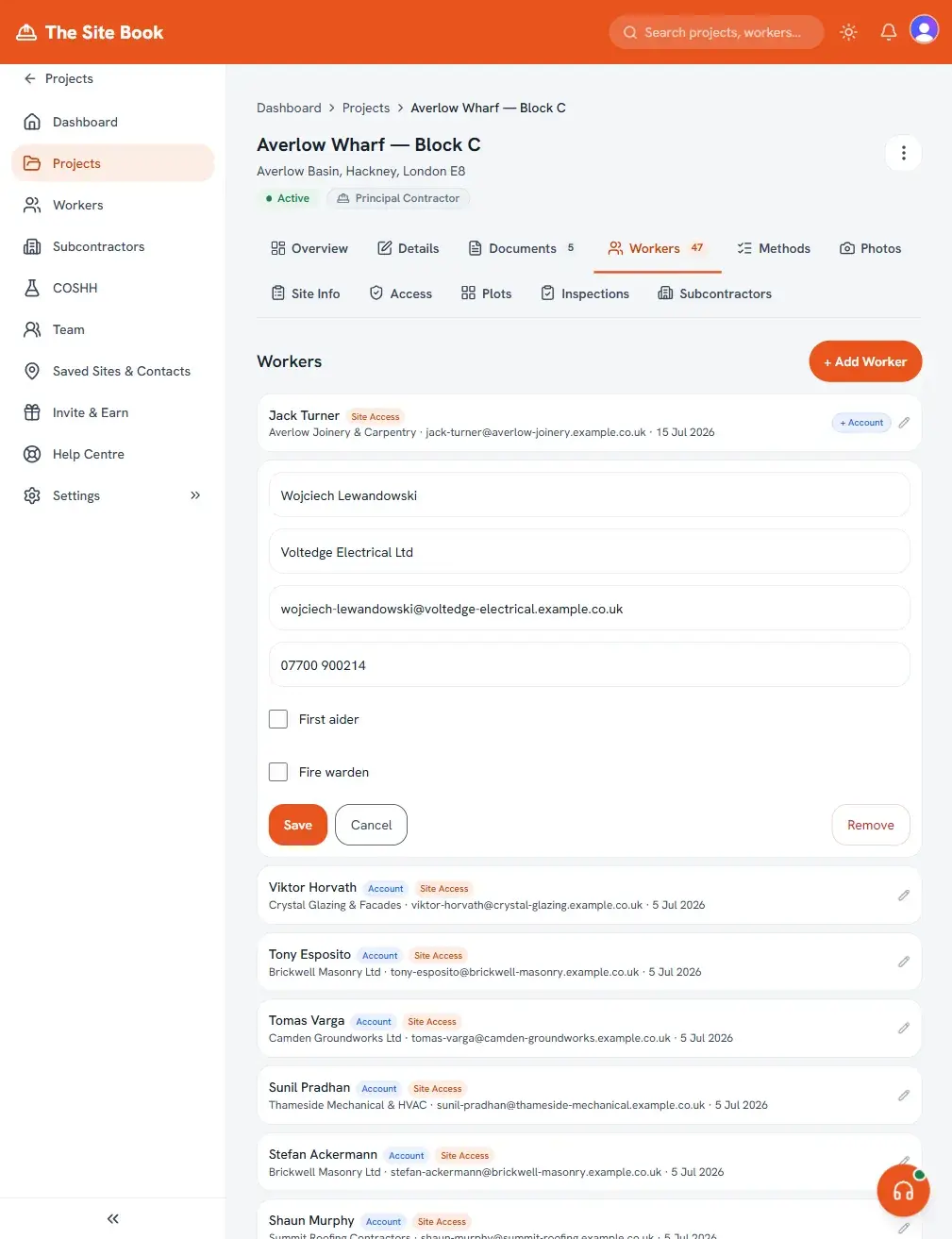
Assign roles like First Aider and Fire Warden
Digital vs paper inductions
Traditionally, site inductions have been done on paper. You print out a form, talk through the content, get everyone to sign, and file the forms. It works, but it has some well-known problems.
Paper inductions
- Forms get lost in the van or on site
- Signatures are illegible or missing
- Hard to prove what was covered
- Time-consuming to file and retrieve
- No easy way to check who has been inducted
- Difficult to update if site conditions change
Digital inductions
- Induction records are stored automatically with the project
- Workers sign on their phone — clear, timestamped records
- Induction content is attached to the sign-off
- Access records from anywhere
- Compliance dashboard shows who has and has not signed
- Easy to update and re-issue when things change
Digital induction records keep the sign-off, timestamp, project and covered content together. If an inspector asks for your induction records, you can open them on your phone. Every sign-off is timestamped, linked to the correct project, and shows exactly what content was covered. No more rummaging through a folder of crumpled forms.
How The Site Book handles inductions
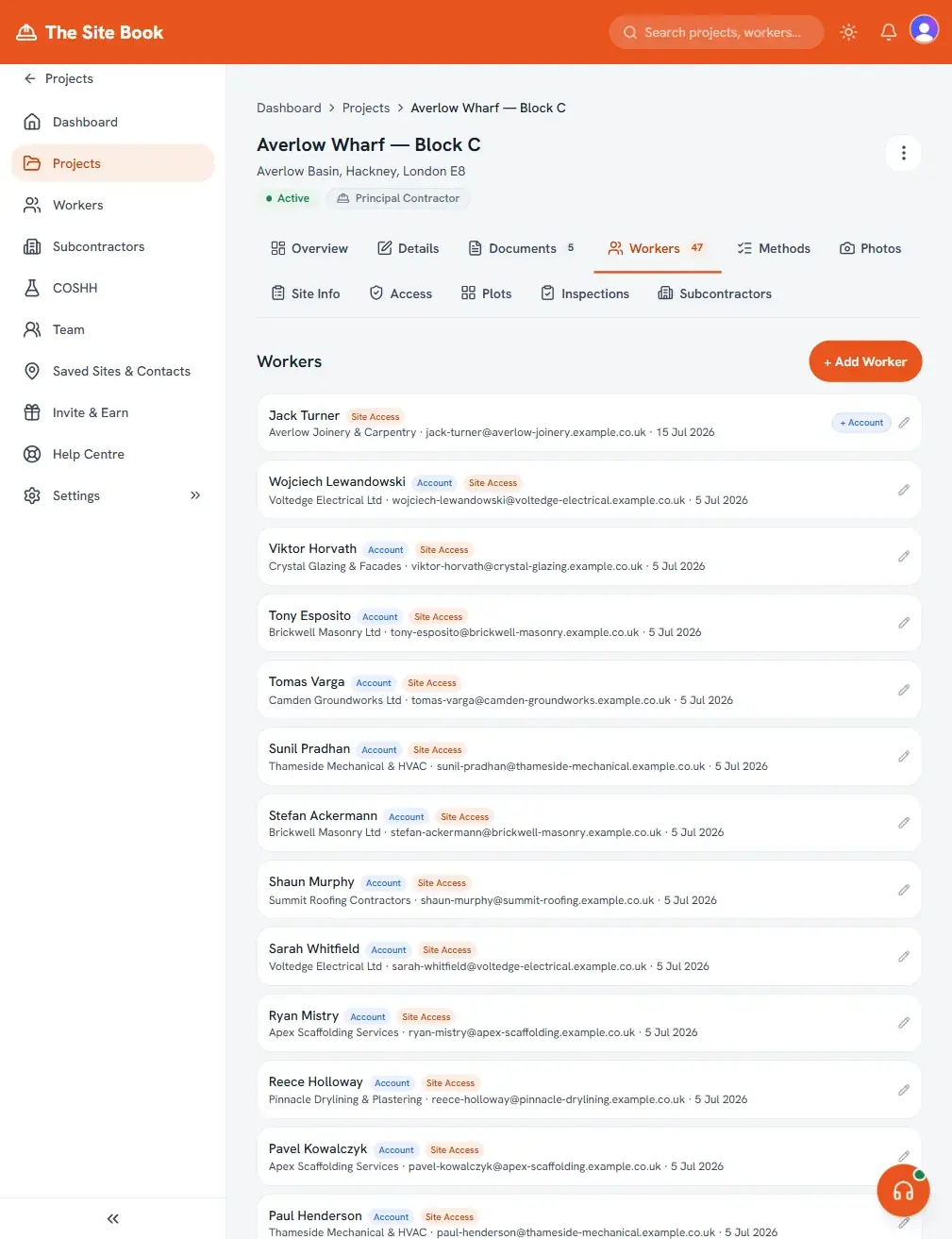
The Site Book takes the pain out of site inductions by auto-creating the induction content from your project data. When you create a project and fill in the details — site address, welfare arrangements, key hazards, emergency procedures — the app automatically builds a site-specific induction document.
Workers sign the induction digitally on their phone. No paper forms, no printing, no chasing signatures at the end of the week. Each sign-off is timestamped and stored against the project, so you always have a complete record of who was inducted and when.
The Compliance Health dashboard tracks induction sign-offs in real time. You can see at a glance who has signed and who has not, so you know before the day starts whether everyone on site has been properly inducted.
If your project details change — new hazards, updated emergency procedures, different welfare arrangements — the induction content updates automatically. You can re-issue the induction and get fresh sign-offs from everyone on site, all through the app.
The induction is also included in your Audit-Ready Pack, so when an inspector asks for evidence of site inductions, everything is together in the pack.
Frequently asked questions
Are site inductions a legal requirement?
Yes. On a project with more than one contractor, CDM 2015 regulation 13(4)(a) requires the principal contractor to ensure a suitable site induction is provided. On every project, regulations 15(8) and 15(9)(a) require each contractor to give every worker under its control appropriate supervision, instructions and information, including a suitable site induction where the principal contractor has not already provided one. The duties apply on domestic and commercial work according to those roles, and HSE guidance says the induction should be site-specific and tailored to the worker.
What should be covered in a site induction?
A site induction should cover the key information that workers need to stay safe on that specific site. At a minimum, this includes: the site rules (PPE requirements, working hours, access and parking, prohibited areas), emergency procedures (fire assembly point, evacuation routes, what to do in an emergency), welfare facilities (location of toilets, washing facilities, rest areas, drinking water), key hazards on the site (anything unusual or particularly dangerous that workers need to be aware of), first aid arrangements (who the first aider is, where the first aid kit is, nearest A&E), and reporting procedures (how to report incidents, near misses, or unsafe conditions). The induction should be proportionate to the site and cover the risks and arrangements workers need to know before starting.
How long should a site induction take?
Allow enough time to explain the access rules, welfare, emergency arrangements, first aid, reporting route and hazards specific to this site. Workers should be able to ask questions and confirm they understand before starting. A complex site may need more detail, while a simple job still needs its relevant risks covered. Keep the briefing focused on actual tasks and record attendance and acknowledgement.
Do visitors need a site induction?
HSE guidance says site inductions should also be provided to occasional and once-only visitors. The briefing should be proportionate: escorted visitors need only the main hazards and controls they may encounter, while unescorted visitors need more detail. Recording attendance is useful for managing who is on site, but CDM 2015 does not prescribe a signed visitor-induction form.
Site induction — structure + delivery that sticks
Pros
- A structured induction supports reg 15(8) contractor briefings and, on a project with more than one contractor, the reg 13(4)(a) principal-contractor induction duty.
- Site-specific hazards + welfare + emergency info delivered in person = strong evidence of due diligence.
- A dated induction record is useful evidence of what a worker was told; CDM 2015 does not prescribe a signed form.
- Pair an induction film with a live site walk to point out actual hazards, welfare and emergency locations.
Cons
- Boilerplate inductions that focus on generic CDM theory bore workers into switching off.
- Inductions without a site walk miss the critical 'here is the fragile roof' moment.
- Re-inductions after long breaks are often skipped — site has changed, worker hasn't.
- Language barriers on multi-national sites need bilingual materials — one-size-fits-all induction fails.
| Topic | Worker induction |
|---|---|
| Site rules (PPE, access, welfare) | Cover as relevant. |
| Site-specific hazards + controls | Cover as relevant. |
| Welfare location + arrangements | Cover as relevant. |
| Emergency procedures + assembly point | Cover as relevant. |
| First-aid arrangements + contacts | Cover as relevant. |
| Incident / near-miss reporting route | Cover as relevant. |
| Site walk-around | Strongly recommended. |
“Induction should be tailored to the site and to the individual.”
Run digital site inductions online
Stop chasing paper sign-off sheets. The Site Book runs site inductions with digital sign-off and automatic record keeping.
See how it works →Ready to go digital?
Ditch the paper forms. Create a site-specific induction from your project data and let workers sign on their phones.
Digital site inductions, sorted.
Auto-created from your project data. Workers sign on their phone. Records stored with the project. No credit card required.
Sources
- Induction — HSE · Accessed 17 April 2026