Construction compliance guide
What is a Construction Phase Plan?
A plain-English guide to CPPs for UK builders. What they are, who needs one, what goes in them, and how to create one without losing your mind.
TL;DR
A plain-English guide to CPPs for UK builders. What they are, who needs one, what goes in them, and how to create one without losing your mind.
Draft your construction phase plan from your project details
Set up a free account and generate the RAMS, construction phase plan and site induction for one real job. No card needed.
Start free →In this guide
What is a CPP?
A Construction Phase Plan (CPP) is a document that sets out how health and safety will be managed during the construction phase of a project. It is required under the Construction (Design and Management) Regulations 2015 — commonly known as CDM 2015. The duty sits in Regulation 12(1) where there is more than one contractor, and in Regulation 15(5) where you are the only contractor.
Think of it as your game plan for keeping people safe on site. It is not a risk assessment (that is a separate thing), and it is not a method statement. The CPP sits above those documents and describes the overall approach to managing health and safety across the whole project — from the first day on site to the final snagging visit.
The CPP must be in place before the construction site is set up. Plan the arrangements before work begins so the project starts with its site rules and relevant risk measures recorded.
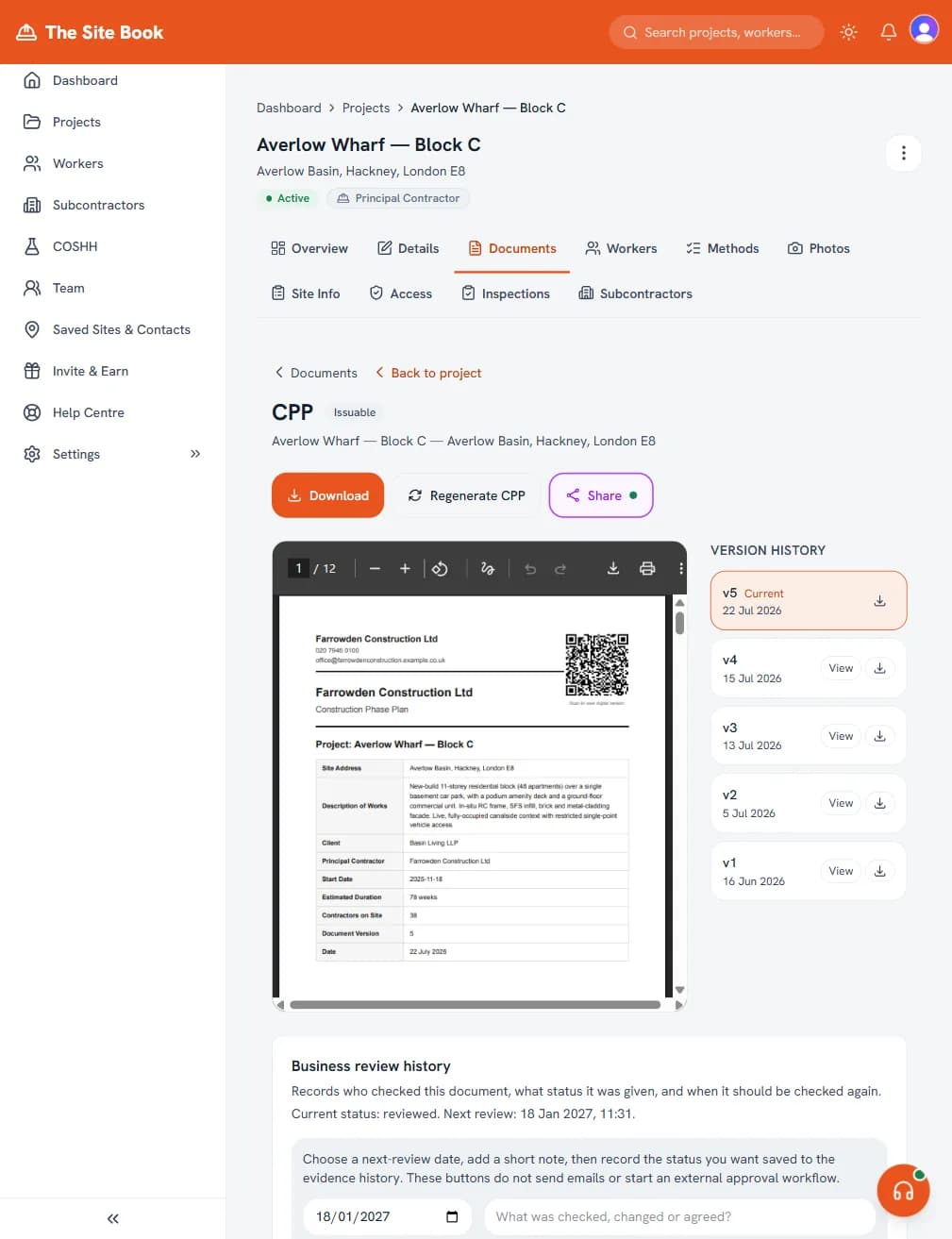
A generated CPP in The Site Book
Who needs a CPP?
Every construction project in Great Britain needs a Construction Phase Plan. There is no minimum size threshold, no exemption for domestic work, and no get-out for sole traders. If you are doing construction work, you need a CPP.
The responsibility for producing the CPP depends on how the project is structured:
- More than one contractor involved or reasonably foreseeable on the project: The principal contractor must draw up the CPP or arrange for it to be drawn up, then review, update and revise it under regulation 12(4).
- Only one contractor involved or reasonably foreseeable for the whole project: That contractor must draw up the CPP or arrange for it to be drawn up. This is common on domestic jobs.
If you are a sole trader fitting a kitchen, you need a CPP. If you are a two-person firm building an extension, you need a CPP. If you are a principal contractor managing a commercial fit-out with five subcontractors, you need a CPP. The scale and detail of the plan will differ, but the requirement is universal.
When is a CPP required?
The CPP must be in place before the construction site is set up. Plan its arrangements during preparation, before the first day on site, so workers start with site rules and relevant risk measures recorded.
On a multi-contractor project, regulation 12(4) requires the principal contractor to review, update and revise the CPP as the project develops. A sole contractor should revisit the plan when work or risks change under its wider regulation 15(2) duty; regulation 15(6) imports the regulation 12(2) content requirement only.
Domestic vs commercial projects
CDM 2015 makes an important distinction between domestic and commercial clients, but it does not exempt domestic projects from compliance. Here is how it works:
A domestic client is someone having construction work done on their own home (or the home of a family member) that is not connected to a business. Under CDM 2015, domestic clients do not have to carry out client duties themselves. Instead, those duties transfer automatically away from them. By default that means the contractor if there is only one contractor, or the principal contractor if there is more than one contractor. Where there is more than one contractor, a written agreement between the domestic client and a principal designer can transfer those same client duties to the principal designer instead. Producing the CPP itself is a separate duty: the only contractor must draw it up or arrange for it to be drawn up on a single-contractor project, while the principal contractor has that duty where there is more than one contractor.
What this means in practice: on a domestic job, the homeowner does not prepare the CPP. If you are the only contractor or the principal contractor, you must draw up or arrange it and manage the work within your control.
On commercial projects, the client retains their CDM duties, provides pre-construction information and ensures adequate welfare facilities. Where more than one contractor is involved, the client must appoint a principal designer and principal contractor. The CPP is typically more detailed for commercial work, reflecting the greater complexity and number of parties involved.
What goes in a CPP?
CDM 2015 does not prescribe a rigid format. Regulation 12(2) requires health and safety arrangements, site rules, and specific measures for any applicable Schedule 3 work. HSE guidance suggests practical headings such as the following; separate welfare duties also apply:
Project description
What the work involves, the site address, expected duration, and the people involved: client, contractors and designers, plus principal designer and principal contractor where more than one contractor is involved.
Management structure
Who is responsible for what on site. On a domestic job with one contractor, this can be straightforward — you are responsible for everything. On a multi-contractor project, you need to set out the chain of responsibility.
Site rules
The rules that everyone on site must follow. This covers things like PPE requirements, working hours, smoking areas, parking, deliveries, and site access.
Arrangements for managing key risks
How you will deal with the main health and safety risks on the project. This does not need to duplicate your RAMS — it is about the overarching arrangements, such as how you will manage working at height, demolition, temporary works, or hazardous materials.
Welfare facilities
Record suitable toilets, washing facilities, drinking water and rest facilities. Add changing or drying facilities where the work and Schedule 2 conditions require them. On domestic jobs, the homeowner’s facilities may be used by agreement if suitable.
Monitoring and review
How you will check that the plan is being followed and what happens if things change. This is about making sure the CPP is a living document, not something that gets filed and forgotten.
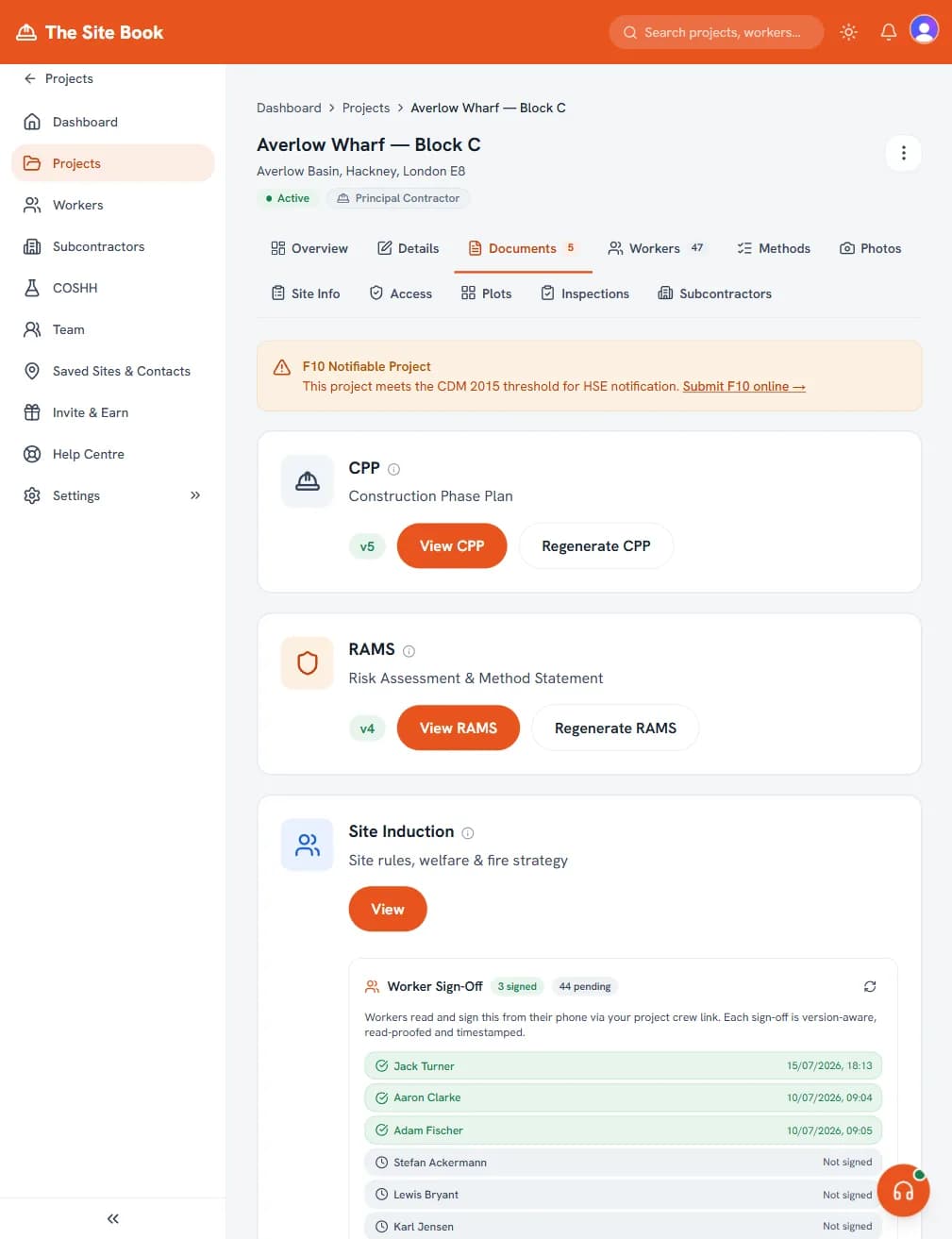
CPP and RAMS documents in your project
How The Site Book creates your CPP automatically
Writing a CPP from scratch is tedious. You know what you are doing on site, but translating that into a formal document takes time you would rather spend on the tools. That is exactly why we built The Site Book.
For domestic projects, the Lightweight CPP wizard asks you just 4 plain-English questions about your job. It then takes your answers and creates a first draft of a site-specific Construction Phase Plan — typically 1–2 pages. Before using it, check the actual work, site conditions, duty holders, welfare arrangements and controls for any applicable Schedule 3 risks, then correct the draft and download a branded PDF. The draft needs project-specific review before use.
For commercial projects, the full CPP wizard has six steps: Project Team, Site Management, Risk & Safety, Welfare & Emergency, optional Site Photos, and Review & Suggestions. It pre-fills as much as possible from your project description and site data. You then check and correct the draft against the actual project before approving it.
Enter site details to generate your CPP
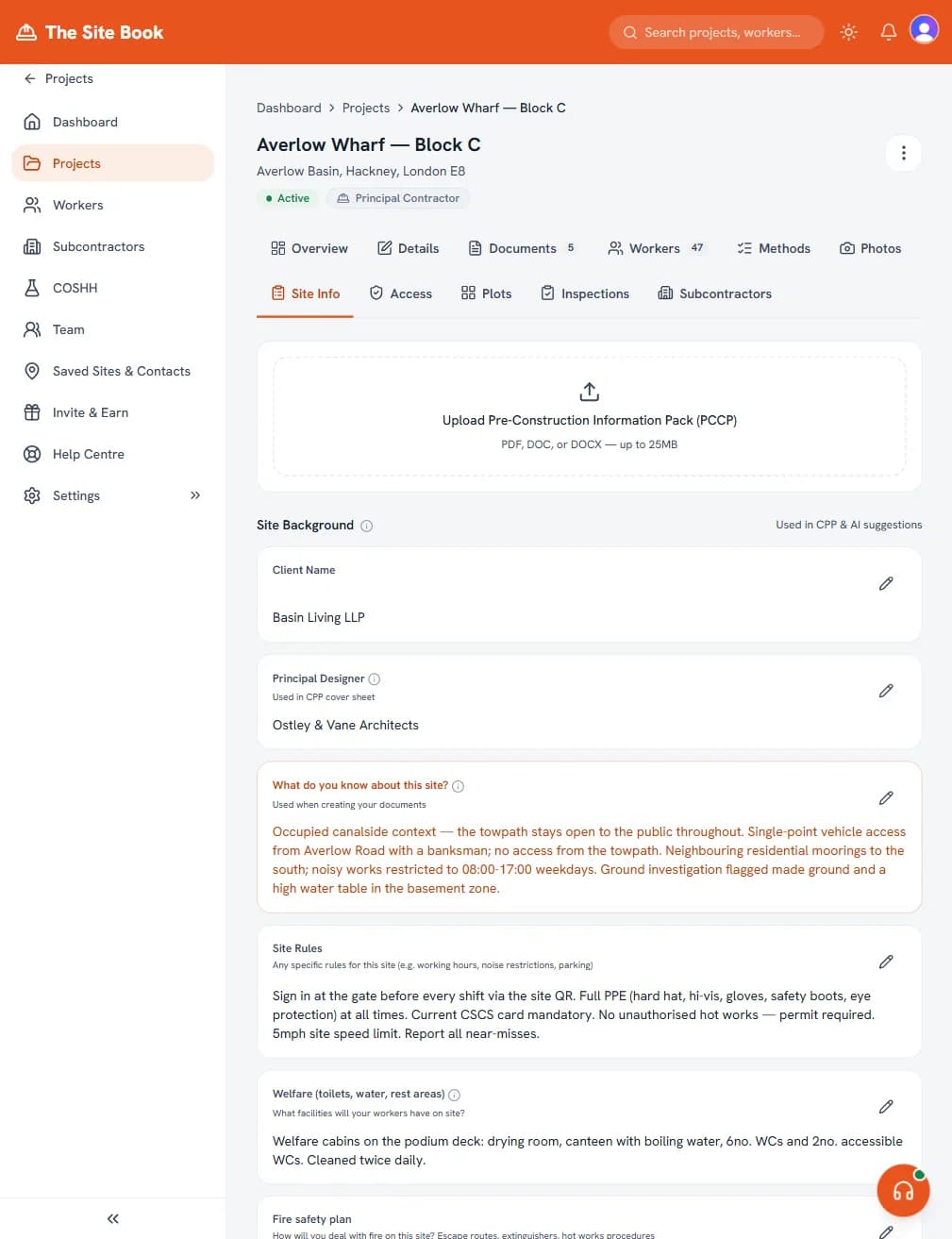
Either way, the generated document is a starting draft. Check that it reflects the project and meets the applicable CDM requirements before using or sharing it.
Construction Phase Plans at a glance
Pros
- Legally required on every construction project in Great Britain — reg 12(1) with more than one contractor, reg 15(5) as the only contractor; reg 12(2) sets the content.
- Proportionate: smaller projects may need less detail, but the CPP must still reflect their work and risks.
- Multi-contractor: principal contractor reviews, updates and revises under reg 12(4). Sole contractor: revisit as risks change under reg 15(2); reg 15(6) imports 12(2) content only.
- Consolidates project basics + site rules + key risks + welfare arrangements in one planning document.
Cons
- Required on ALL construction work — no exemption for sole-trader domestic jobs.
- Must be ready before the construction site is set up; writing one retrospectively misses the required planning stage.
- Generic templates rarely pass the ‘suitable and sufficient’ test without site-specific editing.
- Enforcement bites: the HSE can issue improvement/prohibition notices or prosecute for a missing or inadequate CPP.
| CPP section | Legal or guidance basis | Domestic job example |
|---|---|---|
| Project description | HSE L153 guidance: project description and key dates | Single-storey rear extension, 8 weeks, homeowner. |
| Management structure | Regulation 12(2): health and safety arrangements | You are the only contractor — you manage everything. |
| Site rules | Regulation 12(2): site rules | PPE on site, working hours 08:00–17:00, no smoking inside. |
| Key risk controls | Regulation 12(2): specific measures for applicable Schedule 3 work | Record specific controls where a Schedule 3 risk applies, such as work near high-voltage power lines. |
| Welfare facilities | HSE L153 guidance; separate CDM welfare duties apply | Homeowner’s downstairs toilet + kitchen tap by agreement. |
| Monitoring + review | Regulation 12(4): principal contractor review; regulation 15(2): contractor planning and monitoring | Revise arrangements when the work, risks or team changes. |
“A construction phase plan must be prepared for a project before the construction phase begins.”
Frequently asked questions
Do I need a CPP for a kitchen extension?
Yes. CDM 2015 applies to all construction work in Great Britain, including domestic projects like kitchen extensions, loft conversions, bathroom refurbishments and garage conversions. If you are the only contractor on a domestic job, you must draw up a Construction Phase Plan or arrange for it to be drawn up before the construction site is set up. There is no fixed page count: the plan should reflect the work and risks while recording the required health and safety arrangements, site rules and relevant particular-risk measures. The Site Book's Lightweight CPP wizard asks 4 questions about your job and creates a project-specific draft for your review.
Who is responsible for the CPP?
The responsibility for the Construction Phase Plan depends on the project structure. If there is more than one contractor on the project, the principal contractor must draw up the CPP or arrange for it to be drawn up. If you are the only contractor on the project, you have the equivalent duty. On domestic projects, the homeowner's formal client duties transfer by default to the contractor if there is only one contractor, or to the principal contractor if there is more than one; a principal designer can take those client duties by written agreement where there is more than one contractor. The homeowner does not need to write or commission the CPP.
What happens if I don’t have a CPP?
If you carry out construction work without a suitable and sufficient Construction Phase Plan, you are in breach of CDM 2015. The Health and Safety Executive (HSE) may take enforcement action according to the risks and circumstances, including improvement or prohibition notices or prosecution. The outcome is not automatic. Without a CPP, the project lacks its required health and safety planning document.
Can I write my own CPP?
Yes. There is no legal requirement to hire a consultant to write your Construction Phase Plan. The principal contractor on a multi-contractor project, or the only contractor on a single-contractor project, can draw it up or arrange for it to be drawn up while retaining responsibility for that duty. Regulation 12(2) requires health and safety arrangements and site rules, including specific measures for relevant Schedule 3 risks. A generic template can be a starting point, but the completed plan needs project-specific information. The Site Book guides you through the process and pre-fills a draft from your project description for you to review and correct.
How long should a CPP be?
There is no fixed length requirement. The CPP should be proportionate to the size, complexity and risks of the project, while recording the required arrangements, site rules and relevant particular-risk measures. A straightforward domestic job may need less detail than a complex commercial project, but neither a short nor a long page count by itself shows whether the plan is adequate. What matters is that the content is relevant, project-specific and usable by the people doing the work.
Create your CPP
Now you know what a CPP is — let The Site Book draft yours. Describe the project, then check the plan against your site before use.
See how it works →Ready to create yours?
Stop wrestling with blank templates. Describe your project and get a CPP draft structured around CDM 2015. Check it against your project before use.
Related guides
CPP Examples: Good vs Bad
Fictional construction phase plan examples, section by section.
CDM 2015 for Small Builders
Your duties under CDM 2015, explained without the jargon.
What is RAMS?
A builder’s guide to Risk Assessments and Method Statements.
Site Inductions Guide
What to cover, how to run one, and the case for digital sign-off.
Draft your CPP.
Describe your job, answer a few questions, and get your Construction Phase Plan draft to review. No credit card required.
Sources
- Construction (Design and Management) Regulations 2015, regulation 12 — legislation.gov.uk · Accessed 20 September 2026
- Construction (Design and Management) Regulations 2015, regulation 15 — legislation.gov.uk · Accessed 20 September 2026
- Construction (Design and Management) Regulations 2015, Schedule 3 — legislation.gov.uk · Accessed 17 April 2026
- L153: Managing health and safety in construction — HSE · Accessed 17 April 2026