Asbestos Management Survey or Demolition Survey: Which Do You Need?
Before refurbishment, strip-out or demolition, a management survey is not enough. When you need a refurbishment and demolition asbestos survey, and who arranges it.
7 min read
TL;DR
Before refurbishment, strip-out or demolition, a management survey is not enough. When you need a refurbishment and demolition asbestos survey, and who arranges it.
Write the construction phase plan before work starts
Describe the job in plain English and get a site-specific construction phase plan, structured around CDM 2015, ready for you to review. Your first CPP is free.
Create my free CPP →Before refurbishment, strip-out or demolition on a pre-2000 building, get a refurbishment and demolition asbestos survey of the area you will disturb. A management survey is not enough: it is for normal use and routine maintenance, and it does not open up the structure.
This post covers one decision: which asbestos survey you need before work that disturbs a building. For where asbestos hides, licensing and what to do if you find it, see our asbestos awareness guide for builders.
It covers Great Britain, where the Control of Asbestos Regulations 2012 (CAR 2012) and CDM 2015 apply. Northern Ireland has its own asbestos regulations and CDM 2016.
In March 2026, HSE prosecuted two companies and an individual over a demolition site in Cannock, Staffordshire. Before work began, the client had commissioned an asbestos management survey. It found some asbestos and was shared with the demolition contractor, which went ahead anyway.
An HSE inspector later found demolition had been halted after asbestos was discovered. A refurbishment and demolition survey carried out afterwards found 218 m² of asbestos-containing materials and debris. The client, which had not appointed a principal contractor, was fined £74,900. The demolition contractor was fined £13,400.
What is a management survey for?
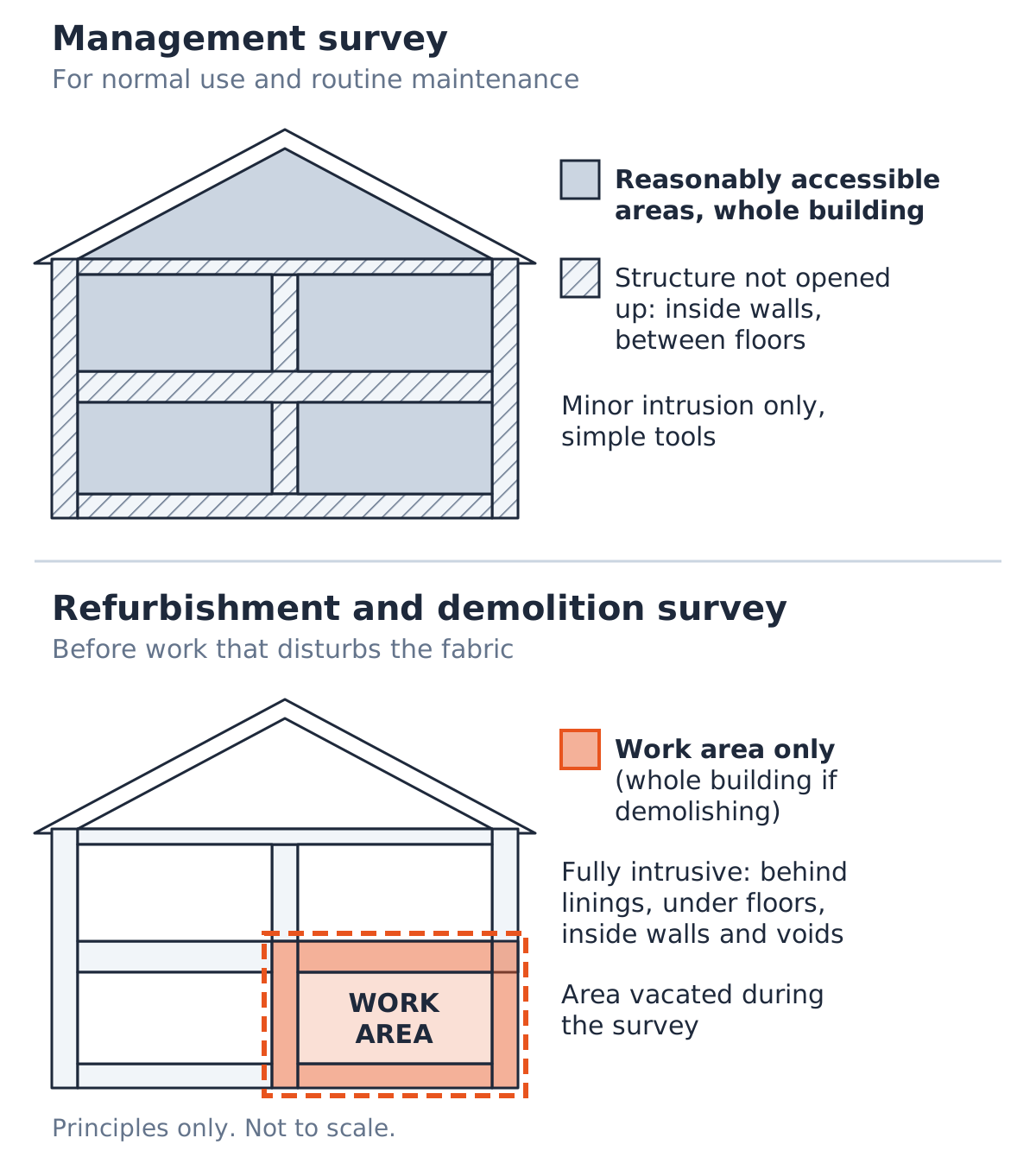
HSE's survey guide, HSG264 (second edition, 2012), describes two types of survey. It calls the management survey "the standard survey". It aims to find, as far as reasonably practicable, asbestos that normal occupancy, foreseeable maintenance or installation could disturb. It also assesses its condition.
It covers areas such as ceiling voids, lofts, risers and ducts, but is only likely to involve simple tools such as screwdrivers and chisels. Areas the surveyor could not reach are presumed to contain asbestos and listed in the report.
What does a refurbishment and demolition asbestos survey cover?
HSG264 says this survey is needed before any refurbishment or demolition work. It aims to find, as far as reasonably practicable, all the asbestos in the area of the work. If the building is being demolished, that means the whole building.
It is fully intrusive. The surveyor may lift carpets and tiles, break through walls, ceilings and partitions, and open up floors. HSE says the area is vacated during the survey and confirmed fit for reoccupation afterwards.
On a small job, the survey can be localised to where the work will take place. HSG264's examples are a cupboard, part of a room, or a kitchen or bathroom.
Why is a management survey not enough before refurbishment or demolition?
HSG264 says management surveys will not have reached structural locations, such as between floors and walls.
So it says a refurbishment survey will be required "for all work which disturbs the fabric of the building in areas where the management survey has not been intrusive".
Who arranges and pays for the survey?
In non-domestic premises, the regulation 4 dutyholder manages asbestos. HSE says that could be the owner, landlord, or whoever is responsible for maintenance or repair. HSG264 says the dutyholder should decide whether a refurbishment survey is needed, and agree its scope with the surveyor.
Under CDM 2015, the client must give pre-construction information to every designer and contractor. HSE's CDM guidance, L153 (2015), gives an asbestos survey as an example. It says the client should fill gaps, for example by commissioning surveys.
The law doesn't say who pays. Our view: on a non-domestic job, the client usually does, as part of the pre-construction information they owe you.
Your own duty doesn't wait for theirs. Regulation 5, quoted below, bars work liable to expose your employees to asbestos without a suitable and sufficient assessment. Where there is doubt, you can instead presume asbestos is present, and not chrysotile alone, and follow the regulations that apply. Regulation 3(1) applies it to the self-employed.
HSE's CIS80 leaflet is blunt. If you suspect asbestos might be present, don't start work until a demolition or refurbishment survey has been done. Presuming instead means applying the controls for the most hazardous types, using a licensed contractor if required (L143).
Do you need a survey on a private house?
In a private home, regulation 5 still applies but the regulation 4 duty to manage doesn't. HSE says that duty covers non-domestic premises and the common parts of blocks of flats, not individual flats. HSE also says owner-occupiers aren't legally responsible for risks to contractors, because they are not at work.
But regulation 5 applies "in respect of any premises", including a house. HSE's worker guide says that in an owner-occupied home, you and your employer must still act so nobody is exposed.
CDM regulation 7 also passes a domestic client's duties, including pre-construction information, to the only contractor or the principal contractor. A principal designer can take them on by written agreement. In practice, arranging the survey usually falls to the builder. See CDM domestic client duties.
What if the survey doesn't cover the area you need to open up?
Check the survey against your scope before you price. L143 tells employers to check a survey is relevant to the work. It warns that asbestos in voids behind walls may not have been included.
If your work goes beyond the surveyed area, get the survey extended first. Otherwise, presume asbestos is present and work to that.
A November 2025 case shows why. Staff at a Hertfordshire film studio were told no asbestos was present and began removing wall panelling with claw hammers and crowbars. HSE found that neither the management nor the refurbishment surveys had considered those wall surfaces. Testing confirmed asbestos that needed licensed removal, and the company was fined £6,000.
Even a full survey can miss things: HSG264 says some asbestos only becomes apparent during demolition. Our post on licensed, notifiable or non-licensed work covers what happens next.
If you have already disturbed something, stop, keep everyone out, and tell whoever is in charge. Don't sweep it up or use a domestic vacuum. Follow HSE's em1 sheet and our steps for what to do if you find suspected asbestos.
What the law says
CAR 2012 never uses the word "survey"; the survey types come from HSG264.
- CAR 2012 regulation 5: an employer must not undertake work in demolition, maintenance or any other work which exposes or is liable to expose their employees to asbestos in respect of any premises, unless either: (a) they have carried out a suitable and sufficient assessment as to whether asbestos, what type of asbestos, contained in what material and in what condition is present or is liable to be present in those premises; or (b) if there is doubt, they assume asbestos is present, and that it is not chrysotile alone, and observe the applicable provisions of the regulations.
- CAR 2012 regulation 4: in non-domestic premises, the dutyholder must ensure a suitable and sufficient assessment of whether asbestos is or is liable to be present. It includes inspecting the parts that are reasonably accessible.
- CAR 2012 regulation 7(3): in final demolition or major refurbishment, the plan of work must, so far as is reasonably practicable, specify that asbestos must be removed before any other major works begin. The exception is where removal would cause a greater risk to employees than if the asbestos had been left in place.
- CDM 2015 regulation 4(4): the client must provide pre-construction information as soon as is practicable to every designer and contractor appointed, or being considered for appointment.
An amendment to CAR 2012 (SI 2026/1153) was made on 2 November 2026, after HSE's consultation. Its new regulation 20 applies from 25 November 2027 and stops the employer who cleaned up after asbestos work appointing the clearance assessor. It does not change regulations 4, 5 or 7.
How to record the survey in your pre-construction information and CPP
- Ask for the survey before you price, and check its type and area against your scope.
- List the areas not accessed, which HSG264 says should be clearly shown on the plans and in the report. Agree how they will be surveyed before anyone opens them up.
- Put the report in the pre-construction information. On a domestic job, that duty usually passes to you (CDM regulation 7).
- In the construction phase plan, record what was found, what is being removed first and by whom, and the stop-work procedure. CIS80 says to make sure everyone on site knows the results.
- Where there is more than one contractor, pass the asbestos survey information on for the health and safety file.
In The Site Book, you can upload your client's pre-construction plan, and details such as asbestos surveys feed into your construction phase plan. You review everything before the document is created. Or start from the free construction phase plan template. Our refurbishment and demolition pages show the asbestos survey flag in the pre-start checklist. We don't commission surveys.
The bottom line
A management survey helps an owner manage asbestos in a building in use. A refurbishment and demolition survey tells you what your work will hit. Get the intrusive survey for the whole area you will disturb, and check it matches your scope. If it hasn't been done and asbestos might be present, HSE's advice is not to start.
This article is general guidance, not legal advice or a guarantee of compliance.
Sources
- HSE press release, 9 March 2026: two companies and site manager prosecuted following large-scale asbestos disturbance
- HSE press release, 20 November 2025: film studio fined after disturbance of asbestos during maintenance works
- CAR 2012, regulation 3 (Application)
- CAR 2012, regulation 4 (Duty to manage asbestos in non-domestic premises)
- CAR 2012, regulation 5 (Identification of the presence of asbestos)
- CAR 2012, regulation 7 (Plans of work)
- CDM 2015, regulation 4 (Client duties)
- CDM 2015, regulation 7 (Domestic clients)
- HSE, HSG264 Asbestos: The survey guide (second edition, 2012)
- HSE, L143 Managing and working with asbestos (second edition, 2013; HSE says it will update it to reflect the 2026 amendment)
- HSE, L153 Managing health and safety in construction (2015)
- HSE, CIS80 Construction phase plan (CDM 2015): what you need to know as a busy builder (04/15)
- HSE, Arrange an asbestos survey
- HSE, Check if you have the duty to manage asbestos
- HSE, A worker's guide to asbestos safety
- HSE, Introduction to asbestos safety
- HSE Asbestos essentials em1: What to do if you discover or accidentally disturb asbestos (fourth edition, 2017)
- HSE Asbestos essentials em4: Using a Class H vacuum cleaner for asbestos
- HSE consultation: legislative and guidance proposals for CAR 2012 (results updated 3 November 2026)
- The Control of Asbestos (Amendment etc.) Regulations 2026 (SI 2026/1153)
Write the construction phase plan before work starts
Describe the job in plain English and get a site-specific construction phase plan, structured around CDM 2015, ready for you to review. Your first CPP is free.
Create my free CPP →