Asbestos Boiler Flue Found on a Boiler Swap: What Now?
Found a suspect asbestos boiler flue, seal or cupboard board on a boiler swap? Which is non-licensed, what HSE's a35 sheet says, waste and your RAMS.
7 min read

TL;DR
Found a suspect asbestos boiler flue, seal or cupboard board on a boiler swap? Which is non-licensed, what HSE's a35 sheet says, waste and your RAMS.
RAMS for gas engineers, asbestos included
Describe your job and get risk assessments covering gas escape and other trade hazards. The boiler job covers flue installation and asbestos around old boilers.
See RAMS for gas engineers →An asbestos cement boiler flue is normally non-licensed work, and HSE's task sheet a35 shows how to replace one. Lagging or asbestos insulating board (AIB) around the boiler is different. HSE says it needs a licensed contractor, apart from some very limited-duration AIB work.
You can't tell which you have by looking. Check the survey, get a sample analysed, or presume the worst type.
This post covers one decision: what to do with a suspect flue, seal or board found on a boiler or warm-air unit swap. For the full process, see our asbestos awareness guide for builders.
This is Great Britain law: the Control of Asbestos Regulations 2012 (CAR 2012) and CDM 2015. Northern Ireland has separate regulations, including CDM 2016.
In March 2016, HSE reported prosecuting a Barnstaple gas engineer. During a gas boiler replacement at a tenants' home, he was removing an old warm air heating system. He disturbed asbestos insulation board around the warm air boiler. Despite the tenants' concerns, he carried on, bagged the material and stored it at his yard. The court heard he used no measures to prevent the spread of asbestos, and no protective clothing or breathing apparatus. He was fined £450 and ordered to pay £921.40 in costs.
Is an asbestos boiler flue licensed or non-licensed work?
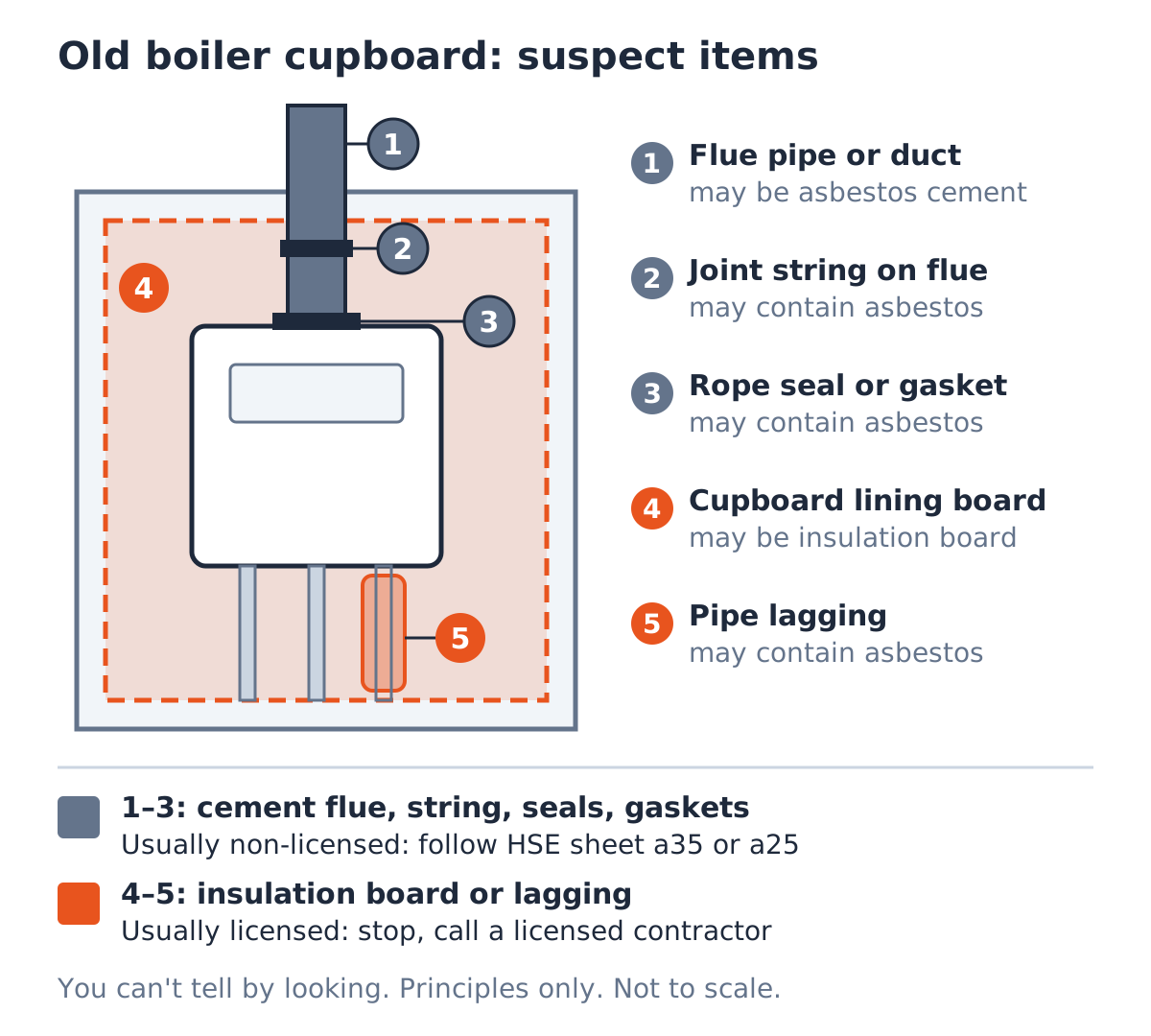
It depends on the material and its condition. HSE's sheet a0 sorts the usual suspects:
- Asbestos cement (AC) flue pipe or duct. a0 lists an asbestos cement flue as normally non-licensed, adding that work causing significant break-up may require notification.
- Rope seals and gaskets. HSE's sheet a25 covers removing these from heaters, boilers and other plant. It says the work is notifiable non-licensed work (NNLW) if they are substantially broken up or damaged during removal.
- Insulation board (AIB) lining the cupboard or a warm-air unit. a0 lists AIB in an airing cupboard as usually licensed. AIB around boilers and warm air heating systems is non-licensed only if the work is short duration and the board is not badly damaged. Otherwise it is licensed.
- Lagging on the boiler or pipes, or sprayed coating on the boiler. a0 lists these as usually licensed; our pipe lagging post covers that decision.
For asbestos cement, HSE's NNLW page says careful removal without breaking it up is non-licensed. It becomes NNLW if the AC is already substantially damaged or broken up. The same applies if removal will substantially break it up, creating significant dust and debris. HSE's example is "dropping" an asbestos cement roof.
a35's method keeps the flue damp, wrapped and in large pieces, and the sheet gives no NNLW warning. Our view: if the flue is crumbling or you can't follow a35, treat the job as NNLW, with notification, medical examinations and health records.
In law, work only counts as "short duration" if, in any seven-day period, it takes no more than two hours in total. That includes ancillary work liable to disturb asbestos. And no one person can do it for more than one hour. HSE lists short-duration removal of AIB in a refurbishment project as NNLW. Our view: on a boiler swap, leave AIB to a licensed contractor.
How do you know what the flue is made of?
Not by looking. HSE's em1 sheet warns you can't tell asbestos just by its colour. a0 says to check the asbestos register or survey first, though homes won't usually have one. If there is no register or survey, or the report is not clear, a0 says do not start work.
Get a sample taken by a competent person and analysed. Or presume it contains the most hazardous types and apply those controls, using a licensed contractor if required.
What does HSE's a35 task sheet say for an AC flue?
a35, "Replacing an asbestos cement (AC) flue or duct" (September 2017), is HSE's non-licensed sheet for mending an AC flue urgently, then replacing it. Read a0 first. In outline, a35 says to:
- Restrict access, close doors and use tape and notices to warn others.
- Wear disposable overalls with a hood, boots without laces and respiratory protective equipment (see em6).
- Turn off the appliance the flue vents and let a hot flue cool.
- Dampen the flue and its joint seals, which are sometimes asbestos string. Ease any string seal into the waste bag with a screwdriver.
- Remove the section intact if you can. If not, wrap it in 1000-gauge polythene and break it into large pieces with a hammer.
- Double-wrap the removed flue in 1000-gauge polythene, tape it and attach asbestos warning stickers.
- Remove fragments that fell down the flue, fit the non-asbestos replacement, and clean with a Class H vacuum (if available) and damp rags.
a35 says clearance air sampling is not normally required, but the owner or client should check off the job.
a35 has no "do not use this sheet if" box, so its limits come from a0. The task sheets do not apply to licensed work: go ahead only if you are sure no licence is needed. a0 also says to follow every action or use equally effective measures, and not to sweep, take used overalls home or reuse disposable PPE. Only do the work if you are trained for it.
Can you leave the old flue in place?
Sometimes. a0's checklist first asks whether you can avoid disturbing asbestos by doing the job another way. If you leave it, tell the customer what you found and where, as em1 advises.
HSE says anyone employed to work on gas appliances in domestic premises must be Gas Safe registered and competent in that area of gas work.
How do you bag, label and get rid of the waste?
a35 says to put debris, rags, polythene and other waste in the asbestos waste bag and tape it closed. Then seal it inside a taped clear polythene bag. HSE's em9 sheet (September 2017) says to avoid breaking up large pieces of waste: double-wrap and label them instead.
em9 says to use a licensed disposal site, and a registered waste carrier unless you hold a waste carrier's licence. Complete a consignment note and keep copies for three years. In practice, check current rules with your waste carrier.
What if you've already disturbed it?
Stop work, keep everyone out and don't sweep up. HSE's em4 sheet says never use a domestic vacuum cleaner on asbestos. Follow HSE's em1 sheet and our guide's steps on what to do if you find suspected asbestos.
What the law says
- Regulation 5: before work that exposes, or is liable to expose, employees to asbestos, an employer must assess whether asbestos is, or may be, present. That includes its type, material and condition. Where there is doubt, the alternative is to assume asbestos is present, and not chrysotile alone, and follow the applicable rules.
- Regulation 7: no work with asbestos without a suitable written plan of work, kept on site while the work continues.
- Regulation 8: an employer must hold a licence before undertaking any licensable work with asbestos. Regulation 2 defines licensable work.
- Regulation 9(2): non-licensed work must be notified to the enforcing authority before it starts, unless regulation 3(2) exempts it.
- Regulation 24: asbestos waste must not be stored, or moved into, out of or around a workplace, unless sealed. It must be clearly marked as containing asbestos. Movement within a totally enclosed distribution system is excepted.
The Approved Code of Practice is L143, Managing and working with asbestos (second edition, 2013). HSE consulted on changes in 2025–26 and says it will keep the NNLW category and update L143 later in 2026. Check the current position.
How to record it in your RAMS
Write the decision into your method statement before anyone touches the flue. Cover what regulation 7(4) requires in a plan of work, plus how you know what the material is:
- What the material is and how you know: survey, sample result or "presumed".
- The category, why, and the HSE sheet you are following.
- The nature, probable duration and location of the work.
- The method and how it keeps exposure down: wetting, wrapping, how the flue comes out and cleaning up afterwards.
- Protective and decontamination equipment, and protection for others nearby.
- Who does it, their training, the waste route and the client's sign-off.
On our plumbing and heating page, describe a job like "boiler swap, combi to combi" and The Site Book creates your RAMS and CPP. The free RAMS generator lets you create RAMS for your first project at no cost. In the RAMS feature, on Business and above, you can turn on per-worker sign-off. Brief the crew with the free asbestos awareness toolbox talk.
The bottom line
An asbestos cement flue and boiler rope seals are normally non-licensed work, if you're trained and follow HSE's a35 or a25 sheet. Substantial damage or break-up makes it notifiable. Insulation board or lagging around the boiler is usually licensed: stop and call a licensed contractor. Never decide what a material is by looking.
This article is general guidance, not legal advice or a guarantee of compliance.
Sources
- HSE press release, 10 March 2016 (UK Government Web Archive): Barnstaple gas engineer prosecuted following unsafe asbestos removal at a tenants' home
- HSE Asbestos essentials a35: Replacing an asbestos cement (AC) flue or duct (09/17)
- HSE Asbestos essentials a25: Removing compressed asbestos fibre (CAF) gaskets and asbestos rope seals (09/17)
- HSE Asbestos essentials a0: Introduction to Asbestos essentials (09/17)
- HSE Asbestos essentials em1: What to do if you discover or accidentally disturb asbestos during your work (fourth edition 2017, amended March 2018)
- HSE Asbestos essentials em4: Using a Class H vacuum cleaner for asbestos (09/17)
- HSE Asbestos essentials em9: Disposal of asbestos waste (09/17)
- HSE, Notifiable non-licensed work (NNLW)
- The Control of Asbestos Regulations 2012
- CAR 2012, regulation 2 (Interpretation)
- HSE, L143 Managing and working with asbestos (second edition, 2013)
- HSE, 3 November 2026: HSE takes action to strengthen asbestos safety standards following consultation
- HSE, Domestic gas: frequently asked questions
- The Control of Asbestos Regulations (Northern Ireland) 2012
- The Construction (Design and Management) Regulations (Northern Ireland) 2016
RAMS for gas engineers, asbestos included
Describe your job and get risk assessments covering gas escape and other trade hazards. The boiler job covers flue installation and asbestos around old boilers.
See RAMS for gas engineers →