Asbestos Pipe Lagging: Can a Plumber Touch It?
Old pipe lagging may be asbestos. What HSE says plumbers and heating engineers can do near it, the narrow repair exception, how to check, and what to do if disturbed.
7 min read

TL;DR
Old pipe lagging may be asbestos. What HSE says plumbers and heating engineers can do near it, the narrow repair exception, how to check, and what to do if disturbed.
RAMS for plumbing and heating jobs
See what compliance documents plumbing and heating jobs need, and how The Site Book identifies hazards such as asbestos in older pipe lagging.
See plumbing and heating RAMS →Treat old pipe lagging as asbestos until a survey or lab analysis shows it isn't. You can work around intact lagging, but HSE lists removal or other work that may disturb it as licensable: a job for licensed contractors.
This post covers one decision: whether a plumber or heating engineer can touch old pipe, boiler or tank lagging. For the full process, including surveys, training and licensing, see our asbestos awareness guide for builders.
It covers Great Britain, where the Control of Asbestos Regulations 2012 (CAR 2012) and CDM 2015 apply. Northern Ireland has its own rules, including the Control of Asbestos Regulations (Northern Ireland) 2012 and CDM 2016.
Maintenance staff at a film studio in Hertfordshire were asked to remove acoustic wall panelling. They were told no asbestos was present and, in July 2022, started with claw hammers and crowbars. One employee spotted insulation he believed was asbestos and stopped. Testing confirmed asbestos which required licensed removal.
HSE found the studio's surveys had not considered those wall surfaces. The company pleaded guilty to breaching regulations 5, 10 and 15 of CAR 2012. In November 2025 it was fined £6,000, plus £6,790 costs. Our view: if the survey didn't look where you're working, it hasn't cleared it.
Is old pipe lagging asbestos?
You can't tell by looking. HSE's survey guide (HSG264, second edition, 2012) says pipe insulation "is often highly variable in composition". Asbestos may have been stripped from long runs but left around elbows, taps and valves. HSG264 tells surveyors to sample all pipes, even when they look similar. It also says lagging was often encapsulated with calico and painted. In practice, a tidy painted finish proves nothing.
HSE's a0 sheet (published 2017) lists pipe lagging as "usually licensed" in a typical house. So are an asbestos insulating board (AIB) airing cupboard and sprayed insulation on a boiler and hot water tank.
HSE's code of practice, L143 (second edition, 2013), says premises completed before 2000 should be presumed to contain asbestos, unless there's strong evidence otherwise.
What does HSE say about asbestos pipe lagging?
HSE's licensable-work page lists "removal or other work which may disturb pipe lagging" as licensable. Its decision page says only licensed contractors can do "most repair or any removal of asbestos insulation". Its example is lagging on pipes and vessels.
HSE's a0 sheet explains why: asbestos insulation is more friable than asbestos cement, so more likely to release fibres when worked on. The same sheet files asbestos lagging under "Don't touch this!"
What can a plumber do near intact lagging?
You can work near intact lagging, as long as your work doesn't disturb it. HSE's a20 sheet (published 2017) covers running cables through areas with intact asbestos lagging. It is a non-licensed task sheet for trained workers. It says to use existing routes or non-asbestos surfaces where possible, and to avoid drilling through or fixing to asbestos materials. If there's no alternative to running cables near asbestos, it says to protect the surfaces with polythene sheeting. It also says to restrict access and provide PPE, including RPE. It is not for areas where damaged asbestos is present: that needs an HSE-licensed contractor.
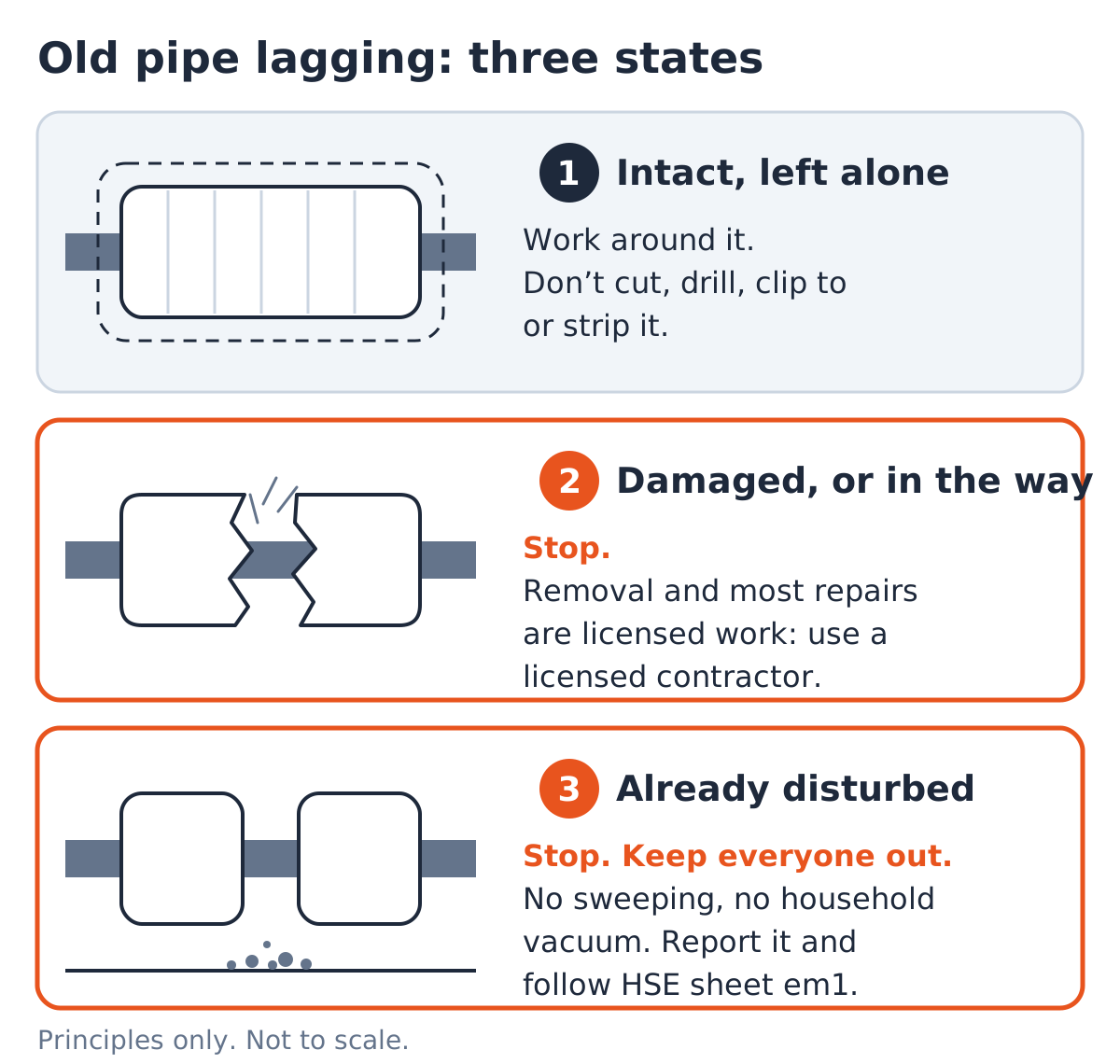
Our view: the same principles apply to pipework. Route new pipe clear of old lagging and don't clip to it. Cutting into a lagged pipe means cutting or stripping the lagging, and that is disturbance. If the lagging has to come off, a licensed contractor takes it off first.
After licensed work, L143 says the area should go through four-stage clearance and get a certificate for reoccupation. In practice, ask to see it before you go back in.
HSE lists plumbers and heating engineers among the trades who need asbestos awareness training. That training helps you avoid disturbing asbestos. HSE says it "will not prepare workers" to carry out work with asbestos-containing materials.
Is there an exception for small repairs?
Yes, but it's narrow. HSE's examples of notifiable non-licensed work (NNLW) include short duration work on asbestos insulation. The example is repairing "minor damage to a small section of pipe insulation" where the exterior coating is broken or damaged.
Under regulation 2(3), work is not short duration if, in any seven-day period, it takes more than two hours. That includes any ancillary work liable to disturb asbestos. The same applies if anyone does it for more than one hour in that period.
NNLW brings extra duties under regulations 9, 18 and 22 of CAR 2012. You must notify the enforcing authority before work starts and mark the work area with a warning notice. Workers need a medical examination before starting, repeated at least every three years. Health records must be kept for at least 40 years.
Our view: this exception suits firms set up for asbestos work. For most plumbers, damaged lagging means stop and call a licensed contractor.
How do you find out before you start?
Regulation 5 covers any work that exposes, or is liable to expose, employees to asbestos. Before it starts, you must make a suitable and sufficient assessment of whether asbestos is, or is liable to be, present. It must cover what type, in what material and in what condition. If there's doubt, you can instead assume asbestos is present, and not chrysotile alone, and follow the regulations.
- Commercial buildings and plant rooms. The dutyholder's plan must include measures to give "every person liable to disturb it" information on the location and condition of asbestos. Ask for the asbestos register and check it covers your work area. HSE's a0 sheet says if there's no register or survey, or it isn't clear, do not start work. Instead, get a sample analysed, or presume the most hazardous types and use a licensed contractor if required.
- Homes. HSG264 says the duty to manage doesn't normally apply to domestic premises, but does apply to common parts such as boilerhouses. In a private house, a0 says to arrange a survey yourself, or assume asbestos and take appropriate control measures. For lagging, a0's decision flow chart says the task needs an HSE-licensed contractor.
- The right survey. HSG264 says a management survey covers routine and simple maintenance. More extensive maintenance or repair work may need a localised refurbishment survey. HSE strongly recommends accredited surveying organisations.
Our post on management versus demolition surveys covers which to ask for.
What if you've already disturbed it?
Stop work immediately. HSE's em1 sheet (fourth edition, 2017) says to keep everyone out, put up a warning sign and report it. Don't sweep. HSE's em4 sheet says domestic vacuum cleaners "should never be used on asbestos". em1 says clean-up of a release of asbestos lagging must be done by a licensed contractor. Our asbestos guide has the full stop-work steps.
What the law says
- Regulation 2(1) defines asbestos insulation as material containing asbestos used for thermal, acoustic or other insulation, including fire protection. It excludes asbestos cement, coatings, AIB and some bitumen, plastic, resin or rubber articles. L143 confirms this covers asbestos lagging and preformed pipe sections.
- Regulation 2(1) makes work on asbestos insulation licensable where the risk assessment shows it is not sporadic and of low intensity. The same applies where it cannot clearly show the control limit won't be exceeded, or shows the work is not short duration.
- Regulation 8(1) says an employer must hold a licence before undertaking any licensable work with asbestos.
- Regulation 10 requires information, instruction and training for employees who are, or are liable to be, exposed to asbestos.
- Regulation 3(1) applies the Regulations to the self-employed as if they were both employer and employee.
HSE consulted on changes to CAR 2012 between November 2025 and January 2026. In November 2026 it said NNLW will be kept, with improved guidance to come, and that it will update L143. Check the current position.
How to record asbestos pipe lagging in your RAMS
- Record what you checked: the register or survey, and whether it covers your work area. If there's none, record that you're presuming asbestos.
- Mark lagged pipes, tanks and boiler insulation as no-touch, and show how new pipe runs avoid them.
- Name who removes any lagging that must come off (an HSE-licensed contractor). Note that your work waits for the certificate for reoccupation.
- Set out your stop-work steps if lagging is uncovered or damaged, following em1.
- Record who has had asbestos awareness training, and brief the team.
Our asbestos awareness toolbox talk is a free download that ends with an attendance sheet for signatures. The free RAMS generator covers your first project at no cost. The Site Book's RAMS turn your job description and selected hazards into a structured first draft, ready for competent-person review.
For trade hazards, see RAMS for plumbing and heating and our page for plumbers.
The bottom line
Treat old lagging as asbestos until a survey or lab clears it. Work around it if it's intact. If the job needs it cut, stripped or repaired, stop and get a licensed contractor in. The one exception is narrow and notifiable. If you've already disturbed it, stop, keep people out and follow em1.
This article is general guidance, not legal advice or a guarantee of compliance.
Sources
- HSE press release, 20 November 2025: film studio fined £6,000 after disturbance of asbestos during maintenance works
- Control of Asbestos Regulations 2012, regulation 2 (Interpretation)
- Control of Asbestos Regulations 2012, regulation 3 (Application)
- Control of Asbestos Regulations 2012, regulation 4 (Duty to manage)
- Control of Asbestos Regulations 2012, regulation 5 (Identification of the presence of asbestos)
- Control of Asbestos Regulations 2012, regulation 8 (Licensing)
- Control of Asbestos Regulations 2012, regulation 9 (Notification of work with asbestos)
- Control of Asbestos Regulations 2012, regulation 10 (Information, instruction and training)
- Control of Asbestos Regulations 2012, regulation 15 (Accidents, incidents and emergencies)
- Control of Asbestos Regulations 2012, regulation 18 (Designated areas)
- Control of Asbestos Regulations 2012, regulation 22 (Health records and medical surveillance)
- HSE, L143 Managing and working with asbestos (second edition, 2013)
- HSE, Licensable work with asbestos
- HSE, Non-licensed work with asbestos
- HSE, Notifiable non-licensed work (NNLW)
- HSE, Deciding if the work must be done by a licensed contractor
- HSE Asbestos essentials a0: Introduction to Asbestos essentials
- HSE Asbestos essentials a20: Laying cables in areas containing undamaged asbestos materials
- HSE Asbestos essentials em1: What to do if you discover or accidentally disturb asbestos during your work
- HSE Asbestos essentials em4: Using a Class H vacuum cleaner for asbestos
- HSE, HSG264 Asbestos: The survey guide (second edition, 2012)
- HSE, The duty to manage asbestos in buildings: arrange an asbestos survey
- HSE, Asbestos information, instruction and training
- HSE, 3 November 2026: HSE takes action to strengthen asbestos safety standards following consultation
RAMS for plumbing and heating jobs
See what compliance documents plumbing and heating jobs need, and how The Site Book identifies hazards such as asbestos in older pipe lagging.
See plumbing and heating RAMS →