Asbestos Floor Tiles: Lift Them or Lay Over Them?
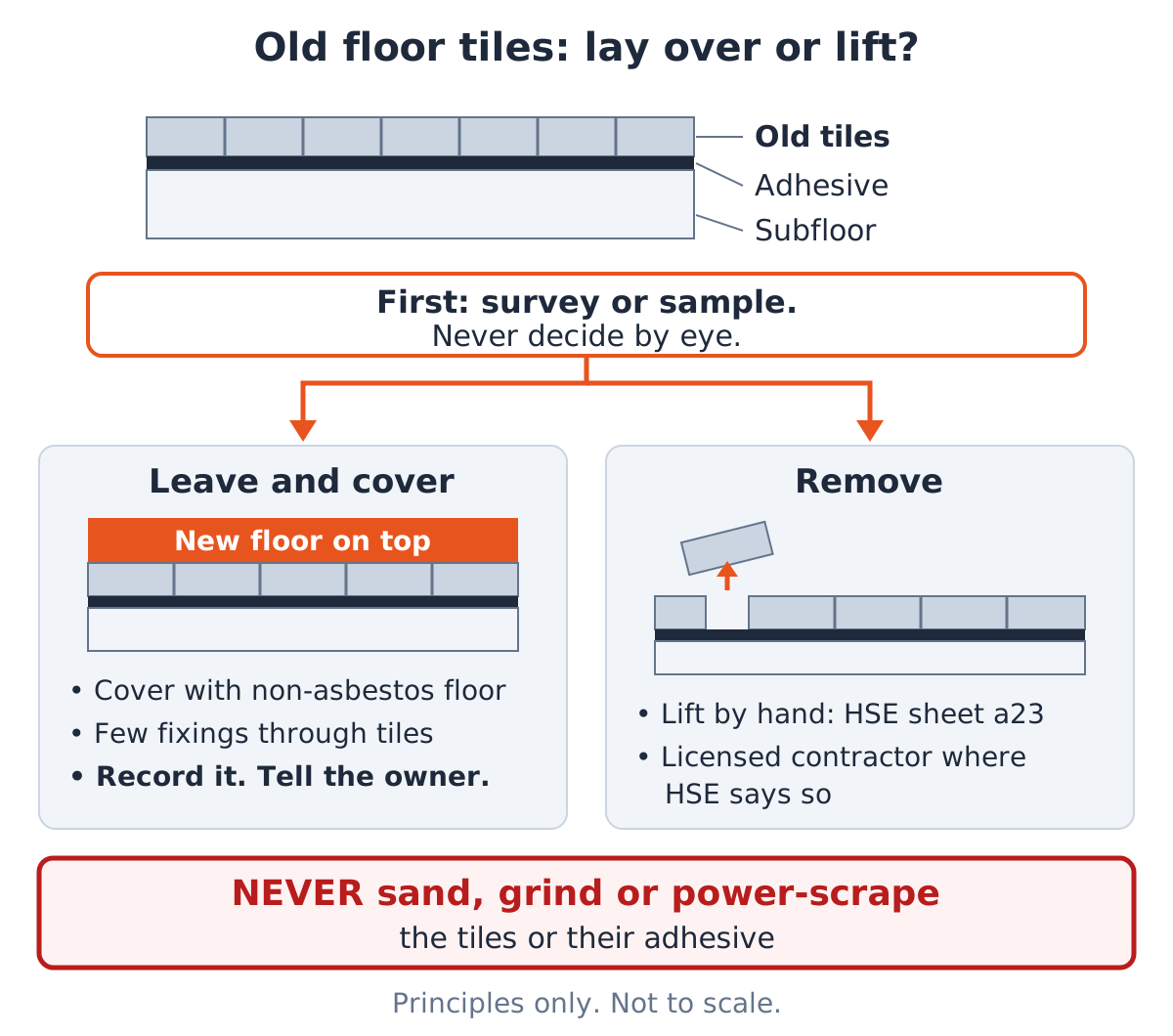
For flooring and kitchen fitters: test old floor tiles first, lay over sound ones and record it, or lift them by hand under HSE's sheet a23. Never sand or grind.
7 min read

TL;DR
For flooring and kitchen fitters: test old floor tiles first, lay over sound ones and record it, or lift them by hand under HSE's sheet a23. Never sand or grind.
Write the RAMS for a floor-tile job
Describe your floor-tile job and get a first-draft RAMS to review and adapt for the site. No credit card required.
Create my free RAMS →Until a sample proves otherwise, treat old floor tiles and their adhesive as asbestos, and lay over them if you can (unless it's a major refurbishment or demolition). If they must come up, lifting them by hand is normally non-licensed work under HSE's sheet a23, but never sand or grind them.
This post covers one decision: lift old floor tiles that might contain asbestos, or leave them and lay over them. For the full process, see our asbestos awareness guide for builders.
It covers Great Britain, where the Control of Asbestos Regulations 2012 (CAR 2012) and CDM 2015 apply. Northern Ireland has its own asbestos regulations and CDM 2016.
HSE says asbestos was added to PVC and thermoplastic floor tiles, found in kitchens and corridors and sometimes hidden under carpets. Some were stuck down with asbestos-containing mastic or backed with asbestos paper.
How do you know if floor tiles contain asbestos?
Not by looking. HSE says asbestos floor tiles and coverings "can be hard to identify", and only sampling and analysis can confirm asbestos.
Before work that could expose workers, regulation 5 of CAR 2012 says identify whether asbestos is present, its type, the material and its condition. Where in doubt, assume it is present, and not chrysotile alone.
In practice:
- Non-domestic premises: ask for the asbestos register. HSE's sheet a0 says if there is no register or survey, or the report isn't clear, do not start work.
- Refurbishment: HSE says a refurbishment or demolition survey must find asbestos, including any hidden in the building fabric, before structural work begins.
- A private house: a0 says you will have to arrange a survey yourself, or assume the material contains asbestos and take appropriate control measures.
If you send a sample away, regulation 21 says you must make sure the analyst is accredited to ISO 17025. In practice, have the tile, adhesive and any backing tested separately.
When should you lay over asbestos floor tiles instead?
Sheet a23 opens its procedure by asking whether you can avoid removal, for example by overlaying with non-asbestos material. HSE's wider advice: leave asbestos in good condition in place and monitor it, if it isn't likely to be damaged.
In practice, that suits sound, well-stuck tiles on a refit, not loose or broken ones.
It isn't the default for final demolition or major refurbishment. There, regulation 7(3) says the plan of work must, so far as is reasonably practicable, specify removal before any other major works begin. The exception is where removal would cause a greater risk to employees than leaving it in place.
Watch the fixings: HSE lists drilling a hole in an asbestos floor tile as non-licensed work, so screwing a base through them is work on asbestos. Our view: use as few as possible, and plan the drilling as non-licensed work: trained people, a risk assessment and controls.
Then record it. Sheet a23 says to warn the building owner about asbestos you have covered by overlaying, so it can be managed properly. In non-domestic premises, the dutyholder's regulation 4 plan must include telling anyone liable to disturb asbestos where it is and its condition. In practice, give them the details in writing.
A private house has no regulation 4 duty, so in practice your note may be the next trade's only warning. Our view: if the project has a health and safety file (CDM 2015, regulation 12), the covered tiles belong in it.
Is lifting asbestos floor tiles licensed, notifiable or neither?
Usually neither: HSE lists manually removing asbestos floor tiles and mastic as non-licensed work. Three things change that:
- Paper backing. Sheet a23 says removing tiles with an asbestos-paper backing will be notifiable non-licensed work (NNLW).
- Break-up. HSE says work likely to cause significant break-up and deterioration of the material needs notifying. Removing materials in poor condition, for example after flood or fire, will normally be NNLW.
- Grinding. HSE says grinding off flooring materials is higher-risk work, and you must use an HSE-licensed contractor.
Under regulation 3(2), the NNLW duties fall away only if all three of these hold:
- exposure is sporadic and of low intensity;
- the risk assessment makes clear no employee's exposure will exceed the control limit; and
- the work is a listed type; for lifting tiles, "removal without deterioration of non-degraded materials in which the asbestos fibres are firmly linked in a matrix".
If the risk assessment can't clearly show the control limit won't be exceeded, the work is licensable (regulation 2(1)).
NNLW duties: notify the enforcing authority online before work starts. Designate the area, make sure workers have a medical at least every three years, and keep health records for at least 40 years. Our post on licensed, notifiable or neither has the full test.
Can I remove asbestos floor tiles myself?
If you're a trade, yes, within limits. HSE says this work should be done by non-licensed workers trained to recognise and work safely with asbestos. You need:
- adequate information, instruction and training, given at regular intervals (regulation 10);
- a risk assessment with its significant findings recorded (regulation 6) and a written plan of work (regulation 7); and
- a job that fits sheet a23: tiles and mastic lifted by hand. If they're paper-backed, in poor condition or likely to break up badly, treat it as NNLW: notify first and have a current medical.
If you're unsure, stop: a0 says only go ahead if you are sure the work does not require a licence. If you have any doubts, it says to use your risk assessment to decide the type of work, or ask the client to employ an HSE-licensed asbestos contractor.
If you're a homeowner, HSE says don't repair or remove asbestos materials yourself without training for non-licensed asbestos work. It strongly encourages using trained professionals. Keep the waste out of household bins; your council can advise.
How does HSE's floor-tile sheet say to lift them?
Sheet a23, "Removing asbestos-containing floor tiles and mastic" (HSE, 09/17), says you must read sheet a0 first. In summary, it says to:
- restrict access, close doors, and warn others with tape and notices;
- wear disposable overalls with a hood, boots without laces, and RPE;
- lift each tile gently with a scraper in the joint, avoiding breakage, spraying water under it and wetting any paper backing;
- gently scrape up stuck mastic, which you can soften with solvent or an infra-red lamp, or make brittle with dry ice; and
- clean with damp rags, using a Class H vacuum on larger areas if you have one, then double-bag the waste.
Sheet a0 says follow all of a task sheet's actions, or use equally effective measures. In practice, a solvent needs its own COSHH assessment; see our RAMS for flooring work page.
What should you never do with asbestos floor tiles?
- Sand them. Sheet a23 says: "Never sand the floor." In practice, that includes sanding to level it for an overlay.
- Grind them off. HSE says that needs an HSE-licensed contractor.
- Power-scrape them. Sheet a23 uses a scraper, hammer and shovel; a powered floor stripper isn't in its method. Our view: don't, unless a competent specialist has assessed the method.
Already disturbed some? Stop work, keep everyone else out, put up a warning sign and report it (HSE sheet em1). Don't sweep it or use a household vacuum. Leave the clean-up to someone trained, with a Class H vacuum or damp rags (a0, em1). See what to do if you find suspected asbestos.
What happens to the waste?
Regulation 24 says asbestos waste must be stored and moved in sealed packaging, clearly marked to show it contains asbestos. HSE's waste sheet em9 adds:
- in England and Wales it is hazardous waste if it contains more than 0.1% asbestos (special waste in Scotland);
- don't mix it with other waste to get below 0.1%;
- carrying it needs a waste carrier's licence; otherwise use a registered waste carrier; and
- use a licensed disposal site, complete a consignment note and keep copies for three years.
What the law says
Two more duties in CAR 2012 apply to any job that disturbs asbestos tiles. Regulation 11: prevent exposure so far as reasonably practicable, or else reduce it to the lowest level reasonably practicable by measures other than RPE. Regulation 16: prevent the spread of asbestos from the work area or, where that isn't reasonably practicable, reduce it to the lowest level reasonably practicable.
The Approved Code of Practice is L143 (2nd edition, 2013). On 3 November 2026, HSE said it will keep the NNLW category, improve guidance on it and update L143 later this year. Check the current position.
How to record it in your RAMS
- What the tiles, adhesive and backing are, and how you know (register, survey, sample or presumed).
- Your decision, overlay or lift, and why.
- Overlay: the build-up, fixings through the tiles, and who you told in writing.
- Removal: non-licensed or NNLW, any notification, and the a23 method.
- Who is trained, their PPE and RPE, how you'll keep others out, and the waste route.
- If tiles break up or something unexpected appears: stop, keep out, follow em1.
Draft it with our free RAMS generator: describe the job, then review the draft. The RAMS features page covers method statements and worker sign-off. See also RAMS for kitchen extensions, and brief the crew with our asbestos awareness toolbox talk.
The bottom line
Identify the tiles first. Sound tiles on a refit: lay over them and tell the owner in writing. Tiles that must come up: lift by hand under a23, and notify first if it's NNLW (paper-backed, poor condition or likely to break up). Grinding: licensed contractor. Sanding: never.
This article is general guidance, not legal advice or a guarantee of compliance.
Sources
Official pages this post draws on; check them for the current wording:
- HSE Asbestos essentials a23: Removing asbestos-containing floor tiles and mastic (09/17)
- HSE Asbestos essentials a0: Introduction to Asbestos essentials (09/17)
- HSE em1: What to do if you discover or accidentally disturb asbestos (2017, amended March 2018)
- HSE em9: Disposal of asbestos waste (09/17)
- HSE: Locations of asbestos and taking the right action
- HSE: Non-licensed work with asbestos
- HSE: Notifiable non-licensed work (NNLW)
- HSE: Arrange an asbestos survey
- HSE: Asbestos frequently asked questions
- Control of Asbestos Regulations 2012 (regulations 2 to 7, 10, 11, 16, 21, 22 and 24)
- CDM 2015, regulation 12 (construction phase plan and health and safety file)
- HSE L143: Managing and working with asbestos (2nd edition, 2013)
- HSE press release, 3 November 2026: HSE takes action to strengthen asbestos safety standards following consultation
Write the RAMS for a floor-tile job
Describe your floor-tile job and get a first-draft RAMS to review and adapt for the site. No credit card required.
Create my free RAMS →