Licensed, Notifiable or Neither: Which Asbestos Work Is Yours?
How to tell licensed asbestos work from notifiable non-licensed work (NNLW) and non-licensed work, using the tests in CAR 2012, and what each lane means you must do.
8 min read

TL;DR
How to tell licensed asbestos work from notifiable non-licensed work (NNLW) and non-licensed work, using the tests in CAR 2012, and what each lane means you must do.
Put the asbestos decision in your RAMS
Describe the job and get a site-specific RAMS first draft to review. Add the survey reference, the lane you chose and why. Your first project is free.
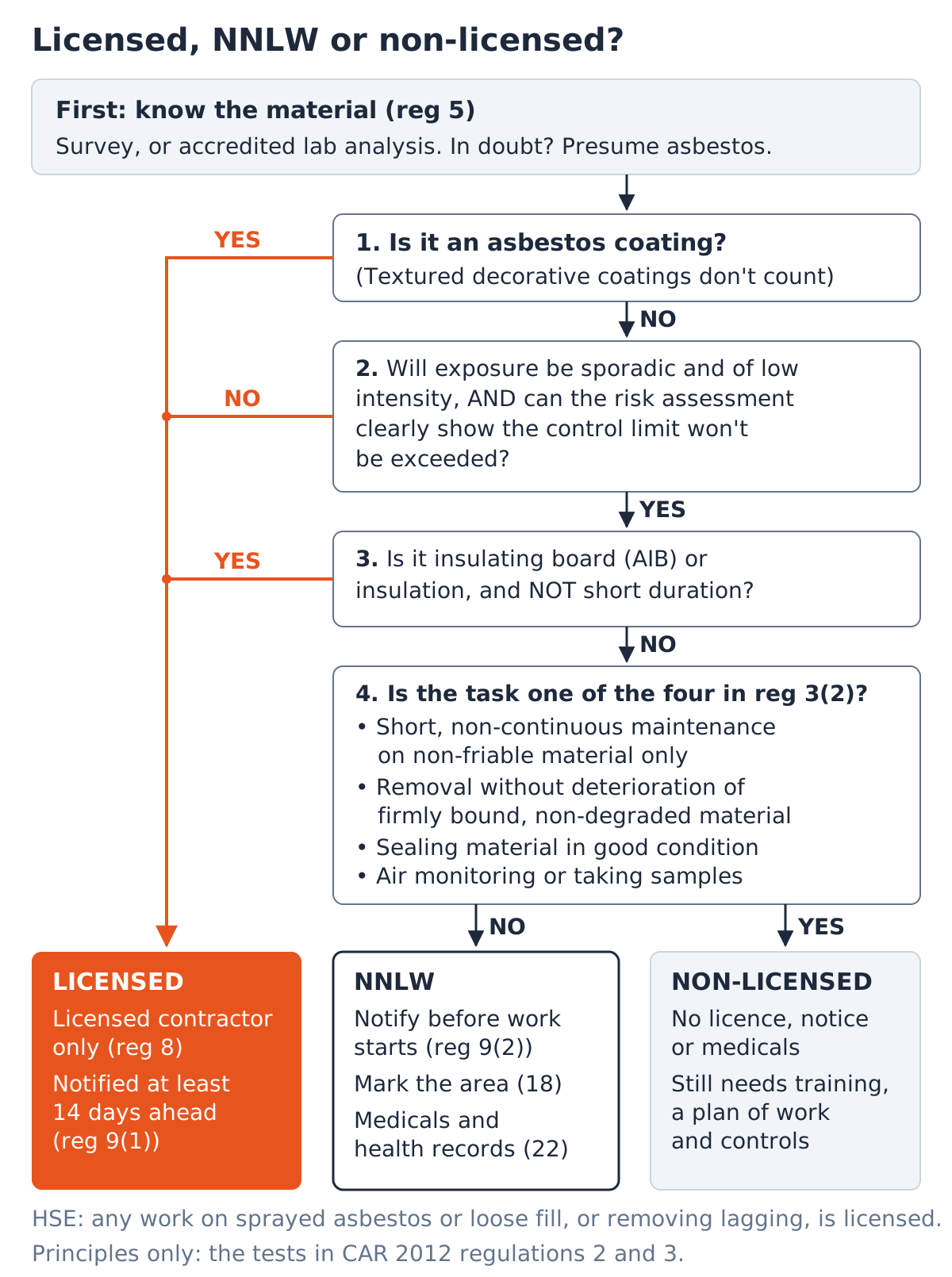
Create my free RAMS →It's licensed asbestos work if it involves an asbestos coating, high or uncertain exposure, or insulating board or insulation beyond short duration. Otherwise it's notifiable non-licensed work (NNLW), unless it fits one of four exempt task types that make it plain non-licensed work. Licensed work goes to a licensed contractor; NNLW adds a notification, a marked area, medicals and health records.
This post covers one decision: which of the three lanes an asbestos job is in, and what it requires. For surveys and the wider picture, see our asbestos awareness guide for builders.
This post covers Great Britain, where the Control of Asbestos Regulations 2012 (CAR 2012) and CDM 2015 apply. Northern Ireland has its own Control of Asbestos Regulations (Northern Ireland) 2012 and CDM 2016.
Already disturbed it? Stop work, put up a warning sign and keep everyone out. Don't sweep up or use an ordinary vacuum: HSE's a0 sheet says use a Class H vacuum or damp rags. Then follow HSE's em1 sheet and the steps in our guide.
HSE's November 2026 consultation response says its data suggests a significant number of NNLW notifications for AIB and insulation exceed the short-duration time frame. Past that, the work is licensable. The response also says the dominant theme from respondents was that confusion about NNLW is widespread.
In a Staffordshire case sentenced in March 2026, a client got a licensed contractor's quote, then appointed an unlicensed firm to clear the asbestos.
Who decides whether it's licensed, notifiable or neither?
HSE says the employer of anyone whose work might involve asbestos decides whether it needs a licensed contractor, based on the risk. CAR 2012 treats a self-employed person as both employer and employee (regulation 3(1)). In practice, that's often you.
You need to know what the material is, and you can't tell by looking. Before work liable to expose your employees, regulation 5 requires either:
- a suitable and sufficient assessment of whether asbestos is present, what type, in what material and in what condition; or
- where there's doubt, assuming it is present and not chrysotile alone, and following the Regulations.
A lab you ask to analyse a sample must be accredited to ISO 17025 (regulation 21).
When is it licensed asbestos work?
Regulation 2(1) says licensable work is work:
- where employees' exposure to asbestos is not sporadic and of low intensity; or
- where the risk assessment cannot clearly demonstrate that the control limit will not be exceeded; or
- on asbestos coating; or
- on asbestos insulating board (AIB) or asbestos insulation, if either exposure test above is failed or the risk assessment shows it isn't short duration work.
Asbestos coating is a surface coating containing asbestos for fire protection, heat insulation or sound insulation. Textured decorative coatings, often called Artex, don't count.
The control limit is 0.1 fibres per cm³ of air, averaged over a continuous 4 hours (regulation 2(1)). L143 puts the sporadic and low intensity line at 0.6 fibres per cm³ over ten minutes. Exposure is judged without counting the RPE being worn, with exceptions in regulation 11 (regulation 2(5)). In practice, a better mask doesn't change the lane.
Work is not short duration if, in any seven-day period, it takes more than two hours (regulation 2(3)). Nor is it if anyone does it for more than one hour. The two hours include ancillary work liable to disturb asbestos and, L143 adds, set-up and clean-up.
HSE's licensable examples include sprayed coatings (limpet asbestos), any work involving loose fill, millboard, and AIB work that won't be short duration. HSE also says only licensed contractors can do any removal, or most repair, of asbestos insulation such as pipe lagging.
Not sure? HSE's sheet a0 says you should only go ahead if you're sure no licence is needed.
When is non-licensed asbestos work notifiable?
If the work isn't licensable, regulation 3(2) decides whether it's NNLW. It escapes the NNLW duties only if all three apply:
- exposure is sporadic and of low intensity; and
- the risk assessment makes clear no employee's exposure will exceed the control limit; and
- the work involves one of the four task types below.
- Short, non-continuous maintenance in which only non-friable materials are handled.
- Removal without deterioration of non-degraded materials in which the fibres are firmly linked in a matrix.
- Encapsulation or sealing of asbestos-containing materials in good condition.
- Air monitoring and control, and collecting and analysing samples.
L143 says non-licensable work should meet the first two automatically. So the real question is the task type: if it isn't one of the four, it's NNLW.
HSE says to weigh three things:
- The type of work. Maintenance, such as drilling for fittings, includes incidental removal. Removal as part of a refurbishment is removal.
- Friability. Friable means easily crumbled or reduced to powder. For removal, also ask how firmly the asbestos is bonded in a matrix such as cement.
- Condition. Removing materials in poor condition, for example after flood or fire, will normally be NNLW. So will work that destroys the matrix, such as large-scale steaming or gelling of Artex.
On a refurbishment, L143 says asbestos tasks that are part of a larger job should be judged together, not one by one.
HSE's NNLW examples include "dropping" an asbestos cement roof and short-duration removal of AIB in a refurbishment. Another is a short repair of minor damage to a small section of pipe insulation where the exterior coating is broken or damaged. Its non-licensed examples include removing asbestos cement sheets carefully without breaking them up, and maintenance on vinyl floor tiles.
What does each lane mean you must do?
Licensed work
- Only a licensed contractor does it: an employer must hold an HSE licence first (regulation 8(1)). HSE says doing it without one is an offence.
- The contractor notifies the enforcing authority in writing at least 14 days before, unless the authority agrees a shorter time (regulation 9(1)).
- From 25 November 2027, the removal contractor can't appoint the analyst who certifies the area fit to reoccupy (new regulation 20, SI 2026/1153).
Notifiable non-licensed work (NNLW)
- Notify before work starts (regulation 9(2)) on HSE's online form; HSE says there's no minimum notice period. For construction sites and domestic premises, the enforcing authority is HSE.
- Mark the area with warning notices, keep out anyone not needed, and allow no eating, drinking or smoking there (regulation 18).
- Each exposed employee needs a medical, including a chest examination, within 3 years before exposure starts, then at least every 3 years (regulation 22). Keep each certificate for at least 4 years.
- Keep a health record for each exposed employee for at least 40 years. HSE says it can be as simple as workers' names on your copy of the notification.
Non-licensed work
- No licence, notification, designated asbestos area, medicals or health records.
- L143 says it still needs trained, competent workers, a plan of work, and controls that prevent exposure and spread. HSE's Asbestos essentials task sheets give methods for common tasks.
What the law says
CAR 2012 regulation 2 defines licensable and short duration work. Regulation 8(1) says an employer "must hold a licence" before undertaking any licensable work with asbestos.
Regulation 3(2) says regulations 9, 18(1)(a) and 22 do not apply where all its conditions are met. Other non-licensable work must be notified "before work is commenced" (regulation 9(2)).
The Approved Code of Practice is L143, Managing and working with asbestos (2nd edition, 2013), which HSE says it will update. HSE consulted on changes in 2025–26; its 3 November 2026 response keeps NNLW and promises clearer guidance.
How to record the decision in your RAMS
- Name the material and how you know: survey reference, lab result, or "presumed asbestos".
- State the lane and the test that decided it.
- For AIB or insulation, set the time budget: total hours in any seven days, including set-up and clean-up, and hours per person.
- For NNLW, record the notification, the marked area and each worker's medical certificate.
- For licensed work, name the contractor and the area your team stays out of.
- If the job changes, stop and decide the lane again.
The Site Book's RAMS generator turns your job description and selected hazards into a structured first draft to review and adapt. Try it on your first project with the free RAMS generator. Brief the crew with our free asbestos awareness toolbox talk, which ends with an attendance sign-off sheet.
On refurbishment and demolition jobs, The Site Book puts an asbestos survey flag in the pre-start checklist. For the rest of the job file, see what paperwork a construction job needs.
The bottom line
Know the material before anyone picks up a tool. Then run the tests: coating, exposure, AIB or insulation time, then the four exempt task types. Licensed work goes to a licensed contractor. NNLW means notify, mark the area, medicals and records. Non-licensed work still needs training, a plan and controls.
This article is general guidance, not legal advice or a guarantee of compliance.
Sources
- HSE press release, 9 March 2026: Cannock asbestos clearance prosecution
- HSE press release, 3 November 2026: consultation response
- HSE consultation on CAR 2012 and its response
- CAR 2012, regulation 2
- CAR 2012, regulation 3
- CAR 2012, regulation 5
- CAR 2012, regulation 8
- CAR 2012, regulation 9
- CAR 2012, regulation 18
- CAR 2012, regulation 21
- CAR 2012, regulation 22
- The Control of Asbestos (Amendment etc.) Regulations 2026 (SI 2026/1153)
- HSE, Deciding if a licensed contractor must do the work
- HSE, Licensable work with asbestos
- HSE, Notifiable non-licensed work
- HSE, Non-licensed work with asbestos
- HSE, L143 Managing and working with asbestos (2nd edition, 2013)
- HSE Asbestos essentials sheet a0, Introduction (published 09/17)
- HSE Asbestos essentials sheet em1, discovering or disturbing asbestos (4th edition 2017, amended March 2018)
- Control of Asbestos Regulations (Northern Ireland) 2012
Put the asbestos decision in your RAMS
Describe the job and get a site-specific RAMS first draft to review. Add the survey reference, the lane you chose and why. Your first project is free.
Create my free RAMS →