Built for Solar Panel Installers
RAMS, CPP & Site Documents for Solar Panel Installers
Solar installation means working on roofs, handling electrical systems, and lifting heavy panels. We have built a ready-made Commercial Solar PV library — mounting system, DC cabling and string wiring, inverters, and commissioning — each with its own method statement, so your RAMS cover height, DC isolation, and manual handling in one document. Working on something the boxes don't quite fit? Add your own work type, give it a method statement, and it flows into your RAMS alongside the built-in stages.
No card needed · Used by UK solar panel installers · Structured around CDM 2015
Built for Solar Panel Installers
Real work, real hazards. Pick the job closest to yours to start a free job pack with the scope already filled in:
Domestic rooftop solar PV
Roof-mounted panel arrays on pitched roofs — covers working at height, roof access, manual handling of panels, and DC electrical isolation.
Start with this job →Commercial Solar PV (ready-made library)
Pick the built-in Commercial Solar PV trade group and get a method statement for every stage — delivery and loading out, roof mounting system, panels, DC cabling and string wiring, inverter, AC grid tie-in, and commissioning — each with the right hazards (fragile-roof and rooflight falls, DC live in daylight, manual handling, wind).
Start with this job →Your own work types
Doing something that does not quite fit the standard boxes — a bespoke mounting frame, a battery storage tie-in, an unusual roof? Add your own work type, give it a method statement, and it flows into the RAMS sequence of works alongside the built-in stages. Build a reusable library in Settings or add it ad-hoc on a single project.
Start with this job →Ground-mounted solar arrays
Ground-mounted frame systems for farms and commercial sites — covers excavation for foundations, manual handling, cable trenching, and electrical connection.
Start with this job →What You Get
Job-specific RAMS
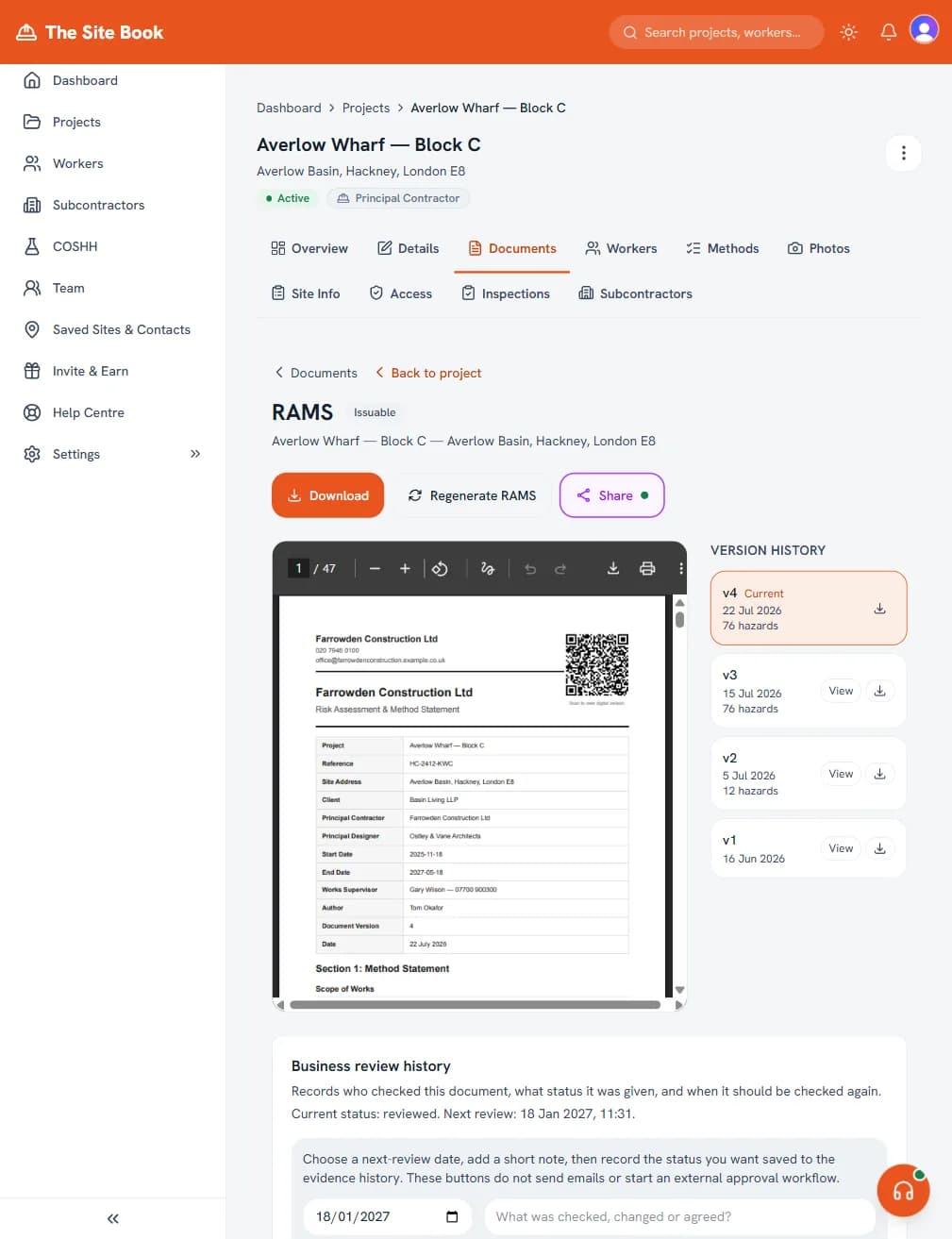
Describe your job and get professional risk assessments covering falls from height and other trade-specific hazards.
Construction Phase Plans
CPP first drafts structured around CDM 2015 requirements and your job details, ready for competent review. Covers management arrangements, risk control, welfare, and emergency procedures.
COSHH Assessments
Smart substance search and SDS upload. Pre-loaded with common solar installer substances like sealants, adhesives, and flux for electrical connections.
Site Inductions
Digital induction sign-offs for every worker on site. Linked to your CPP and site rules. Works on any phone or tablet.
Worker & subcontractor tracking
Track certifications, insurance, and CSCS cards. Get alerts before documents expire. One view for all your workers.
Digital document sharing
Share your full document pack with clients, principal contractors, or inspectors via a secure read-only link. No login needed on their end.
Common Hazards We Cover
These are the real risks solar panel installers face on site every day. Your RAMS will address each one with specific control measures.
- Falls from height — most domestic and commercial solar work involves roof access with limited edge protection
- Electrical shock from DC systems — solar panels generate DC voltage in daylight and cannot be fully isolated like AC circuits
- Manual handling of heavy panels — standard panels weigh 20–25kg and must be lifted onto roofs, often in awkward positions
- Roof fragility — older roofs, skylights, and fibre cement sheets may not support worker or panel weight
- Burns from electrical arcing — DC arcs from damaged connectors or cables do not self-extinguish like AC arcs
- Weather exposure — installers work on exposed roofs in wind, rain, and heat, increasing slip and fatigue risks
Key Regulations & Standards
BS 7671 (IET Wiring Regulations) and MCS Installation Standards (MIS 3002)
Solar PV installations must comply with BS 7671 for electrical safety, MCS 3002 for design and installation standards, and CDM 2015 for site safety. Installers must also comply with the Work at Height Regulations 2005 and the Electricity at Work Regulations 1989. Competent person schemes such as MCS certification are required for installations eligible for government incentives.
What's included at each tier
Starter
£0- Risk Assessments (RAMS)
- Construction Phase Plans (CPP)
- Site inductions
- Worker document signing (no per-signature charge)
Pro
£39/mo or £360/yr- Risk Assessments (RAMS)
- Construction Phase Plans (CPP)
- Site inductions
- COSHH assessments (standalone doc, SDS upload, site-specific register)
- Worker cert tracking and expiry alerts
- Right-to-work evidence records
- Subcontractor tracking
- Toolbox talks
- Worker document signing (no per-signature charge)
- Integrations (Drive, Xero, Zapier)
Business
£199/mo- Risk Assessments (RAMS)
- Construction Phase Plans (CPP)
- Site inductions
- COSHH assessments (standalone doc, SDS upload, site-specific register)
- Worker cert tracking and expiry alerts
- Right-to-work evidence records
- Subcontractor tracking
- Toolbox talks
- Worker document signing (no per-signature charge)
- Integrations (Drive, Xero, Zapier)
- Up to 10 internal team logins
- Site Supervisor: a field-only login for whoever runs the site
- Up to 50 active site portal users
- Site attendance check-in/check-out
- Multilingual worker inductions (9 languages)
- Optional 4-digit PIN for shared-link document sign-off
- Plant & equipment register with project assignment, certificates, inspections and defects
- Slack Site Ready readiness checks
Site Control
£675/site/mo- Risk Assessments (RAMS)
- Construction Phase Plans (CPP)
- Site inductions
- COSHH assessments (standalone doc, SDS upload, site-specific register)
- Worker cert tracking and expiry alerts
- Right-to-work evidence records
- Subcontractor tracking
- Toolbox talks
- Worker document signing (no per-signature charge)
- Integrations (Drive, Xero, Zapier)
- Up to 10 internal team logins
- Site Supervisor: a field-only login for whoever runs the site
- Up to 50 active site portal users
- Site attendance check-in/check-out
- Multilingual worker inductions (9 languages)
- Optional 4-digit PIN for shared-link document sign-off
- Plant & equipment register with project assignment, certificates, inspections and defects
- Slack Site Ready readiness checks
- Permanent entrance QR: guest sign-in and contractor self-join
- CSCS credential capture, review and expiry alerts
- Digital induction gating before check-in
- Live people-on-site, attendance and audit-grade exports
- Single sign-on (SSO) with Okta or Microsoft Entra
- Public REST API with scoped account keys
- Signed real-time webhooks into your own systems
Running live sites with subcontractors? Site Control is the per-site enterprise tier above Business — entrance QR sign-in, CSCS checks, induction gating, live attendance and audit-grade exports. From £675/site per month, plus £5,000 setup.
Frequently Asked Questions
- Do solar installers need RAMS?
- Yes. Solar installation involves working at height, electrical work on DC systems, and manual handling of heavy panels — all classified as significant risk activities under CDM 2015. Principal contractors and clients will expect RAMS that cover roof access, fall protection, electrical isolation, and panel handling. Generic templates are not sufficient for solar work.
- How does The Site Book draft RAMS for solar installation?
- The Site Book creates a first draft for your competent review. Describe the job — for example, '16-panel domestic PV install on a pitched tile roof' — and the AI generates RAMS covering roof access, fall protection, DC isolation, manual handling, and weather precautions, specific to your project.
- Does The Site Book cover MCS and BS 7671 requirements?
- Yes. The Site Book generates RAMS that reference BS 7671 (IET Wiring Regulations) for electrical safety and MCS installation standards. It covers DC isolation procedures, string voltage calculations for safe working, and the requirement for competent person certification on incentive-eligible installations.
- Is there a ready-made method statement library for solar PV?
- Yes. There is a built-in Commercial Solar PV trade group covering delivery and loading out, the roof mounting system, PV panels, DC cabling and string wiring, the inverter, AC grid tie-in, and commissioning. Each stage comes with its own method statement and the right hazards — fragile-roof and rooflight falls, DC live in daylight, manual handling of panels, and wind exposure — and they flow straight into your RAMS sequence of works.
- What if my work does not fit the standard trade sections?
- You can add your own work types. If a job does not quite fit the boxes — a bespoke mounting frame, battery storage, or an unusual roof — add a custom work type, give it a method statement, and it slots into the RAMS sequence alongside the built-in solar stages. Save it to a reusable library in Settings to use across projects, or add it ad-hoc on a single job.
Why The Site Book
- UK construction compliance tool that ships RAMS + CPP + COSHH + inductions (readable and acknowledgeable in 9 worker languages on Business, with the language audit-recorded) + worker sign-off, including optional 4-digit shared-link PIN evidence on Business, plus site attendance, portal users, site files, document reviews, subcontractor evidence and inspections/actions.
- Generate a site-specific RAMS first draft from a natural-language brief, ready for competent-person review - not a template library you hand-fill.
- Controlled document workflow without an enterprise contract: version history and a recorded issue confirmation before a document is shared with a client or downloaded in the app on every plan, re-sign on revision with superseded signatures preserved plus PCPP import, cert tracking and document checking from the £39/month Pro plan - and on Business, optional named-approver routing (a designated approver accepts or rejects each version, with recorded reasons, before it can be issued) plus client approve/reject/request-changes via share links.
- Transparent pricing: Starter £0, Pro £39/month or £360/year, Business £199/month with 10 management logins and 50 active site portal users. Worker document signing has no per-signature charge; project workers count as active portal users while assigned.
- Build RAMS for any trade - add your own work types and method statements alongside the built-in library, reusable across projects, including a ready-made Commercial Solar PV group. Save a finished job as a reusable project template, or clone it, so the next job of the same shape starts from your own setup.
- COSHH goes deep: a standalone COSHH assessment document, upload-a-Safety-Data-Sheet extraction, a site-specific substance register and an expert-reviewed library - plus per-worker RAMS sign-off and a one-click Audit Pack covering documents, sign-offs, worker evidence, attendance, incidents, COSHH, permits and up to the latest 500 live Site Diary entries.
Ready to stop writing RAMS by hand?
Describe your job, get professional RAMS, a CPP and a site induction. No credit card required.