Construction compliance guide

How to Write a RAMS for Construction Work: Step-by-Step UK Guide

Everything you need to know about writing a RAMS that actually meets the legal standard. Covers risk assessment structure, method statement format, worked examples, and the mistakes that trip builders up.

ND
Nicola Dobbie·Founder, The Site Book

TL;DR

  • • A RAMS combines a risk assessment (what could go wrong) with a method statement (how you’ll do the work safely) into one document.
  • • Use a 5×5 risk matrix to score hazards before and after controls — if residual risk is still high, rethink your approach.
  • • Follow the hierarchy of controls: eliminate, substitute, engineering controls, administrative controls, PPE — in that order.
  • • Every RAMS must be site-specific. Generic templates downloaded from the internet will not protect you or your workers.
  • • Brief your team on the RAMS before work starts, and update it whenever conditions change.

What goes in a RAMS?

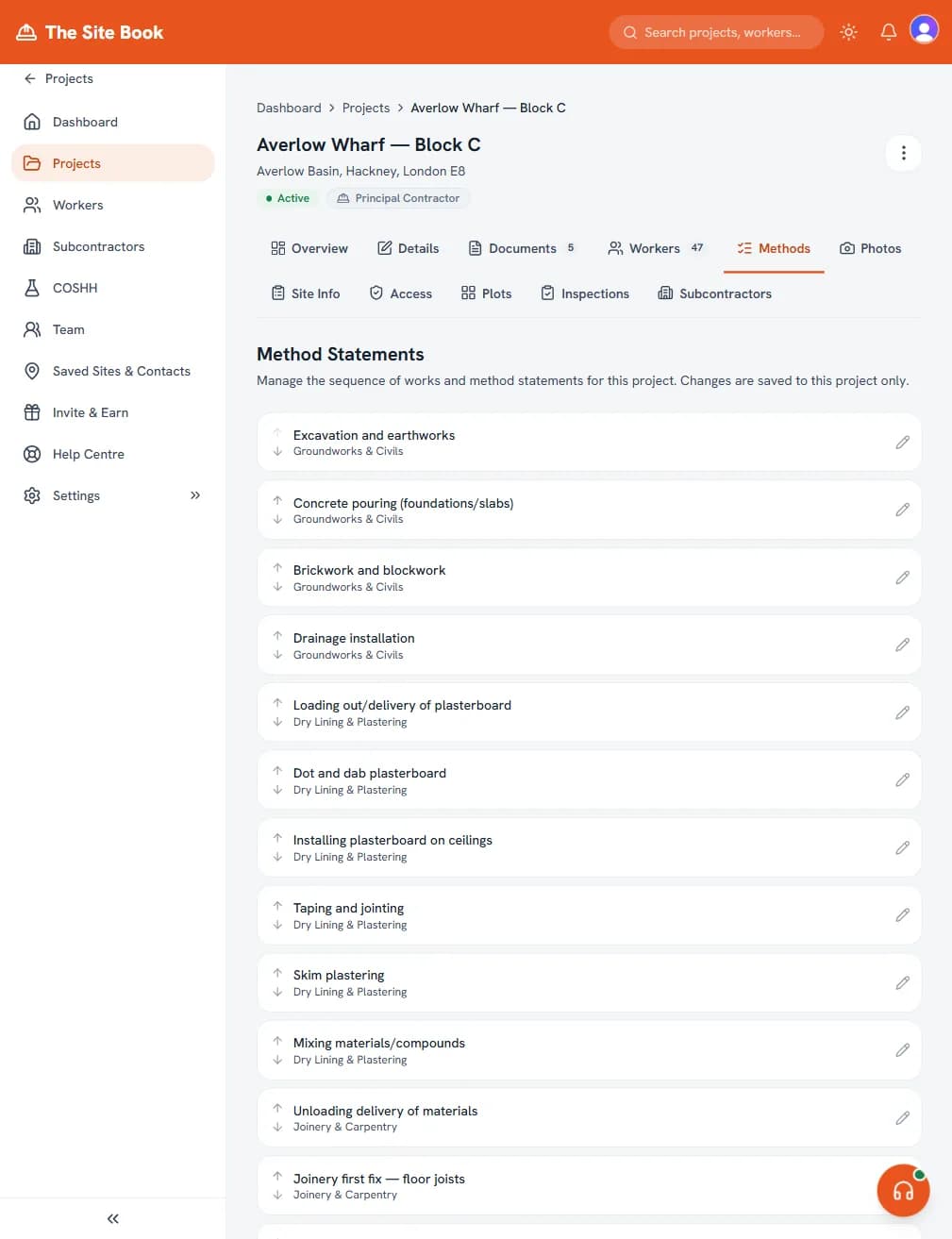
A RAMS is a single document that combines two things: a risk assessment and a method statement. The risk assessment identifies the hazards associated with the work, evaluates the level of risk, and sets out the control measures you will use to reduce that risk. The method statement takes those controls and weaves them into a step-by-step description of how the work will actually be carried out.

At a minimum, your RAMS should include: project details (site address, client name, contractor details, start date), a description of the work being carried out, a list of hazards and risks, the control measures for each hazard, a step-by-step method of work, the plant and equipment being used, materials (especially anything requiring a COSHH assessment), PPE requirements, emergency procedures, and the names and responsibilities of the people involved.

Think of the risk assessment as the thinking and the method statement as the doing. You cannot write a good method statement without first completing the risk assessment, because the controls you identify in the risk assessment dictate how the work is carried out. Equally, a risk assessment without a method statement leaves a gap — you have identified the risks but not explained how the work will be done safely in practice.

Under CDM 2015, every contractor must plan, manage, and monitor construction work so it is carried out without risks to health and safety. The RAMS is the standard way the UK construction industry meets this duty. Principal contractors will almost always require one before letting you on site, and many domestic clients now ask for them as well.

How do you structure the risk assessment?

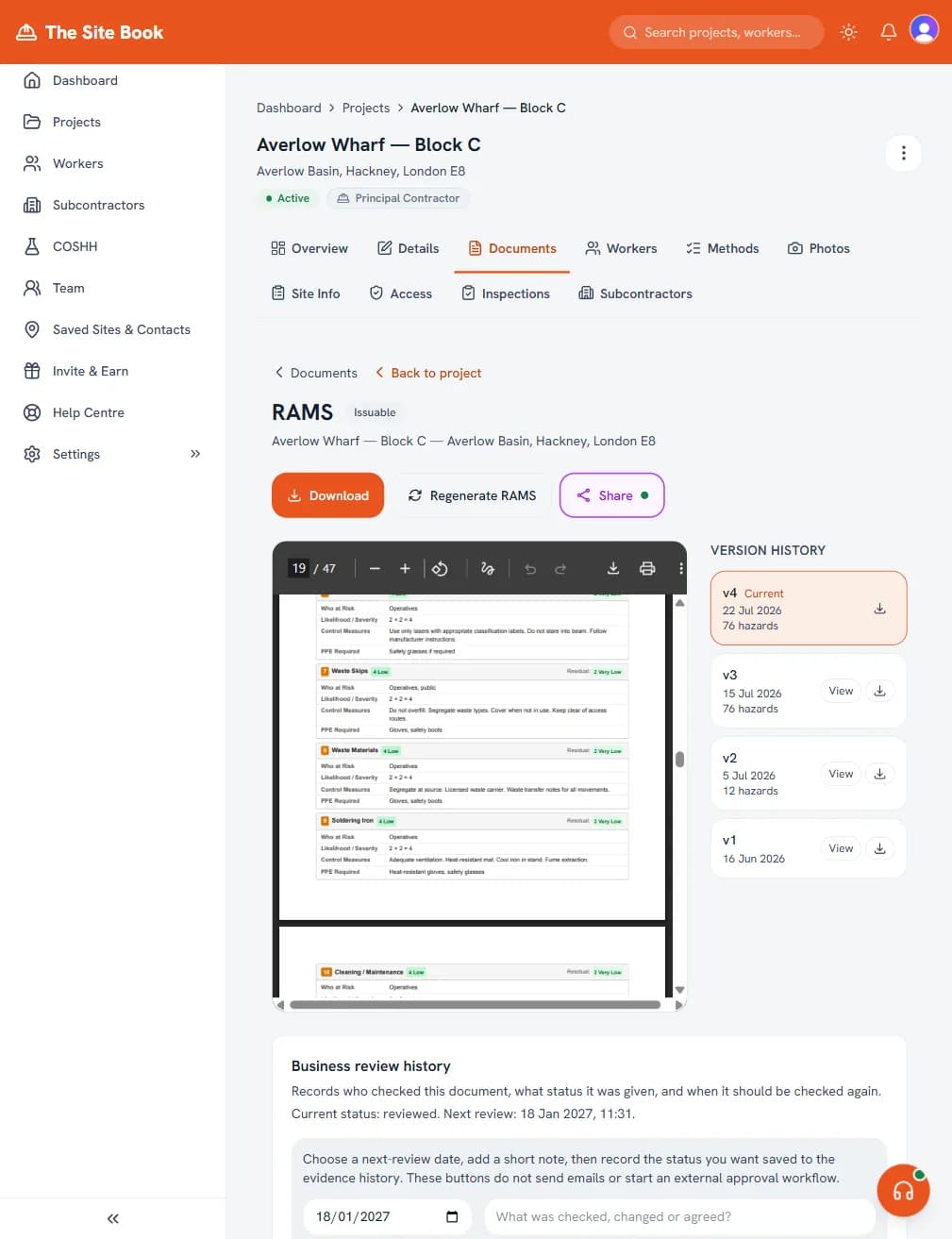
The risk assessment is the analytical half of your RAMS. Its job is to identify every significant hazard associated with the work, evaluate the level of risk each hazard presents, and set out the control measures you will use to bring that risk down to an acceptable level. The standard approach uses a tabular format with columns for each element.

For each hazard, you should record: a description of the hazard (e.g. “fall from scaffold during brickwork at first-floor level”), who might be harmed (operatives, visitors, members of the public), how they might be harmed (fractures, head injuries, fatality), the uncontrolled risk rating (the risk level before any controls are applied), the control measures you will put in place, and the residual risk rating (the risk level after controls are applied).

The control measures are the most important part. These are the specific actions you will take to prevent harm. They should be concrete and measurable — not vague platitudes like “appropriate measures will be taken.” For example: “Scaffold erected to full height with double guard rails, toe boards, and brick guards. Scaffold inspected by a competent person before first use and every seven days thereafter. Scaffold inspection register maintained on site.”

The HSE expects risk assessments to be suitable and sufficient — meaning they must identify the significant risks and set out sensible measures to control them. You do not need to identify every conceivable hazard, but you must cover the significant ones. If you miss a hazard that a competent person would have identified, and someone is harmed as a result, the absence will count against you.

How does the 5×5 risk matrix work?

The 5×5 risk matrix is the standard tool for scoring risk levels in UK construction. It works by multiplying two factors: likelihood (how probable is it that the harm will occur?) and severity (how serious would the harm be if it did occur?). Each factor is scored from 1 to 5, giving a risk score between 1 and 25.

For likelihood: 1 means very unlikely (could happen but only in exceptional circumstances), 2 means unlikely (could happen but is not expected), 3 means possible (might happen occasionally), 4 means likely (will probably happen at some point), and 5 means very likely (almost certain to happen). For severity: 1 means insignificant injury (minor bruise, scrape), 2 means minor injury (sprain, small cut needing first aid), 3 means moderate injury (broken bone, burns requiring hospital treatment), 4 means major injury (amputation, permanent disability), and 5 means fatality.

You score each hazard twice: once before controls are applied (the inherent risk) and once after controls are applied (the residual risk). For example, “fall from scaffold” might be scored as likelihood 4, severity 5 = risk score 20 (very high) before controls. After installing edge protection, toe boards, and daily inspections, it might drop to likelihood 2, severity 5 = risk score 10 (medium). Notice that severity stays the same — a fall from height is still potentially fatal even with controls. What changes is how likely it is to happen.

A common mistake is to reduce severity scores after applying controls. Unless your control physically changes the outcome (for example, working at ground level instead of at height), the severity stays the same. Controls reduce likelihood, not consequences. If your residual risk score is still high (above 15), you need to rethink your approach — either add more controls or find a different way to do the work.

What is the hierarchy of controls?

The hierarchy of controls is the framework the HSE expects you to follow when deciding how to manage a hazard. It ranks control measures from most effective to least effective. You should always start at the top and only move down when the higher-level control is not reasonably practicable.

1. Elimination

Remove the hazard entirely. Can you design out the risk? For example, if you are building a flat roof, can the parapet wall be built high enough to act as edge protection, eliminating the need for temporary barriers? Can prefabricated components be assembled at ground level rather than at height? Elimination is always the best option because it removes the risk completely.

2. Substitution

Replace the hazard with something less dangerous. Use water-based adhesives instead of solvent-based ones. Use a mechanical lifting device instead of manual handling. Substitute a less toxic cleaning product. The hazard still exists in some form, but the potential harm is reduced.

3. Engineering controls

Put physical measures in place that separate people from the hazard. Scaffold with edge protection, extraction ventilation for dust, machine guards, barrier fencing around excavations, temporary propping for structural openings. Engineering controls protect everyone in the area automatically — they do not rely on individual behaviour.

4. Administrative controls

Change the way people work. Permit-to-work systems, task rotation to reduce exposure, training, signage, restricted access zones, toolbox talks, supervision. These controls depend on people following procedures, so they are less reliable than engineering controls.

5. PPE (Personal Protective Equipment)

The last line of defence. Hard hats, safety boots, hi-vis vests, dust masks, hearing protection, safety glasses. PPE should never be your primary control — it is there to protect against residual risk after higher-level controls have been applied. If your RAMS relies entirely on PPE to control a hazard, the risk assessment is probably inadequate.

In your RAMS, each control measure should sit at the highest practicable level of the hierarchy. When a reviewer or an HSE inspector reads your document, they will check whether you have considered higher-level controls before defaulting to PPE.

How do you write the method statement?

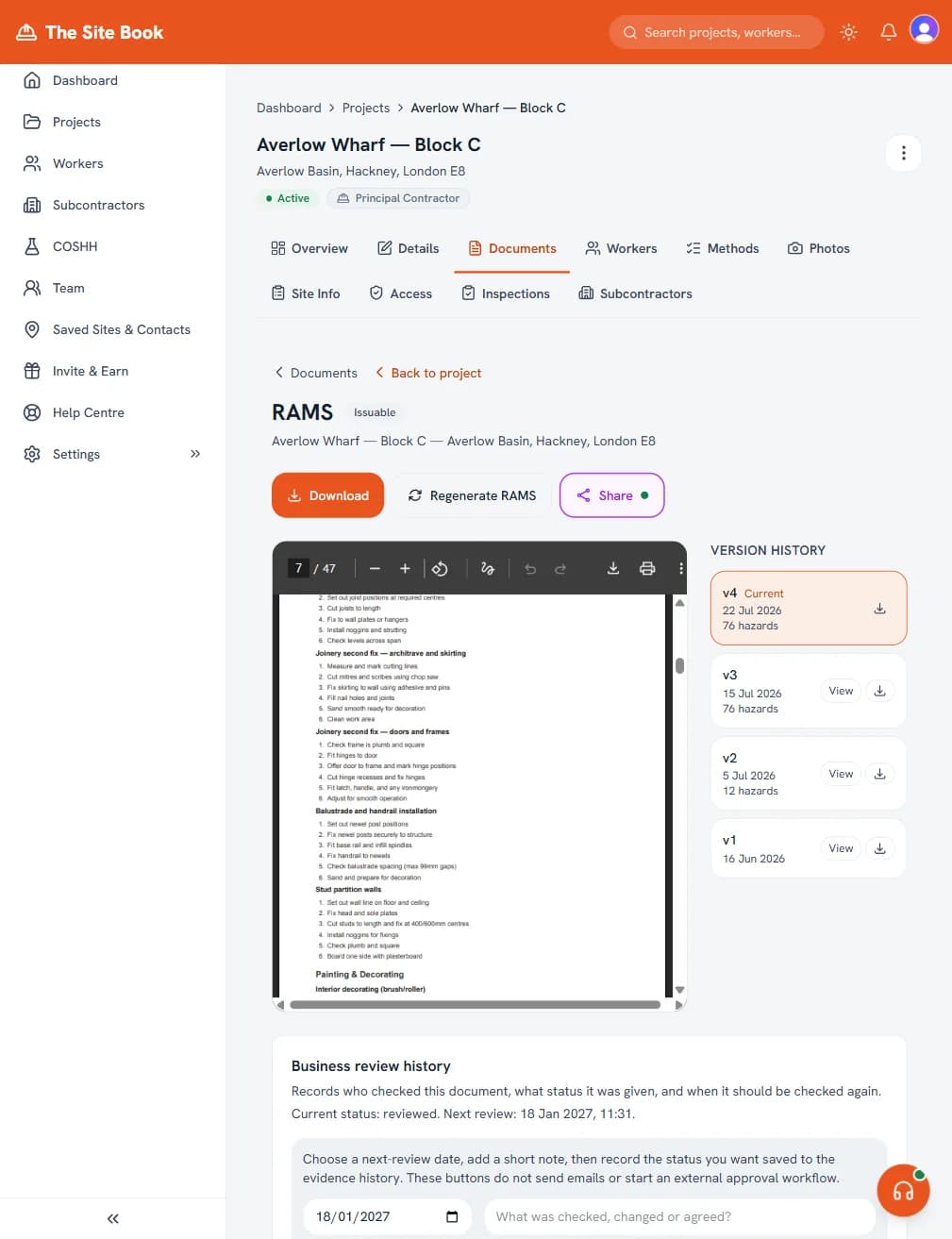
The method statement is the practical half of your RAMS. Where the risk assessment identifies hazards and sets out controls, the method statement describes the step-by-step sequence of operations for carrying out the work safely. It is your plan of action.

Start with the preparatory work: site set-up, welfare arrangements, deliveries, storage areas, access routes. Then describe each phase of the main activity in the order it will happen. At each step, include the relevant safety measures from your risk assessment. Finish with clean-up, waste disposal, and site demobilisation.

Each step should be written clearly enough that someone unfamiliar with the job could follow it. For example: “Step 3: Excavate foundation trenches to a depth of 900mm using a 1.5-tonne mini digger. Spoil to be stockpiled in the designated area at the front of the property, minimum 2m from the trench edge. All operatives to remain outside the swing radius of the excavator arm during digging operations. Trench supports to be installed as excavation progresses where depth exceeds 1.2m.”

Do not forget to include: the plant and equipment for each step, any permits required (hot work, confined space entry, permit to dig), the PPE needed at each stage, and the emergency procedures. The method statement should be a standalone guide to doing the work safely — someone should be able to pick it up, read it, and understand exactly what needs to happen.

How specific does a RAMS need to be?

Very specific. This is the single biggest area where builders get it wrong. A RAMS that could apply to any site in the country is not meeting the legal standard. It needs to describe your site, your work, and your conditions.

Your RAMS should name the site address. It should describe the access arrangements specific to that site — the narrow side gate, the shared driveway, the school next door. It should mention the overhead power line at the rear of the property, the live gas main running under the front garden, the asbestos survey results showing textured coating in the hallway. These are the details that make a RAMS site-specific and therefore useful.

Here is a quick test: if you could swap the site address for a different property and the document would still read exactly the same, it is too generic. A good RAMS reads like a description of a specific job on a specific site, not a textbook chapter on construction safety.

That said, there is a balance. You do not need to describe every individual nail being hammered. The level of detail should be proportionate to the level of risk. High-risk activities like excavation near services, structural demolition, or working at height need more detail. Lower-risk activities like internal decoration can be covered more briefly. The HSE’s own guidance makes this point: risk assessment should be proportionate to the level of risk.

How many hazards should you include?

There is no magic number, but as a rough guide: a RAMS for a straightforward domestic job (say, a kitchen refit) might identify eight to twelve significant hazards. A RAMS for a more complex project (a two-storey extension with groundworks, steelwork, and roofing) might have fifteen to twenty-five. The key word is “significant” — you do not need to list every trivial risk, but you must cover everything that could realistically cause harm.

Common hazards that appear on almost every construction RAMS include: working at height, manual handling, slips/trips/falls, dust and silica exposure, noise, contact with live services (electric, gas, water), falling objects, use of power tools, vehicle movements, and fire. Depending on the job, you might also need to include: excavation collapse, structural instability, asbestos disturbance, confined space entry, lead paint, work near water, or exposure to cement burns.

A useful exercise is to walk through the job mentally, step by step, and ask yourself at each stage: “What could go wrong here? Who could be hurt? How?” This helps you identify hazards that a generic template would miss — the low doorway that delivery drivers keep hitting their heads on, the uneven patio that becomes slippery in wet weather, the client’s dog that escapes into the work area every time the gate is opened.

If in doubt, include the hazard. It is far better to have a slightly longer RAMS that covers everything than a shorter one that misses something important. The Site Book’s hazard library suggests hazards based on the type of work you describe, so you are less likely to miss something obvious.
What are the most common RAMS mistakes?

After reviewing thousands of RAMS from builders across the UK, these are the mistakes we see most often:

Too generic

The number one problem. The RAMS reads like a textbook rather than a site-specific document. It mentions ‘working at height’ as a hazard but does not say what height, where, or what specific access equipment will be used. It says ‘PPE will be worn’ but does not list which items. A principal contractor or HSE inspector will reject a generic RAMS immediately.

Wrong severity ratings

Reducing the severity score after applying controls is the most common scoring error. If a fall from a scaffold could be fatal before controls, it could still be fatal after controls — the scaffold might prevent the fall from happening (reducing likelihood), but it does not change the consequences if someone does fall. Only change severity if the control genuinely changes the outcome, such as lowering the working height.

Missing controls for identified hazards

Some RAMS list hazards but then fail to provide adequate controls. ‘Manual handling’ is listed as a hazard with the control ‘workers will be trained.’ That is an administrative control at the bottom of the hierarchy. Where is the mechanical lifting? The smaller loads? The team lifting for heavy items? Every hazard needs controls that work through the hierarchy.

No sequence of operations

The method statement section is either missing or consists of a single paragraph saying ‘the work will be carried out in accordance with best practice.’ A method statement must describe the step-by-step sequence — what happens first, what happens next, and how each step links to the safety controls. Without a sequence, the document is just a risk assessment, not a RAMS.

Never updated

A RAMS written on day one that is never revised is a red flag. Site conditions change, new hazards appear, the scope of work evolves. If your RAMS does not match what is actually happening on site, it is not meeting its purpose. Review the document at least weekly, and update it immediately if anything significant changes.

Worked example: RAMS for a single-storey extension

Let’s walk through what a real RAMS might look like for a common domestic job: a single-storey rear extension in a suburban semi-detached house. The project involves demolishing the existing rear wall, excavating foundations, building new blockwork walls, installing a steel beam, and fitting a flat roof.

Sample risk assessment entries

Hazard: Excavation collapse

Who is at risk: Groundworker in trench. Uncontrolled risk: Likelihood 3 × Severity 5 = 15 (high). Controls: Trench support (hydraulic shores) installed as excavation progresses. Spoil stockpiled minimum 2m from trench edge. No operatives in unsupported trench exceeding 1.2m depth. Trench inspected at start of each shift and after heavy rain. Residual risk: Likelihood 1 × Severity 5 = 5 (low).

Hazard: Striking underground services

Who is at risk: All operatives. Uncontrolled risk: Likelihood 3 × Severity 4 = 12 (medium-high). Controls: Utility plans obtained from the client. CAT and Genny scan carried out before any excavation. Trial holes dug by hand within 500mm of any detected service. All operatives briefed on service locations. Residual risk: Likelihood 1 × Severity 4 = 4 (low).

Hazard: Manual handling of steel beam

Who is at risk: Operatives lifting beam. Uncontrolled risk: Likelihood 4 × Severity 3 = 12 (medium-high). Controls: Steel beam delivered as close to final position as possible. Mini crane or telehandler used for beams exceeding 50kg. Team lift with minimum four persons for lighter beams. Temporary propping installed immediately after placement. Residual risk: Likelihood 1 × Severity 3 = 3 (low).

Sample method statement extract

  1. Set up site: install temporary fencing to rear garden perimeter. Establish welfare facilities (portaloo, hand-washing station, drying room). Designate material storage and skip areas.
  2. Carry out CAT and Genny scan of excavation area. Mark all detected services with spray paint. Dig trial holes by hand within 500mm of any detected service.
  3. Excavate foundation trenches to 900mm depth using 1.5-tonne mini digger. Spoil stockpiled in front garden, minimum 2m from trench edge. Install hydraulic trench supports as depth exceeds 1.2m.
  4. Pour concrete foundations to structural engineer’s specification. Allow minimum 48 hours curing before loading.
  5. Build blockwork walls to DPC level. Install cavity trays and weep holes. Step-up brickwork to wall plate height using mobile scaffold tower (PASMA-trained operatives only).
  6. Install structural steel beam using telehandler. Temporary Acrow props installed immediately. Props to remain in place until beam is fully built in and mortar has cured for minimum 7 days.
  7. Construct flat roof: install joists, decking, vapour barrier, insulation, and single-ply membrane. Edge protection (scaffold) to remain in place throughout roofing works.
  8. Remove temporary propping, scaffold, and site fencing. Clear site of all waste. Final clean.

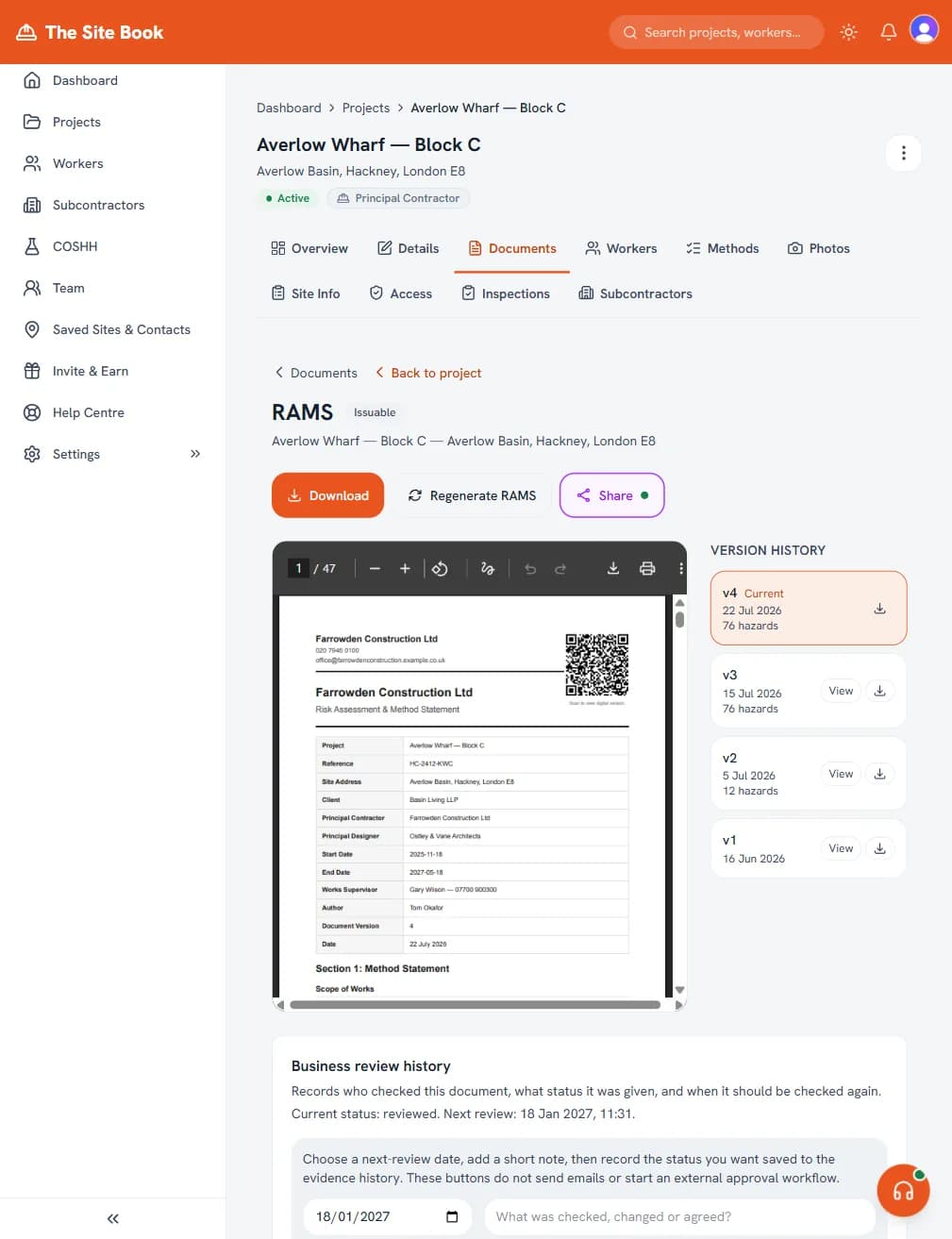
This is a condensed example — a real RAMS would include more detail on PPE, emergency procedures, personnel, permits, and additional hazards. But it shows the level of site-specific detail you should be aiming for. The Site Book creates this kind of tailored content automatically from your project description.

How do you review and brief a RAMS?

Writing the RAMS is only half the job. The other half is making sure the people doing the work actually know what is in it. A RAMS that sits unread in an email inbox or a filing cabinet is protecting nobody.

Before work starts, hold a site induction and brief your team on the RAMS. Walk through the key hazards, the control measures, and the method of work. Confirm that everyone understands their responsibilities. Record that the briefing took place — get each person to sign the RAMS or a separate briefing record. This is critical evidence if the HSE ever investigates.

Review the RAMS at least weekly, and immediately after any of the following: a near miss or incident, a change in scope of work, new trades arriving on site, adverse weather conditions (heavy rain affecting excavation stability, high winds affecting lifting operations), or discovery of an unexpected hazard (unmarked services, suspected asbestos). If you update the RAMS, re-brief the relevant team members on the changes.

On sites with a principal contractor, your RAMS will typically be reviewed and approved before you are allowed to start work. Principal contractors often have their own review criteria and may ask you to amend the document before approving it. Do not treat this as a nuisance — it is an opportunity to improve the quality of your planning and catch things you might have missed.

Create professional RAMS in minutes

Stop spending hours writing RAMS by hand. The Site Book creates site-specific risk assessments and method statements from your job description.

See how it works →

Frequently asked questions

Common questions builders ask about writing RAMS.

How long should a RAMS be?

There is no fixed length requirement. A RAMS for a straightforward task like fitting a new door might be three to four pages. A RAMS for a complex demolition or structural alteration could run to fifteen or twenty pages. The legal standard is ‘suitable and sufficient’ — it must cover the work adequately without being so padded with generic waffle that nobody reads it. Focus on being specific and relevant rather than hitting a page count. If a competent person who has never visited your site could read the document and understand exactly what work is being done, what hazards exist, and what controls are in place, it is long enough.

Can I use one RAMS for an entire project?

It depends on the scope. For a small job where one team carries out all the work — say, a loft conversion with a single subcontractor — a single comprehensive RAMS covering every phase may be perfectly adequate. For larger projects with multiple trades, different risk profiles, and different teams, you are better off producing separate RAMS for each significant activity: groundworks, steelwork, roofing, electrical, plumbing, and so on. The test is whether the document can clearly and comprehensively cover the work without becoming so long or complex that people stop reading it. Principal contractors often prefer task-specific RAMS because they can be briefed to the relevant team and reviewed independently.

Who is responsible for writing the RAMS?

Under CDM 2015, every contractor has a duty to plan, manage, and monitor construction work so it is carried out without risks to health and safety. In practice, this means the contractor carrying out the work is responsible for producing the RAMS. On a site with a principal contractor, each subcontractor submits their own RAMS for their scope of work, and the principal contractor reviews and approves them before work begins. For a sole trader working on domestic projects, you are both the contractor and the person writing the RAMS. You can use tools like The Site Book to help create the document, but the responsibility for its accuracy and completeness remains with you.

Do I need a RAMS for every job?

Strictly speaking, UK law does not use the word ‘RAMS’ — but it does require you to assess risks and plan safe systems of work for all construction activities. For very low-risk work like painting an interior wall in a domestic property, a formal written RAMS may not be strictly necessary, though many builders produce one anyway for professionalism and liability reasons. For anything involving significant risk — working at height, excavation, structural alteration, demolition, hot works, confined spaces, or work near live services — a written RAMS is essential. If you are working on a site with a principal contractor, you will almost always be required to submit a RAMS before being allowed to start.

What is the difference between a risk assessment and a method statement?

A risk assessment identifies the hazards, evaluates how likely someone is to be harmed and how severe that harm could be, and sets out control measures to reduce the risk. It answers: ‘What could go wrong, and how do we prevent it?’ A method statement takes those control measures and weaves them into a step-by-step description of how the work will be done safely. It answers: ‘Here is exactly how we are going to do this work.’ Together they form a RAMS. The risk assessment is the analysis; the method statement is the action plan. You cannot write a sensible method statement without first completing the risk assessment, because the controls in the risk assessment dictate how the work is carried out.

Can AI write my RAMS for me?

AI can help you write a RAMS, but it cannot replace your site-specific knowledge. A generic AI chatbot will produce a generic document that does not know about the overhead power line behind your site, the shared access road, or the fact that your client’s elderly neighbour uses the adjacent footpath. The Site Book takes a different approach: it asks you to describe your job, your site, and your conditions, then creates a RAMS tailored to your project. It suggests hazards you might not have considered, recommends control measures, and structures the document professionally. But you review and approve everything before creating. This gives you speed and consistency combined with your professional judgement and site-specific knowledge.

How The Site Book helps

  • • Creates site-specific RAMS from your job description — no more staring at a blank template
  • • Quality checking flags vague wording, missing controls, and severity scoring errors before you create
  • • Built-in hazard library with pre-built controls for common construction activities, so you never miss the obvious ones
Start free — first project on us →

Get a free RAMS writing checklist

No spam. Just the free resource. Unsubscribe any time.

Stop wrestling with blank templates.

Describe your job in plain English. The Site Book creates a site-specific RAMS — complete with risk assessment, method statement, and all the detail you need. Free trial — no credit card required.