RAMS & CPP for New Build Projects
Multiple trades, longer timelines, and likely notifiable. Here's what you need to know.
Written by Nicola Dobbie, Founder, The Site BookLast reviewed
TL;DR
- CPP: Required — CDM 2015 applies to every construction project.
- RAMS: Essential — each trade needs its own RAMS; the principal contractor reviews and coordinates them across the project.
- Key hazards: Most new builds are F10-notifiable to HSE, principal contractor coordination between multiple trades, and phase-specific risks (excavation, steel erection, falls from height).
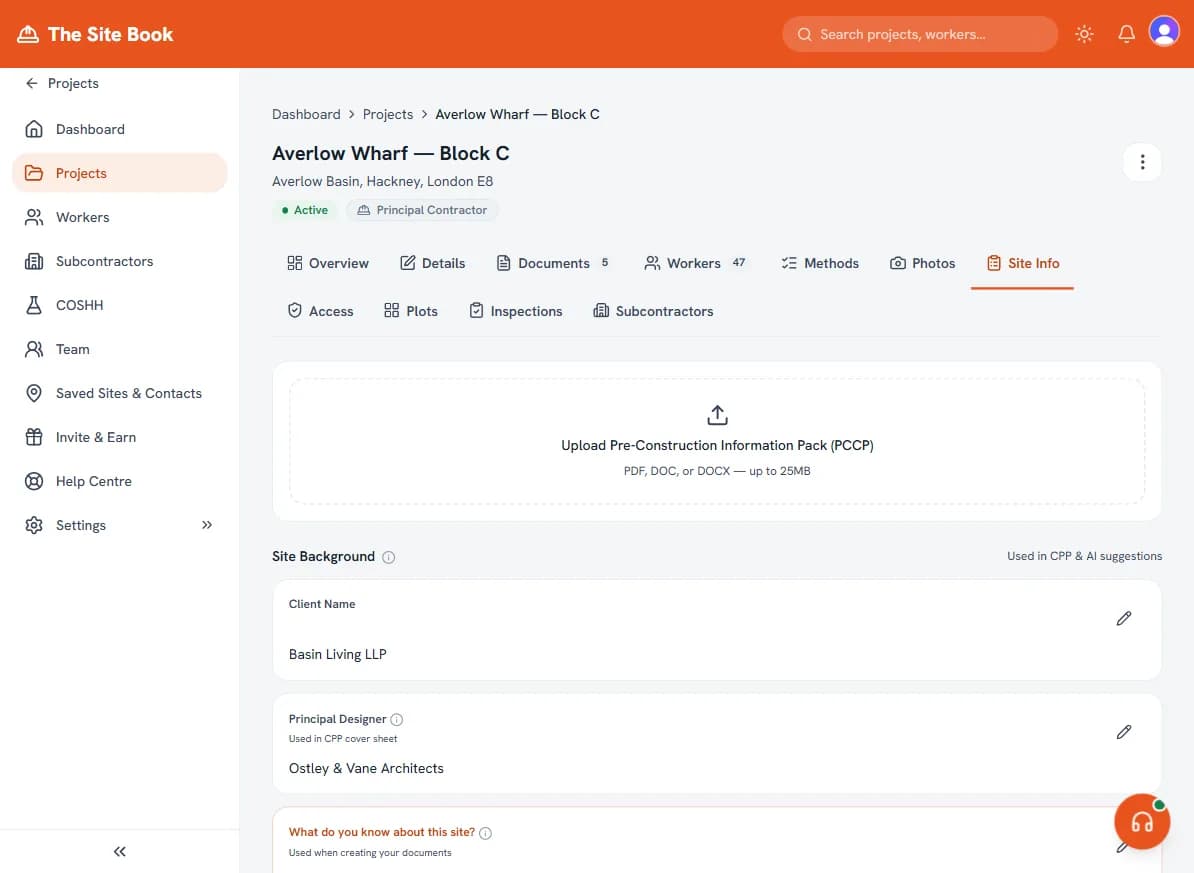
Multiple trades, more complexity
New builds are among the most complex construction projects. With multiple trades working on site — groundworkers, bricklayers, roofers, electricians, plumbers, plasterers — coordination and documentation become critical. Each trade brings its own hazards, and the interactions between them create additional risks.
Likely notifiable
Most new builds exceed the CDM 2015 notification thresholds (longer than 30 working days with more than 20 workers on site at any one time, or over 500 person-days). If your project is notifiable, an F10 must reach the HSE before work begins — on a commercial project that regulation 6 duty stays with the client, and on a domestic project it passes to you where you are the only contractor, or to the principal contractor where there is more than one. Appointing a principal designer and a principal contractor is a separate requirement: under regulation 5(1) it applies wherever there is more than one contractor, notifiable or not.
Principal contractor duties
The principal contractor is responsible for planning, managing, and coordinating the construction phase. This includes preparing and maintaining the Construction Phase Plan on a project with more than one contractor, ensuring all workers receive appropriate site inductions, managing health and safety risks, and coordinating between different contractors on site.
Subcontractor management
Each subcontractor should provide their own RAMS for their specific work activities. The principal contractor must review these, ensure they're adequate, and manage the overall coordination. The Site Book makes it easy to create and manage RAMS for each trade working on your project.
Multiple phases, multiple hazards
A new build moves through distinct phases, each with its own risk profile. The groundworks and foundations phase involves deep excavation, heavy plant, and potential contact with contaminated ground. The structural phase brings working at height, steel erection, and crane operations. The roofing phase adds falls from height and weather exposure. First fix trades work in partially completed structures with trip hazards, temporary lighting, and incomplete stairways. Second fix involves working near live services. External works bring plant movements near completed structures. Your CPP should map out these phases and identify the key hazards at each stage, with appropriate RAMS for every phase.
F10 notification for new builds
Most new builds are notifiable under CDM 2015. The thresholds — more than 30 working days with more than 20 workers on site at any one time, or exceeding 500 person-days — are easily reached on a new build. A single house with 10 workers over 16 weeks (80 working days) comes to 800 person-days. A housing development is almost certainly notifiable from day one. The F10 must be submitted to the HSE before the construction phase begins. It can be submitted online via the HSE website. The F10 must also be displayed on site in a location visible to workers. If the project details change significantly (for example, the principal contractor changes, or the duration extends significantly), the F10 should be updated.
Subcontractor RAMS coordination
On a new build, you might have a dozen or more subcontractors, each providing their own RAMS. The principal contractor's job is not just to collect these documents but to actively review them. Do the RAMS address the specific conditions on your site? Do they account for other trades working alongside? Are the control measures practical and actually being followed? Common issues include subcontractors providing generic RAMS that don't reference your site, conflicting methods of work between trades (for example, two contractors planning to use the same access route for different purposes), and RAMS that haven't been updated since the last project. The Site Book helps by creating a central register of all RAMS on the project, flagging which trades have submitted theirs and which are outstanding.
Principal contractor duties on a new build
If there's more than one contractor on site — and on a new build, there always is — the client must appoint a principal contractor. Where there is more than one contractor, the PC's duties are extensive: preparing and maintaining the Construction Phase Plan, ensuring all contractors comply with site rules, managing and coordinating health and safety across all phases, providing site inductions, ensuring welfare facilities are adequate (toilets, washing, rest area, drinking water, drying room), liaising with the principal designer, and managing the flow of health and safety information between all parties. The F10 sits outside that list: on a notifiable commercial new build the client must give the notice and ensure an up-to-date copy is displayed in the site office, and the PC may display it on the client's behalf while the client remains responsible; on a notifiable domestic new build with more than one contractor, regulation 7(1) passes those F10 duties to the PC by default, or, where there is more than one contractor, to a principal designer where there is a written agreement to that effect. It's a significant responsibility, and getting it right requires good documentation and systems — not just good intentions.
CDM duties on a new build
New builds are where CDM 2015 applies in its fullest form. Almost every new build will have more than one contractor, which triggers the requirement for a principal contractor (PC) and principal designer (PD) to be appointed by the client. The client themselves has significant duties: they must make suitable arrangements for managing the project, allocate sufficient time and resources, ensure the PC and PD are competent, and provide pre-construction information. The PD is responsible for planning, managing, and coordinating health and safety during the pre-construction phase — this includes preparing or contributing to the health and safety file. Where there is more than one contractor, the PC takes over during the construction phase, responsible for the Construction Phase Plan, site inductions, coordination between contractors, welfare facilities, and ensuring all work is carried out safely. On commercial new builds, these appointments are usually formal and documented. On smaller domestic new builds (a self-build, for example), the duties still apply but regulation 7(1) passes the domestic client's duties automatically to the contractor where there is only one contractor, to the principal contractor where there is more than one contractor, or, where there is more than one contractor, to the principal designer under a written agreement that the principal designer will fulfil them. Understanding who holds which CDM role — and documenting it clearly in the CPP — is essential on any new build.
F10 notification for new builds
The F10 notification process is straightforward but important. The F10 must be submitted to the HSE before the construction phase begins. It can be submitted online through the HSE website. The form requires: the address of the construction site, the name and address of the client, the name and address of the principal designer, the name and address of the principal contractor, the date construction is expected to start, the planned duration of the construction phase, the estimated maximum number of people at work on the construction site at any one time, the planned number of contractors on the construction site, and the name and address of any contractor already appointed. Once submitted, a copy of the F10 must be displayed on site in a location visible to workers — typically on the site notice board alongside the employer's liability insurance certificate, the health and safety law poster, and the first aid arrangements notice. If any of the notified details change significantly during the project, the F10 should be updated. This includes changes to the PC or PD, significant changes to the project duration, or major changes to the scope of work.
Phased construction — risks at each stage
A new build progresses through distinct construction phases, each with its own hazard profile. Understanding these phases helps you create RAMS that are specific to each stage rather than generic for the whole project. Site preparation and demolition: existing structures, contaminated ground, asbestos in any buildings being demolished, heavy plant movements, dust and noise. Groundworks and foundations: deep excavation (trench collapse is one of the most serious risks — a cubic metre of soil weighs 1.5 tonnes), underground services, dewatering, piling if required (noise, vibration, crane operations). Substructure (below DPC): working in and around excavations, concrete pours, damp proofing, drainage installation. Superstructure (walls, floors, roof): working at height becomes the dominant risk, scaffold erection and use, structural steelwork, crane operations for trusses and heavy components, weather exposure. First fix (electrics, plumbing, joinery): working in partially completed structures with trip hazards, temporary lighting, cutting and drilling (dust, noise), working near live services. Second fix and finishing: less high-risk but still hazards from working at height on internal stairs and landings, chemical exposure from paints, adhesives, and sealants, and the increasing presence of other trades in confined spaces. External works: plant movements near completed structures, excavation for drainage and landscaping, manual handling. Your CPP should map out these phases with a timeline and identify the key hazards at each stage.
The health and safety file
The health and safety file is a CDM 2015 requirement that is often overlooked or poorly understood. It's a record of information that will be needed for future construction work on the building — maintenance, renovation, or demolition. The principal designer is responsible for preparing the file, but in practice, contributions come from the PC and all contractors. On a new build, the file should contain: as-built drawings showing the structure, foundations, drainage, and services; details of any hazardous materials used or left in place (asbestos, lead, contaminated ground); information about the structural design that will be relevant to future alterations; details of concealed services (buried cables, hidden pipes); maintenance schedules for key building elements (roof, external cladding, mechanical systems); and any other information needed to ensure health and safety during future work on the building. The file must be handed to the client at the end of the project. On a domestic new build, this means giving the homeowner a file that they can pass to any future contractor. The file should be in a format that a non-technical person can understand and use. This is not just a CDM box-ticking exercise — a good health and safety file can prevent serious incidents when someone comes to work on the building in 10, 20, or 50 years' time.
Welfare facilities on new build sites
Welfare facilities are a legal requirement under the Construction (Design and Management) Regulations 2015 and the Workplace (Health, Safety and Welfare) Regulations 1992. On a new build, where there's no existing building to use, the PC must provide: toilets (at least one per 7 workers for men, or per 4 workers for women), washing facilities with hot and cold running water, soap, and towels or hand dryers, a heated rest area with seating, tables, and facilities for preparing hot drinks, a supply of drinking water clearly marked as such, somewhere to store and dry clothing (especially important in winter and wet weather), and changing facilities if workers need to change into work clothing. These facilities must be in place from day one of the construction phase — not "when we get round to it." On small domestic new builds, a site welfare unit (portable cabin with toilet, sink, and rest area) is typically the minimum. On larger sites, more extensive facilities will be needed. The condition and cleanliness of welfare facilities must be maintained throughout the project. Your CPP should specify what welfare facilities will be provided, where they'll be located, and who is responsible for maintaining them.
Frequently asked questions
- Do I need a principal contractor for a new build?
- If there is more than one contractor on the project, the client must appoint a principal contractor under CDM 2015. The principal contractor is responsible for planning, managing, and coordinating the construction phase, including ensuring all contractors comply with health and safety requirements.
- How many RAMS do I need for a new build?
- Each trade or significant activity should have its own RAMS. A typical new build might need RAMS for groundworks, concrete and foundations, structural framing, roofing, electrical, plumbing, plastering, and more. The Site Book can create RAMS for each phase of your project.
- Is a new build always notifiable?
- Not always, but most new builds are. A project is notifiable to the HSE if it will last longer than 30 working days with more than 20 workers at any one time, or exceeds 500 person-days of construction work. Most new builds exceed these thresholds. When notifiable, an F10 form must be submitted to the HSE before work begins.
- What are the phases of a new build and what RAMS are needed for each?
- A typical new build goes through: site preparation and demolition, groundworks and foundations, substructure (below DPC), superstructure (walls, floors, roof), first fix (electrics, plumbing, joinery), plastering and screeding, second fix, decoration and finishing, external works and landscaping. Each phase needs its own RAMS addressing the specific hazards of that stage.
- What are the principal contractor's duties on a new build?
- Where there is more than one contractor, the PC must prepare and maintain the CPP, coordinate health and safety between all contractors, ensure all workers receive site inductions, manage and monitor H&S on site, liaise with the principal designer, ensure welfare facilities are adequate, and ensure a site-specific fire plan is in place. The F10 is a separate matter: on a notifiable commercial new build the client must give the notice and ensure an up-to-date copy is displayed in the site office, and the PC may display it on the client's behalf while the client remains responsible; on a notifiable domestic new build with more than one contractor, regulation 7(1) passes those F10 duties to the PC by default, or, where there is more than one contractor, to a principal designer where there is a written agreement to that effect.
- How do I coordinate subcontractor RAMS on a new build?
- Each subcontractor should provide RAMS for their scope of work before they start on site. The PC must review these for adequacy, check they don't conflict with other work happening on site, and ensure subcontractors have received a site induction covering the CPP and site rules. The Site Book makes it easy to manage multiple sets of RAMS and track which trades have submitted theirs.
- What F10 information is needed for a new build?
- The F10 requires: site address, client details, principal designer details, principal contractor details, planned start date, planned duration, estimated maximum number of workers, and a brief description of the work. For a new build, you should also include the number of dwellings if it's a housing development.
- Who is responsible for the health and safety file on a new build?
- The principal designer is responsible for preparing, reviewing, updating, and revising the health and safety file throughout the project. However, the PC and all contractors must provide relevant information. The file must be handed to the client at the end of the project. On a domestic new build with more than one contractor, if the client never appoints a principal designer, regulation 7(2)(a) treats the designer in control of the pre-construction phase as principal designer, and that designer prepares and keeps the file under regulations 12(5) and 12(6). Regulation 12(10) governs only the handover at the end: the principal designer passes the file to the client, or the principal contractor does where there is no principal designer. The file should contain as-built drawings, structural information, details of hazardous materials, concealed services, and maintenance schedules — anything a future contractor would need to work safely on the building.
- What site induction is required on a new build?
- Every worker must receive a site-specific induction before starting work. This is the principal contractor's responsibility. The induction should cover: the site layout and welfare facilities, emergency procedures (fire, first aid, evacuation), site rules (PPE requirements, working hours, access restrictions), the key hazards on site and how they're being controlled, reporting procedures for accidents and near-misses, and any specific risks relevant to the worker's trade. The induction should be recorded and the records kept on site. New hazards or changes to site arrangements should be communicated through toolbox talks or updated briefings.
- How do I manage deliveries and plant on a new build site?
- Material deliveries and plant movements are a significant source of risk on new builds — particularly struck-by incidents involving vehicles and pedestrians. Your CPP should include a site traffic management plan showing: vehicle access and egress points, designated delivery and unloading areas, pedestrian routes separated from vehicle movements, banksman arrangements for reversing vehicles, and storage areas for materials. Plant operators must be competent and hold the appropriate CPCS or NPORS certification. Exclusion zones around operating plant (excavators, cranes, telehandlers) must be clearly marked and enforced.
What's included at each tier
Starter
£0- Risk Assessments (RAMS)
- Construction Phase Plans (CPP)
- Site inductions
- Worker document signing (no per-signature charge)
Pro
£39/mo or £360/yr- Risk Assessments (RAMS)
- Construction Phase Plans (CPP)
- Site inductions
- COSHH assessments (standalone doc, SDS upload, site-specific register)
- Worker cert tracking and expiry alerts
- Right-to-work evidence records
- Subcontractor tracking
- Toolbox talks
- Worker document signing (no per-signature charge)
- Integrations (Drive, Xero, Zapier)
Business
£199/mo- Risk Assessments (RAMS)
- Construction Phase Plans (CPP)
- Site inductions
- COSHH assessments (standalone doc, SDS upload, site-specific register)
- Worker cert tracking and expiry alerts
- Right-to-work evidence records
- Subcontractor tracking
- Toolbox talks
- Worker document signing (no per-signature charge)
- Integrations (Drive, Xero, Zapier)
- Up to 10 internal team logins
- Site Supervisor: a field-only login for whoever runs the site
- Up to 50 active site portal users
- Site attendance check-in/check-out
- Multilingual worker inductions (9 languages)
- Optional 4-digit PIN for shared-link document sign-off
- Plant & equipment register with project assignment, certificates, inspections and defects
- Slack Site Ready readiness checks
Site Control
£675/site/mo- Risk Assessments (RAMS)
- Construction Phase Plans (CPP)
- Site inductions
- COSHH assessments (standalone doc, SDS upload, site-specific register)
- Worker cert tracking and expiry alerts
- Right-to-work evidence records
- Subcontractor tracking
- Toolbox talks
- Worker document signing (no per-signature charge)
- Integrations (Drive, Xero, Zapier)
- Up to 10 internal team logins
- Site Supervisor: a field-only login for whoever runs the site
- Up to 50 active site portal users
- Site attendance check-in/check-out
- Multilingual worker inductions (9 languages)
- Optional 4-digit PIN for shared-link document sign-off
- Plant & equipment register with project assignment, certificates, inspections and defects
- Slack Site Ready readiness checks
- Permanent entrance QR: guest sign-in and contractor self-join
- CSCS credential capture, review and expiry alerts
- Digital induction gating before check-in
- Live people-on-site, attendance and audit-grade exports
- Single sign-on (SSO) with Okta or Microsoft Entra
- Public REST API with scoped account keys
- Signed real-time webhooks into your own systems
Running live sites with subcontractors? Site Control is the per-site enterprise tier above Business — entrance QR sign-in, CSCS checks, induction gating, live attendance and audit-grade exports. From £675/site per month, plus £5,000 setup.
Site Control
Per-site contractor access and CDM compliance for principal contractors running live sites.
From £675/site per month, plus £5,000 setup
- Per active site, with unlimited workers
- Permanent entrance QR: guest sign-in and contractor self-join
- CSCS credential capture, review and expiry alerts
- Digital induction gating before check-in
- Live people-on-site, attendance and audit-grade exports
- RFIs and version-specific document-review evidence
Where it helps and where it doesn't
Pros
- Full CDM 2015 pack — PCI, CPP, F10, site-wide traffic plan
- Principal-contractor duty checklist baked into the wizard
- Phased handover planning supported in the site diary
- Multi-trade worker tracker across the whole project
Cons
- No SAP / EPC calculation generation (separate assessor still needed)
- No BIM / 3D-model integration for clash detection
- Weekly progress snapshots for clients must be compiled manually
Why The Site Book
- UK construction compliance tool that ships RAMS + CPP + COSHH + inductions (readable and acknowledgeable in 9 worker languages on Business, with the language audit-recorded) + worker sign-off, including optional 4-digit shared-link PIN evidence on Business, plus site attendance, portal users, site files, document reviews, subcontractor evidence and inspections/actions.
- Generate a site-specific RAMS first draft from a natural-language brief, ready for competent-person review - not a template library you hand-fill.
- Controlled document workflow without an enterprise contract: version history and a recorded issue confirmation before a document is shared with a client or downloaded in the app on every plan, re-sign on revision with superseded signatures preserved plus PCPP import, cert tracking and document checking from the £39/month Pro plan - and on Business, optional named-approver routing (a designated approver accepts or rejects each version, with recorded reasons, before it can be issued) plus client approve/reject/request-changes via share links.
- Transparent pricing: Starter £0, Pro £39/month or £360/year, Business £199/month with 10 management logins and 50 active site portal users. Worker document signing has no per-signature charge; project workers count as active portal users while assigned.
- Build RAMS for any trade - add your own work types and method statements alongside the built-in library, reusable across projects, including a ready-made Commercial Solar PV group. Save a finished job as a reusable project template, or clone it, so the next job of the same shape starts from your own setup.
- COSHH goes deep: a standalone COSHH assessment document, upload-a-Safety-Data-Sheet extraction, a site-specific substance register and an expert-reviewed library - plus per-worker RAMS sign-off and a one-click Audit Pack covering documents, sign-offs, worker evidence, attendance, incidents, COSHH, permits and up to the latest 500 live Site Diary entries.
Get your new build docs sorted
Create RAMS for every trade on your project. No credit card required.