Do You Need a Banksman When Reversing on Site?
Is a banksman a legal must when reversing on site? What CDM 2015 actually requires, how to plan reversing out, and when a trained banksman is the right control.
7 min read

TL;DR
Is a banksman a legal must when reversing on site? What CDM 2015 actually requires, how to plan reversing out, and when a trained banksman is the right control.
Talk your crew through plant and reversing
Free mobile plant and vehicles toolbox talk for UK sites. Download the PDF or an editable Word file, with an attendance sign-off sheet. No sign-up.
Get the toolbox talk →No law says every reversing vehicle on a building site must have a banksman. CDM 2015 requires the site to be organised so people and vehicles can move safely, so you plan reversing out first, keep people away from it, and use a trained banksman when a driver still has to reverse without a clear view.
This post covers one decision: whether you need a banksman when a dumper, telehandler, excavator or lorry reverses on a small site. For the wider picture on plant and vehicles, and a talk to give your crew, see our mobile plant and vehicles toolbox talk.
This post covers Great Britain, where the Construction (Design and Management) Regulations 2015 (CDM 2015) apply. Northern Ireland has its own CDM regulations, made in 2016.
In August 2026 HSE reported the sentencing of a telehandler driver after a lift supervisor was struck and reversed over on a large construction site in Ellesmere Port, Cheshire, while walking back to his work area from the welfare compound. He died. HSE found the principal contractor had taken steps to minimise the need for reversing, including a turning circle that was clear at the time. The driver, a qualified and experienced telehandler operator, chose to reverse without a banksman, and had been using his mobile phone while in control of the telehandler, against site rules he had signed up to. He pleaded guilty to breaching section 3(2) of the Health and Safety at Work etc. Act 1974 and was given 12 weeks' imprisonment suspended for 12 months, an £800 fine and £2,000 costs.
The site had planned for this; the site rules weren't followed. Two other prosecutions HSE reported in 2026: in June 2026 a landscaping and civil engineering company near Wolverhampton was fined £125,000 after a visiting flatbed truck reversed into an employee walking across its site, where HSE found no clearly marked pedestrian routes. In July 2026 a groundworks company was fined £20,000 after a one-tonne dumper being reversed in Ince, near Wigan, went into an unprotected excavation and overturned. HSE says nearly a quarter of all deaths involving workplace transport happen during reversing.
When do you need a banksman for reversing on site?
Only when the steps before it can't remove the risk. HSE's workplace transport guide says banksmen should only be used when there is no other way to control reversing risks, and its construction advice says to use them for reversing vehicles only if they are trained and authorised. Work down this list for every vehicle:
- Can you stop it reversing? One-way routes, turning areas and drive-through loading are HSE's first answer.
- If it must reverse, can you keep people out? Plan and clearly mark a reversing area, and keep anyone who doesn't need to be there well clear.
- Can the driver see? Mirrors, cameras and sensors help. HSE says drivers who can't see behind should leave the cab and check before reversing.
- People still about, or a blind spot you can't fix? Use a trained, authorised banksman with agreed signals.
Does it change for dumpers, telehandlers, excavators and lorries?
The order stays the same; the blind spots change. HSE's construction vehicle guide, HSG144, singles out the points below. It dates from 2009 and HSE says it is under review, so use it for practical advice, not as a statement of the law:
- Dumpers: missing stop blocks at excavation and spoil heap edges are among the causes of dumper accidents it lists. Fit wheel stops and keep reversing away from open edges.
- Telehandlers: rear visibility may be a significant hazard, and with the boom raised there can be a blind spot to the front right. Both belong in your risk assessment.
- Excavators tracking back or slewing: barriers to keep people away, and a signaller in a safe position to direct the machine and any pedestrians.
- Tipper lorries: a competent signaller on hand to supervise tipping, and working reversing alarms and lights.
- Delivery lorries: site-specific delivery instructions when you order materials, so drivers know where to turn before they arrive.
How do you keep people away from reversing vehicles?
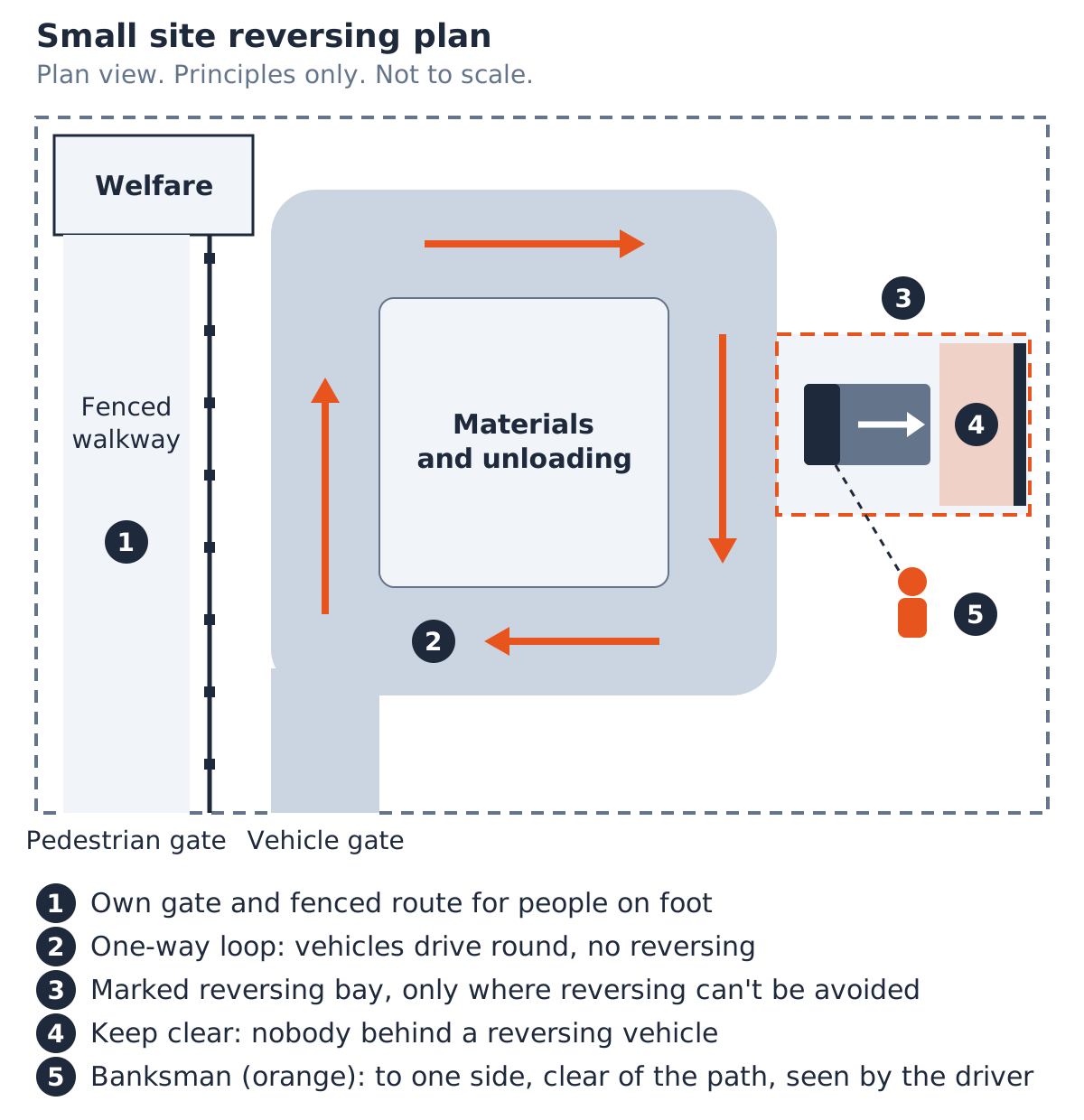
Separation beats supervision. HSG144 says pedestrian routes should be clearly separated from vehicle routes by fencing, a kerb or other suitable means. On a small site that usually means:
- a separate pedestrian gate, so nobody walks in through the vehicle gate
- a fenced walkway from the gate to the welfare cabin and the work area
- controlled crossing points where people cross a vehicle route, especially near welfare
- a marked reversing area with a stop block at the end, and nobody allowed behind the vehicle
Where should a banksman stand, and what must they never do?
From HSE's guidance, a banksman needs:
- Training and authority: they often stand close to a reversing vehicle, so they must be properly trained, competent and authorised by site management.
- A safe position to one side, where they can guide the vehicle without being in its way.
- Visibility both ways: seen by the driver at all times, in a high-visibility vest that marks them out, and able to see the driver.
- Agreed signals: HSE points to the standard hand signals in the Health and Safety (Safety Signs and Signals) Regulations 1996, agreed with the driver before any manoeuvre starts.
- A stop rule: if the driver loses sight of the banksman, the driver stops immediately.
A banksman must not:
- stand directly behind the reversing vehicle
- carry on when they and the driver can't see each other: HSG144's checklist says stop the vehicle moving
- ride on the vehicle they're directing, unless in a designated safe position
- direct vehicles when affected by alcohol or drugs
Our recommended site rule, not an HSE requirement: one banksman, one vehicle, and phones away for the banksman and the driver. HSG144 says drivers and signallers need to be in constant communication during reversing operations, and a phone call or a second vehicle breaks that.
Vehicle banksman or slinger signaller? Different jobs, and HSE uses the words loosely. Its construction FAQ describes banksmen as trained to direct vehicle movement on or around site, and signallers as trained to direct crane drivers during lifting operations. But HSG144 and HSE's reversing page call a vehicle banksman a "signaller", which is the sense used above. Check what a person was actually trained for, not their job title.
What the law says
No regulation in CDM 2015 uses the word "banksman". The duties sit in Part 4, which contractors must follow so far as it affects them or their workers or relates to matters within their control (regulation 16).
Regulation 27 (traffic routes) says a construction site must be organised so that, so far as is reasonably practicable, pedestrians and vehicles can move without risks to health or safety. There must be sufficient separation between vehicles and pedestrians, or, where that isn't reasonably practicable, other means of protecting pedestrians plus effective arrangements to warn anyone liable to be crushed or trapped by a vehicle of its approach.
Regulation 28 (vehicles) is the closest the law gets to a banksman. Where a person may be endangered by a moving vehicle, suitable and sufficient steps must be taken to warn anyone at risk, by the driver or operator, or, where someone is directing them because the driver doesn't have full visibility, by the person giving directions, or by both. It also requires measures to stop a vehicle falling into any excavation or pit.
So the law sets the outcome, not the method, and a banksman is one way to meet it. HSE says following its guidance isn't compulsory, but if you do you will normally be doing enough to comply with the law. And as the Cheshire case shows, a driver can be prosecuted personally.
One catch: if the principal contractor's site rules say every reverse needs a banksman, follow them. The construction phase plan must set out the site rules (regulation 12(2)). Where there is more than one contractor, each must comply with the principal contractor's directions and the parts of the plan relevant to their work (regulation 15(3)).
How to record your banksman and reversing plan in your RAMS and CPP
- Draw the site plan: vehicle gate, pedestrian gate, one-way route or turning area, fenced walkway, reversing area and banksman position.
- Put it with your site rules in the construction phase plan. Our free construction phase plan template lists site rules and safety procedures as a key section, and our construction phase plan example shows site rules for keeping a shared driveway clear and where vehicles park.
- For each vehicle that reverses, say in the method statement where and why, and what keeps people out.
- Name the banksman, their training and authorisation, the agreed signals and where they stand.
- Write the stop rules: driver stops if they lose sight of the banksman, banksman stops the vehicle if they lose sight of the driver, phones away, one banksman per vehicle.
Our free RAMS generator drafts a site-specific RAMS from your job description, and you review the hazards and controls because you know the site. See also RAMS for groundworks and excavation, the RAMS features for step-by-step method statements, and the construction phase plan generator, which drafts a CPP, including site rules, for your competent review.
The bottom line
The law doesn't require a banksman for every reverse, though your principal contractor's site rules may. A banksman can't fix a badly laid-out site. Plan reversing out, fence people away from vehicles and give drivers the aids to see. When a vehicle still has to reverse near people or into a blind spot, use a trained, authorised banksman to one side, in the driver's view, with agreed signals and one job only. Then make sure the plan is followed.
This article is general guidance, not legal advice or a guarantee of compliance.
Sources
Official pages this guide draws on; check them for the current wording:
- HSE press release, 18 August 2026: telehandler driver sentenced over death of colleague
- HSE press release, 23 June 2026: company fined after employee injured by reversing flat-bed truck
- HSE press release, 21 July 2026: groundworks company fined after dumper truck overturned
- CDM 2015, regulation 12 (Construction phase plan and health and safety file)
- CDM 2015, regulation 15 (Duties of contractors)
- CDM 2015, regulation 16 (Application of Part 4)
- CDM 2015, regulation 27 (Traffic routes)
- CDM 2015, regulation 28 (Vehicles)
- HSE, HSG144: The safe use of vehicles on construction sites
- HSE, HSG136: A guide to workplace transport safety
- HSE, Workplace transport: reversing
- HSE, Banksmen and signallers
- The Health and Safety (Safety Signs and Signals) Regulations 1996
- The Construction (Design and Management) Regulations (Northern Ireland) 2016
Talk your crew through plant and reversing
Free mobile plant and vehicles toolbox talk for UK sites. Download the PDF or an editable Word file, with an attendance sign-off sheet. No sign-up.
Get the toolbox talk →