Underground Service Colours: Which Cable or Pipe Is Which?
The UK colour codes for buried electricity, gas, water, telecoms, sewers and street lighting, and why you still locate, trial-hole and treat every service as live.
8 min read

TL;DR
The UK colour codes for buried electricity, gas, water, telecoms, sewers and street lighting, and why you still locate, trial-hole and treat every service as live.
Get a free permit to dig before you break ground
Download a blank permit to dig as a PDF or Word file, free with no sign-up. It includes an underground services checklist for plans, locating, marking and safe digging.
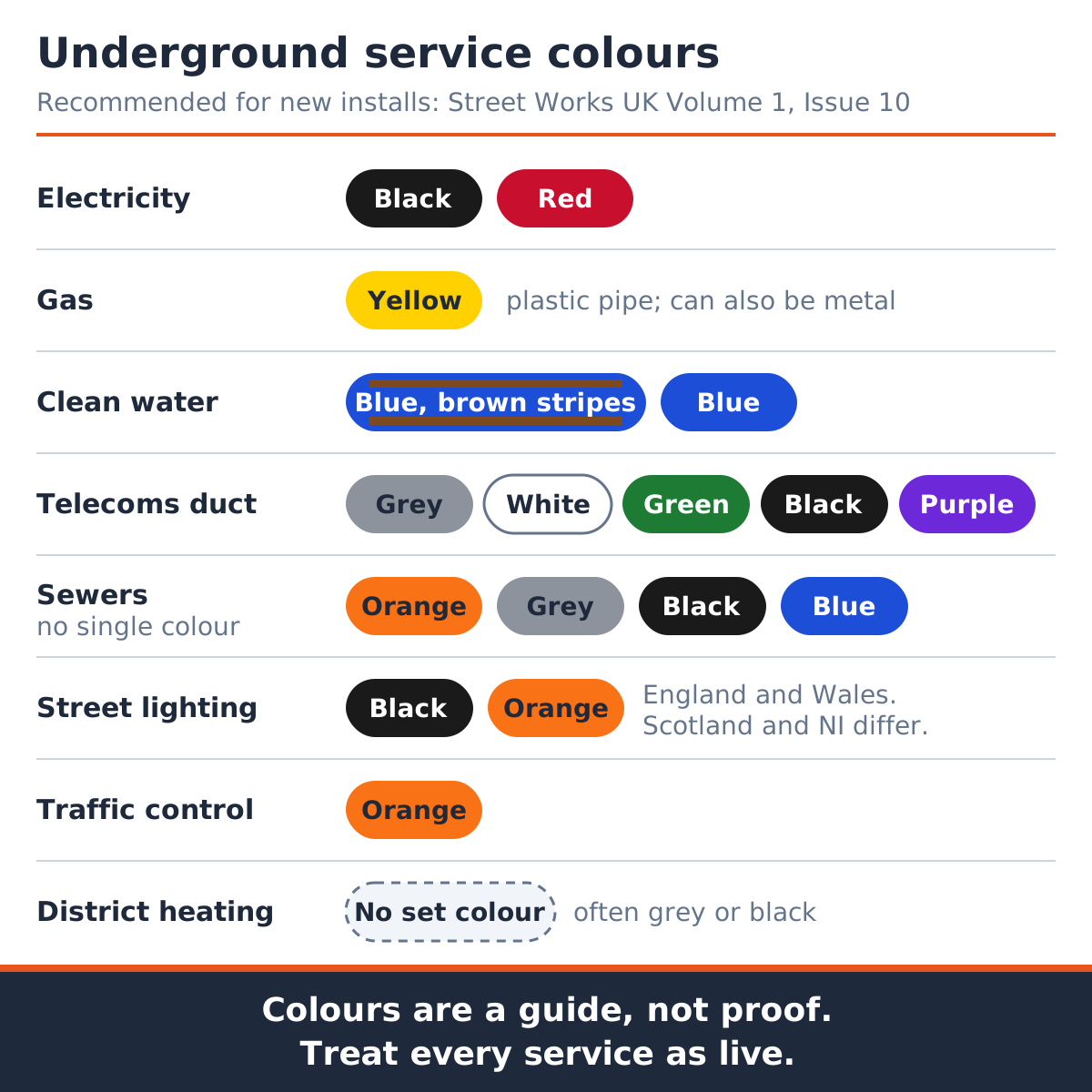
Get the permit to dig →UK underground service colours: electricity is black or red, gas is yellow, clean water is blue (or blue with brown stripes), telecoms ducts are grey, white, green, black or purple, and sewers have no single colour. These are recommendations for new installations, not proof, so locate every service with plans, a cable locator and hand-dug trial holes, and treat it as live.
This post covers one decision: whether you can trust the colour of a buried pipe or cable, and what to do instead. For the full process, including permits to dig, safe digging and support, see our excavation safety guide and its HSG47 section.
This post covers Great Britain, where the Construction (Design and Management) Regulations 2015 (CDM 2015) apply. Northern Ireland has its own CDM 2016 regulations.
In May 2026, a Liverpool fencing contractor was fined £10,000 and ordered to pay £5,487 costs after a worker struck a live underground cable. He was using a breaker to dig into the ground on a Manchester construction site, ready to put up security fencing, and suffered an electric shock and multiple burns. HSE found the firm had failed to put suitable and sufficient controls in place to prevent risk from underground services. It pleaded guilty to breaching regulation 25(4) of CDM 2015.
Colour only helps once a service is out in the open. By then, a breaker or bucket may already have hit it. Colour is the last check, not the first.
What are the underground service colours in the UK?
The UK colour code is published by Street Works UK, the trading name of NJUG (the National Joint Utilities Group), in its Volume 1 guidance on the positioning and colour coding of underground utilities' apparatus (Issue 10, 2023). It recommends these colours for all new installations. HSE's guidance HSG47 calls it the national colour coding system most utilities have agreed for modern installations.
| Service | Colour | Notes |
|---|---|---|
| Electricity (including EV charging) | Black or red cable, in a black or red duct | Low-voltage domestic services and street furniture: black cable |
| Gas | Yellow plastic pipe (medium and low pressure) | Intermediate-pressure plastic can be orange or yellow with brown stripes, or yellow or black with yellow stripes. Gas pipes can also be steel, iron, copper, lead, PVC or asbestos |
| Clean water | Blue, or blue with brown stripes (plastic pipe) | Mains can also be iron, steel, PVC, concrete, copper, lead or galvanised iron |
| Sewers | No single colour. Volume 1 lists orange, grey, black or blue | Those colours are in Volume 1's duct column. It lists the pipes by material only: clay, concrete, iron, plastic, pitch fibre or asbestos cement |
| Telecoms | Grey, white, green, black or purple duct | Copper and fibre cables can be buried with no duct, for example in rural grass verges |
| Street lighting | England and Wales: black cable, black or orange duct. Scotland: purple cable, purple duct. Northern Ireland: black or purple cable, orange duct | May belong to the highway or street lighting authority, so ask them for plans too |
| Traffic control (signals) | Orange cable, orange duct | All regions |
| Street furniture | Black cable, black duct | Highway authority telecoms: black cable, purple or orange duct |
| District heating | No specific colour | Commonly grey or black |
| Oil and fuel pipelines | Steel, no colour given | Welded steel pipes are often used for major accident hazard pipelines: take extra care |
This is our simplified summary of Street Works UK's Volume 1 (Issue 10, 2023), without its depths and distances. Older NJUG charts differ in places, so older services may follow them. Motorway and trunk road lighting and communications cables have their own combinations, so if you work near them, download the full guidance free from Street Works UK.
Two things stand out. The same colour turns up for different services: black for electricity, telecoms ducts, sewers, street lighting and street furniture; orange for sewers, street lighting ducts, traffic signals and some gas pipes. And Volume 1 says plainly that you should not assume all apparatus follows its recommendations.
Why can't you rely on the colour of a buried service?
A colour only shows what a pipe or duct was meant to carry, if it followed the code at all. HSE and Street Works UK give these reasons not to trust it:
- Old services. Many materials and colours have been used over the years, and old or non-utility services may not follow the code. An older duct can hold something its colour doesn't suggest.
- Ducts can hold anything. Electricity cables are sometimes placed in ducts that don't match the code.
- Private services. Utilities don't own everything underground, and private pipes and cables may have no easy-to-get records. On some building sites, electricity cables have been run in yellow service pipes or blue water pipes.
- Faded colour. Colours can look different under poor or artificial light, and aggressive soils can discolour pipes and ducts over time.
- Look-alikes. Water pipes, electricity cables and telecoms cables can all be covered in black plastic. Iron and steel water and gas pipes can look very similar.
- Marker tape. Tape or tiles may be missing, or not directly above the service. They warn you something is there; they don't prove what it is.
So HSG47 says: treat black plastic as a live electricity cable, treat iron or steel pipes as gas, and treat continuously welded steel pipes as carrying a hazardous or high-pressure fluid. If in doubt, treat it as an electricity cable or gas pipe until proved otherwise.
Can you rely on the depth of underground services?
No. Volume 1 recommends minimum depths for new apparatus, with the same warning that not all apparatus will conform. HSG47 says not to rely on plans for distances or depths, and that re-grading of the surface can make recorded depths wrong. For electricity cables, it says never assume depths: you may find them shallower. A cable is positively located only when it has been safely exposed.
How do you find out which service is which before you dig?
HSG47 sets out three elements of a safe system of work: planning the work, locating and identifying buried services, and safe excavation. On a small job, that means:
- Get the plans. Obtain plans or other suitable information about all underground services in the area while you plan the work, consulting the owners wherever possible. Plans alone are not enough, and missing records are never proof that an area is clear. Ask about street lighting, private supplies and anything the client owns.
- Locate and mark. A person trained in the equipment traces the services across the whole work area with a cable locator and signal generator, often called a CAT and genny on site. HSG47 says to use signal generators whenever possible, because they greatly increase accuracy. Most locators won't find plastic pipes without a tracer wire, rod or marker. A locator picking up a cable's own current can miss one carrying little or none, such as street lighting in the daytime, and two close cables can show as one. Mark the line with paint or chalk, or wooden pegs to one side on grass, never steel pins.
- Dig trial holes by hand. Use trial holes, dug with suitable hand tools or vacuum excavation, to positively identify each service and its depth. Dig alongside the service, not on top of it, and keep using the locator as cover comes off.
- Identify it, then treat it as live. Only now does colour help, alongside the plans and any owner's name stamped on the pipe or duct. Assume every service is live until disconnected and proven safe at the point of work.
- Stop if it doesn't add up. Don't keep digging around something you can't identify. In the highway, Volume 1 says contact the highway authority first. If a service on the plan can't be found, HSG47 says ask its owner.
What the law says
Regulation 25(4) of CDM 2015 says construction work that is liable to create a risk from an underground service, or from damaging or disturbing it, "must not be carried out unless suitable and sufficient steps" have been taken to prevent the risk, so far as is reasonably practicable. That is the regulation the fencing contractor pleaded guilty to breaching.
CDM 2015 doesn't mention colours. HSG47 is HSE's guidance on what suitable steps look like, and Volume 1 says it has no legal or statutory authority: it describes utility industry practice.
How to record service checks in your RAMS
Write the checks into your method statement before anyone breaks ground:
- Which plans you obtained, from which owners and when.
- Who will locate services, with what equipment, and how they will be marked.
- Where trial holes will go, dug by hand tools or vacuum excavation.
- That every service is live until its owner confirms otherwise, with black plastic treated as a live cable and iron or steel pipes as gas.
- What happens if something doesn't match the plans: stop, keep people clear, contact the owner.
- Emergency contacts for each service owner.
Our free RAMS generator gives you a structured first draft to review, and our RAMS features show what goes into a full document. For what to include, see RAMS for groundworkers. Where the site uses a permit to dig, our free permit to dig template includes an underground services checklist. Brief the crew with the working near services toolbox talk, and see our electrical safety guide for what to do if a cable is struck.
The bottom line
Learn the colours, but don't trust them: they are what the industry recommends for new work, not a promise about your trench. Get the plans, trace with a CAT and genny, prove each service with hand-dug trial holes, and treat every pipe and cable as live until its owner says otherwise.
This article is general guidance, not legal advice or a guarantee of compliance.
Sources
- HSE press release, 27 May 2026: Fencing contractor fined after employee suffers electric shock and burns
- Street Works UK, Volume 1: Guidance on the positioning and colour coding of underground utilities' apparatus (Issue 10, 2023)
- Street Works UK publications
- HSE, HSG47: Avoiding danger from underground services (third edition, 2014)
- CDM 2015, regulation 25 (Energy distribution installations)
- The Construction (Design and Management) Regulations (Northern Ireland) 2016
Get a free permit to dig before you break ground
Download a blank permit to dig as a PDF or Word file, free with no sign-up. It includes an underground services checklist for plans, locating, marking and safe digging.
Get the permit to dig →