Fragile roof or rooflight: do you need crawl boards, netting or covers?
A worker fell about 10 metres through a fragile barn roof. What decides whether you need staging, nets or rooflight covers, and when you must not go on the roof at all.
9 min read
TL;DR
A worker fell about 10 metres through a fragile barn roof. What decides whether you need staging, nets or rooflight covers, and when you must not go on the roof at all.
Put your fragile roof plan in writing
Describe the roof job and get a site-specific risk assessment and method statement to review, edit and download as a PDF. Your first project is at no cost.
Try the free RAMS generator →Treat every roof as a fragile roof until a competent person confirms otherwise, and stay off it if the job can be done from underneath or from a MEWP. If someone must go on, they need staging with guard rails, nets or another collective measure below wherever the rails can't protect them, and secured, labelled covers or barriers on rooflights: a crawl board alone is not enough.
This post covers one decision: what protection you need before anyone works on or next to a fragile roof or rooflight, and when to stay off it. For the full process, see our guide to RAMS for roof work.
It covers Great Britain, where the Work at Height Regulations 2005 and CDM 2015 apply. Northern Ireland has its own Work at Height Regulations (Northern Ireland) 2005 and CDM (Northern Ireland) 2016.
On 5 November 2026, HSE reported that a Lancashire-based construction and landscaping firm had been fined £20,000, plus £4,955 costs, after a worker replacing a damaged skylight fell about 10 metres through a fragile barn roof, fracturing his ribs, vertebrae and pelvis. HSE found the firm had not adequately planned the work or ensured appropriate control measures were in place, and workers had not been trained enough to be competent in the control measures in its own risk assessment. The firm pleaded guilty to breaching section 2(1) of the Health and Safety at Work etc. Act 1974.
Notice that last finding. The controls were written down. The workers hadn't been trained well enough to use them.
It isn't a one-off. Other HSE cases this year:
- 28 May: unsecured plyboard over rooflight openings on a new roof in Altrincham gave way under a joiner, who suffered a complete spinal cord injury.
- 19 June: a man replacing skylights on a farm outbuilding near Preston fell through the roof, with no control measures such as crawling boards and netting in place.
- 6 August: a worker on a Fulham roof refurbishment fell through an open, unprotected roof light.
- 10 August: a worker repairing a Northumberland farm roof stepped on a polycarbonate sheet and fell onto concrete.
What counts as a fragile roof?
The regulations define a fragile surface as one liable to fail if any reasonably foreseeable loading is applied to it. HSG33, HSE's roof work guidance, lists these as likely to be fragile (the list is not exhaustive):
- old roof lights
- old liner panels on built-up sheeted roofs
- non-reinforced fibre cement sheets
- corroded metal sheets
- glass, including wired glass
- rotted chipboard or similar
- wood wool slabs
- some slates and tiles
HSG33 adds that asbestos cement sheet can't be relied on to take someone's weight and can shatter without warning under a stumble. Even non-fragile roofs become fragile with age, so HSE says all roofs should be treated as fragile until a competent person has confirmed they are not.
Rooflights are the trap on barns and outbuildings: some are hard to see in certain light, others are painted over, discoloured or hidden under insulation. And don't walk the bolt line. HSG33 says some sheets, such as roof lights, asbestos cement and fibre cement, have their weakest point of impact within 150 mm of the purlin line. The purlin gives the sheet an edge to tear on.
When should you not go on a fragile roof at all?
Whenever it's reasonably practicable to do the job safely another way. HSG33 sets out this order for fragile roofs:
- Work from underneath, on a suitable work platform.
- Failing that, consider a MEWP, so people work from the basket without standing on the roof.
- Only if access onto the roof can't be avoided: perimeter edge protection and staging, plus guard rails, nets or a harness system (see below).
Where practical, rooflights and profiled sheets can be replaced from below, and HSG33 asks whether repeated patching is worth the risk compared with re-roofing with a non-fragile assembly.
Don't walk on a suspect roof to survey it; look from the ground, from a MEWP or another equally safe way. Small jobs aren't exempt either: HSG33 says any work on fragile roofs, however trivial it may seem, should be carefully assessed, planned and supervised.
What protection do you need if you have to go on the roof?
HSG33 says you must provide a safe working platform and safe access to the working position. In practice that means:
- Perimeter edge protection, which HSG33 puts first when access onto a fragile roof can't be avoided.
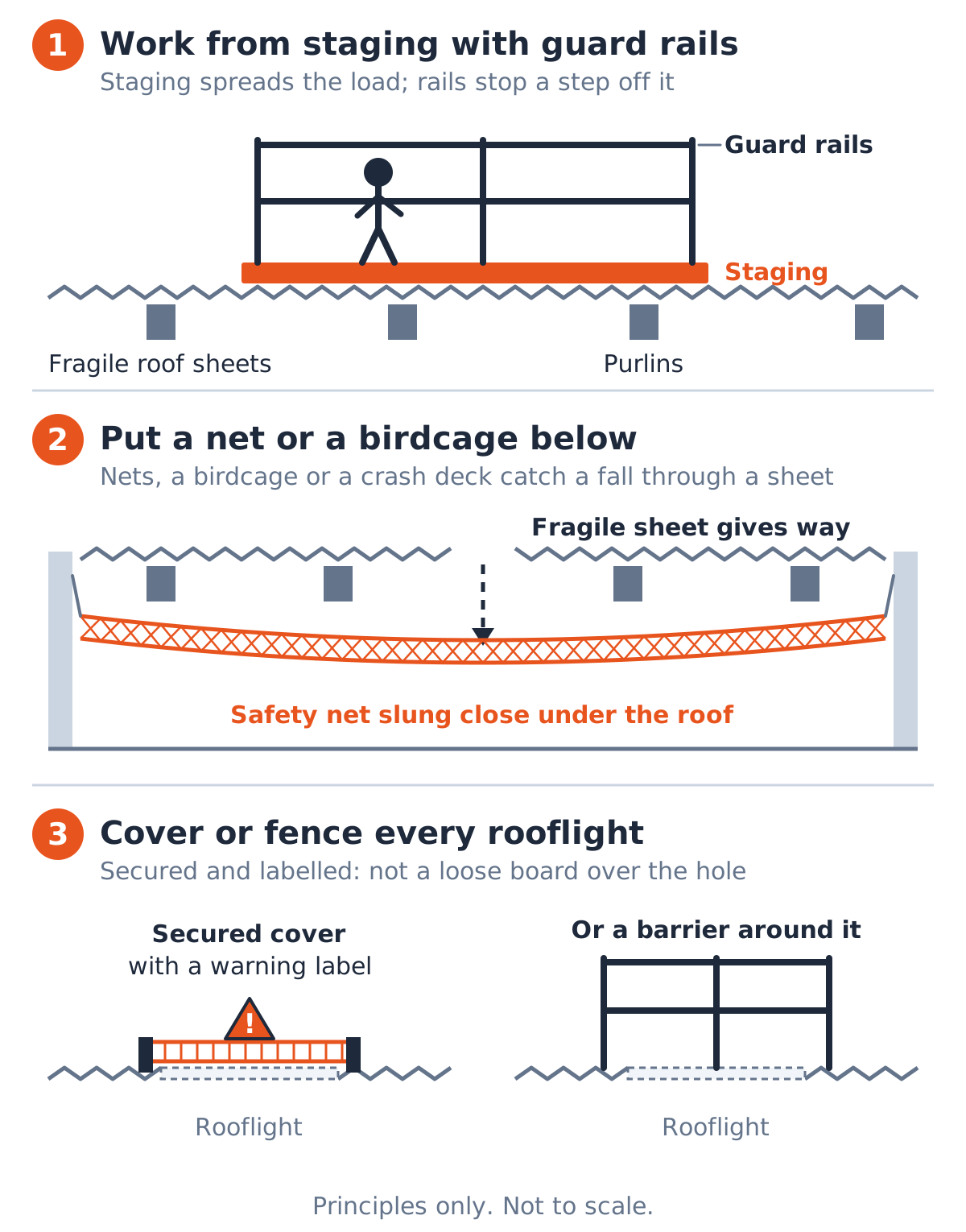
- Staging or platforms spanning the purlins to carry anyone on the fragile material, secured against slipping. HSG33 says stagings should span at least two purlins.
- Guard rails or coverings to stop anyone passing or working nearby from falling through.
- Nets or another collective measure below, unless all the work and access is on staging or platforms with guard rails. HSG33 lists birdcage scaffolds, a tower or scaffold used as a crash deck, safety nets (with enough clearance below) or soft landing systems.
- A safe area fenced by a continuous physical barrier at least 2 m from the nearest fragile material, according to HSG33. A painted line or bunting is not acceptable.
Harnesses come lower down: the regulations give collective protection priority over personal protection, and HSG33 notes harnesses need adequate anchorage and rely on training and supervision. Protect the people installing all this, too.
Are crawl boards enough on a fragile roof?
On their own, no. A board spreads your weight while you're on it; it does nothing if you step off, stumble or it slides. HSG33 describes a worker killed when he stepped off one of his boards onto a fragile roof light while power-washing a farm building. An HSE leaflet for builders describes a 20-year-old killed falling through a factory skylight; his employer had provided only two crawling boards and had not trained him properly.
Boards are part of the answer, not all of it. HSE's fragile surfaces guidance says work on or near fragile surfaces "requires a combination of stagings, guard rails, fall restraint, fall arrest and safety nets slung beneath and close to the roof". So ask: if the worker steps or falls off the board, what stops them? If nothing, add guard rails, nets or another collective measure before anyone goes up.
How do you protect rooflights?
HSE says fragile rooflights must be protected by barriers or by covers that are secured and labelled with a warning. That means every rooflight people will pass or work near, and open rooflight holes on a roof under construction.
- Covers: proprietary covers can be temporary or permanent, and HSG33 says they can be retrofitted over existing roof lights. Any cover must be secured against slipping and bear any foreseeable loading. The Altrincham case shows an unsecured board over a hole is not a cover.
- Barriers: stop people walking onto the rooflight at all.
- Netting: HSE's fragile roofs leaflet shows safety netting protecting rooflights during minor roof works.
- Warning notices: fixed at the approach to any fragile surface, so far as reasonably practicable.
What the law says
Regulation 9 of the Work at Height Regulations 2005 covers fragile surfaces. In summary:
- Employers must make sure no one at work passes across or near, or works on, from or near a fragile surface where it is reasonably practicable to do the work safely, and under appropriate ergonomic conditions, without doing so.
- Where that isn't reasonably practicable, they must make sure, so far as reasonably practicable, that "suitable and sufficient platforms, coverings, guard rails or similar means of support or protection" are provided and used to bear any foreseeable loading and, if a risk of falling remains, minimise the distance and consequences of a fall.
- Prominent warning notices must go at the approach, so far as reasonably practicable, or people must be made aware of the fragile surface another way.
Regulation 6 sets the order: avoid work at height where reasonably practicable, otherwise prevent falls, and where a risk remains, minimise the distance and consequences. Regulation 7 gives collective protection priority over personal protection. The June (Preston) and August (Fulham) cases were prosecuted under regulation 6(3), the duty to prevent falls; the Altrincham case under CDM 2015 regulation 13(1), the principal contractor's duty to plan, manage and monitor the construction phase.
How to record it in your RAMS
HSG33 says a method statement should show working positions and access routes, how falls will be prevented or minimised, the equipment and training needed, and who will supervise. For a fragile roof, record:
- Every fragile surface, including rooflights, and who confirmed anything you treat as non-fragile.
- Why the work can't be done from underneath or from a MEWP, if anyone goes on the roof.
- Access route, working positions, perimeter edge protection, staging, guard rails and safe-area barrier.
- What is below (nets, a birdcage or a crash deck) and how the installers are protected.
- How each rooflight is covered or fenced, and where the warning notices go.
- Who is trained in these controls and who supervises. In the November case, HSE found workers had not been trained enough to use the controls in the firm's own risk assessment.
- If the sheets could be asbestos cement, how the asbestos was identified before work starts.
Our free RAMS generator turns a description of the job into a site-specific risk assessment and method statement to review, edit and download as a PDF. For regular roof work, RAMS on The Site Book give each hazard real control measures and step-by-step method statements. Prefer a blank sheet? Use the free risk assessment template. Then brief the crew with the working at height toolbox talk, which includes an attendance sign-off sheet.
The bottom line
Assume the roof is fragile, and work from underneath or from a MEWP if you can. If you can't, use staging with guard rails, nets or another collective measure underneath where the rails can't protect, and secured, labelled covers or barriers on every rooflight. A crawl board alone is not a plan, and neither is a risk assessment the crew hasn't been trained to follow.
This article is general guidance, not legal advice or a guarantee of compliance.
Sources
- HSE press release, 5 November 2026: worker falls through fragile barn roof
- HSE press release, 28 May 2026: joiner injured in skylight fall
- HSE press release, 19 June 2026: man fell through roof
- HSE press release, 6 August 2026: worker seriously injured
- HSE press release, 10 August 2026: employee fell through a fragile roof
- Work at Height Regulations 2005, regulation 9
- Work at Height Regulations 2005, regulation 6
- Work at Height Regulations 2005, regulation 7
- Work at Height Regulations 2005, regulation 2 (definitions)
- CDM 2015, regulation 13
- HSE, Health and safety in roof work (HSG33)
- HSE, Roof work
- HSE, Fragile surfaces
- HSE, Fragile roofs (GEIS5)
- HSE, Roof repair work (CIS60)
Put your fragile roof plan in writing
Describe the roof job and get a site-specific risk assessment and method statement to review, edit and download as a PDF. Your first project is at no cost.
Try the free RAMS generator →