How Deep Can a Trench Be Without Support? The 1.2 m Myth
GB law sets no depth below which a trench is safe without support. Where the 1.2 m and 5 ft figures come from, and what really decides it.
8 min read
TL;DR
GB law sets no depth below which a trench is safe without support. Where the 1.2 m and 5 ft figures come from, and what really decides it.
Not sure if your trench needs support?
Answer six questions about the dig. See which approaches to discuss with your competent person, the points to raise, and a record you can print.
Try the excavation selector →There is no depth in Great Britain below which a trench is automatically safe without support. The law requires all practicable steps to stop an excavation collapsing on anyone, so the answer to how deep can a trench be without support is not a number: the ground, water, loads at the edge and the work decide it, and a competent person should make that call before anyone goes in.
This post covers one decision: whether a trench is shallow enough to work in unsupported, and where the quoted numbers come from. For the full process, see our excavation safety guide.
It covers Great Britain, where the Construction (Design and Management) Regulations 2015 (CDM 2015) apply. Northern Ireland has its own CDM 2016 regulations.
Ask on site how deep you can dig before a trench needs support and someone will say 1.2 metres. Search online and you will be told 5 feet. Neither is the law in Great Britain, and a trench short of both can kill.
The Construction Plant-hire Association (CPA), whose shoring guidance HSE's excavations page links to, describes a case credited to HSE. A groundworker was laying a drain in a trench 1.0 metre deep and 0.6 metres wide. He crouched down to prepare and connect a joint, and the trench collapsed, trapping and killing him. It took one cubic metre of soil, weighing about 1,500 kg. Heavy plant moving about a metre from the edge was part of the cause. The guide does not say when or where it happened.
Is there a depth at which a trench legally needs support?
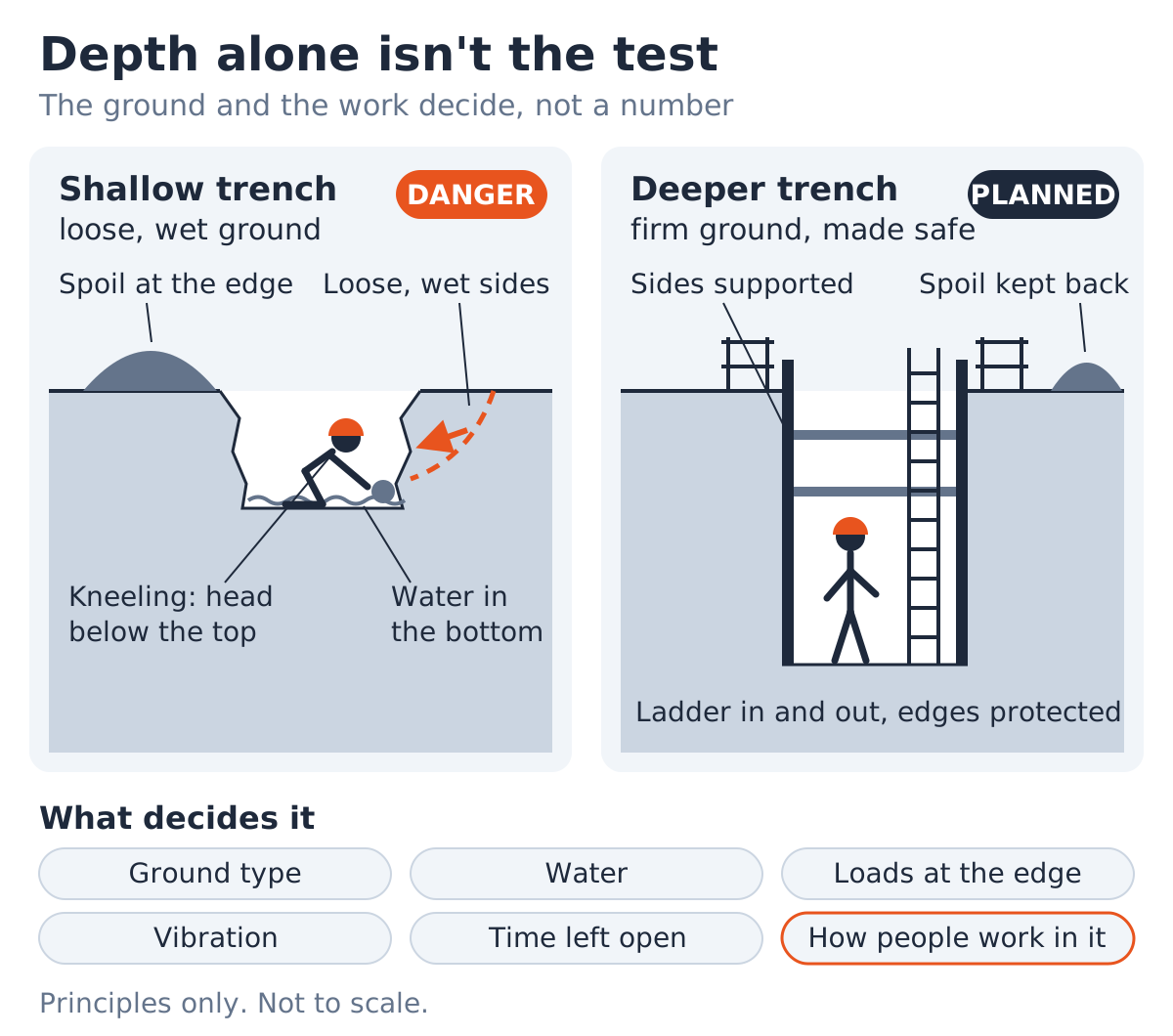
No. Regulation 22 of CDM 2015 is the excavations rule, and there is no depth in it. It requires all practicable steps to prevent danger, "including, where necessary, the provision of supports or battering", so that no excavation collapses and nobody is buried or trapped. The test is whether the sides could fall on someone, not how far down you have dug.
HSE's excavations page is blunt: "No ground can be relied upon to stand unsupported in all circumstances." Its construction guide, HSG150, says an excavation is safe without support only if its sides are battered back sufficiently, or it is in sound rock.
Where does the 1.2 metre rule come from?
From regulations revoked in 1996. The Construction (General Provisions) Regulations 1961 required timber or other support, where necessary, to prevent danger from falling earth, rock or other material in an excavation. Regulation 8 then excused an excavation where, given the nature and slope of its sides and other circumstances, no fall of earth was liable to bury or trap a person, or to strike a person from a height of more than four feet. Four feet is about 1.2 metres.
Even then, the exception turned on the ground and the slope of the sides, not depth alone. The Construction (Health, Safety and Welfare) Regulations 1996 revoked those rules, and their excavation regulation set no depth. Nor does CDM 2015.
The habit outlived the law. The CPA guide says shoring any excavation deeper than 1.2 metres that people had to enter used to be standard UK practice, but relying on that rule of thumb is not acceptable: each site's risks must be assessed.
Some firms set their own trigger: the CPA guide gives the example of a standing rule to shore before anyone enters an excavation deeper than 1 metre. That is a company rule, not a legal limit. The duty to stop a shallower trench collapsing still applies.
Where does the 5 foot figure come from?
The United States, and it turns up in a lot of search results. The US federal standard, OSHA 29 CFR 1926.652, requires workers in an excavation to be protected from cave-ins, except where the excavation is made entirely in stable rock or where the excavation is less than 5 feet (1.52 m) deep and a competent person's examination of the ground gives no indication of a potential cave-in.
It does not apply in Great Britain, and even there, under 5 feet still needs a competent person to check the ground.
What decides whether a trench needs support?
HSG150 says the need for support depends on the type of excavation, the nature of the ground and the groundwater. These change the answer:
- The ground. Where sides are battered, HSE says wet ground needs a considerably flatter slope. The CPA guide says most UK excavations are relatively shallow, in urban ground that has probably been reworked several times, and made ground is particularly variable.
- Water. Weather and groundwater change how soil behaves. Depending on the ground, water can flow into any excavation below the natural groundwater level.
- Loads at the edge. Spoil, materials, plant and vehicles near the sides make collapse more likely. HSE's busy-builder leaflet describes an unsupported trench collapse that killed one worker and injured another. Heavy machinery at the edge contributed, and the two companies were fined a total of £320,000.
- Vibration. The CPA guide lists surcharging and vibration around the edge, such as heavy plant working close by, among common causes of collapse.
- How long it stays open. The CPA's hazard guide lists the duration of the excavation as a risk assessment factor. Ground that stood this morning may not stand after heavy rain.
- The work, and the person doing it. The same CPA hazard guide also lists whether anyone needs to go in, and the work to be done in or near the excavation, as risk assessment factors. Our own view: judge the depth against the person in the trench, not just the tape measure. Someone kneeling to joint a pipe or crouching to clear the bottom has their head and chest far lower than when standing, like the man in the case above.
- What is nearby. HSE warns that many garden and boundary walls have very shallow foundations that "even small trenches" can undermine, bringing the wall down on the people working there.
Who decides if a trench is safe without support?
Under CDM 2015, the contractor doing the work must meet regulation 22 for anything within its control, but the judgement should come from someone competent who has seen the ground. The CPA guide warns that the short-term stability of an exposed face is difficult to judge, even for experts.
HSG150 says support work should be directed by a competent supervisor, and where supports or battering are provided, CDM 2015 bars work in the excavation until a competent person has inspected it and is satisfied it is safe.
Where the support needs designing, it is temporary works: the CPA guide follows BS 5975, which identifies roles including a temporary works coordinator and a temporary works designer. For more complicated excavations, HSE's busy-builder leaflet says to speak to an expert, such as a structural engineer.
If the answer is to batter or step the sides instead, our post on when to batter back or step an excavation covers that choice.
What the law says
Regulation 22 of CDM 2015 (Excavations) requires:
- all practicable steps to prevent danger, including supports or battering where necessary, so that no excavation collapses and nobody is buried or trapped (22(1));
- steps to stop people, work equipment or material falling in, and, where necessary, to stop the excavation or the ground next to it being overloaded (22(2) and (3)); and
- where supports or battering are provided, a competent person's inspection at the start of the shift, after any event likely to have affected its strength or stability, and after any material unintentionally falls or is dislodged, with no work until the inspector is satisfied and any problem is put right (22(4) and (5)).
None of it mentions depth. HSE's busy-builder leaflet boils it down: shore, step or batter back, and do not assume ground will stand unsupported.
How to record it in your RAMS
Write the decision down before anyone gets in. Your method statement should cover:
- The planned depth and length, and your ground information, such as client information, trial holes or soil tests.
- The water you expect, and what happens if it starts coming in.
- Whether anyone needs to go in, and what they will do there, such as kneeling to joint pipes.
- The support, batter or step method, who decided it, and who designed it if it needed design. Get the support equipment on site before digging starts.
- Where spoil, materials and plant will be kept, back from the edge.
- Who inspects, when, how it is recorded, and the stop-work triggers: heavy rain, water coming in, or material falling from the sides.
Our free batter, step or support selector asks six questions about the dig and gives you the points to raise with your competent person and a record you can print. The Site Book's RAMS generator turns your job description and selected hazards into a structured first draft that you review and adapt for the site (see RAMS for groundworks and excavation). Then brief the crew with the free excavation safety toolbox talk.
The bottom line
There is no safe depth to quote. The 1.2 metre figure is a leftover from regulations revoked in 1996, and 5 feet is a US rule. In Great Britain the question is whether the sides could fall on someone, given the ground, the water, the loads at the edge and the work, and a competent person should answer it before anyone goes in. A trench one metre deep killed a man who crouched to make a joint.
This article is general guidance, not legal advice or a guarantee of compliance.
Sources
- CDM 2015, regulation 22 (Excavations)
- CDM 2015, regulation 16 (Application of Part 4)
- HSE, Excavations
- HSE, Health and safety in construction (HSG150)
- HSE, Excavation: what you need to know as a busy builder (CIS64)
- CPA, Management of Shoring in Excavations, Part 1: Management Process
- CPA, Management of Shoring in Excavations, Part 2: Hazard Identification for Risk Assessment
- The Construction (General Provisions) Regulations 1961
- The Construction (Health, Safety and Welfare) Regulations 1996, Schedule 10 (Revocations)
- The Construction (Health, Safety and Welfare) Regulations 1996, regulation 12 (Excavations)
- OSHA (US), 29 CFR 1926.652, Requirements for protective systems
Not sure if your trench needs support?
Answer six questions about the dig. See which approaches to discuss with your competent person, the points to raise, and a record you can print.
Try the excavation selector →