Spoil Heap Distance From a Trench Edge: Is There a Rule?
UK law sets no spoil heap distance from a trench. What decides how far back spoil, materials, plant and vehicles stay, plus stop blocks and edge protection.
8 min read
TL;DR
UK law sets no spoil heap distance from a trench. What decides how far back spoil, materials, plant and vehicles stay, plus stop blocks and edge protection.
Spoil or plant near the edge? Plan it before you dig
Answer six questions about your excavation, including whether loads will sit near the edge. See the points to raise with a competent person and print a record.
Open the free selector →There is no fixed spoil heap distance in UK law. CDM 2015 says you must stop people, plant and material falling into an excavation, and stop the ground beside it being overloaded, but it gives no figure. How far back is far enough depends on the depth, the ground, water, the weight and the support, and it should be set by a competent person for the actual dig.
This post covers one decision: how far back spoil, stacked materials, plant and vehicles stay from the edge of a trench or excavation, and what stops anything going in. For the full process, see our excavation safety guide. Choosing whether to batter back, step or support the sides is covered in our batter, step or support post.
This post covers Great Britain, where the Construction (Design and Management) Regulations 2015 (CDM 2015) apply. Northern Ireland has its own CDM 2016 regulations.
What happened when spoil was piled at the edge in the rain?
In June 2026 HSE reported the sentencing of the sole director of a London-based construction company. A 50-year-old worker had been levelling the ground in a three-metre deep excavation. It had been raining, and the excavated soil and other material was piled up by the side of the excavation. The side fell towards him and pinned him against the wall, leaving him with life-changing injuries.
The incident was not reported to HSE as RIDDOR requires; the worker's solicitor reported it two months later. Inspectors found the work had not been suitably planned, managed and monitored, including the excavations. The director pleaded guilty to breaching section 37(1) of the Health and Safety at Work etc. Act 1974, by virtue of CDM 2015 regulation 15(2), the contractor's duty to plan, manage and monitor the work. He received six months suspended for two years, with £4,608.32 costs and a £154 surcharge. The inspector said planning the work and shoring the excavation walls would have prevented the injuries.
Is there a minimum spoil heap distance in UK law?
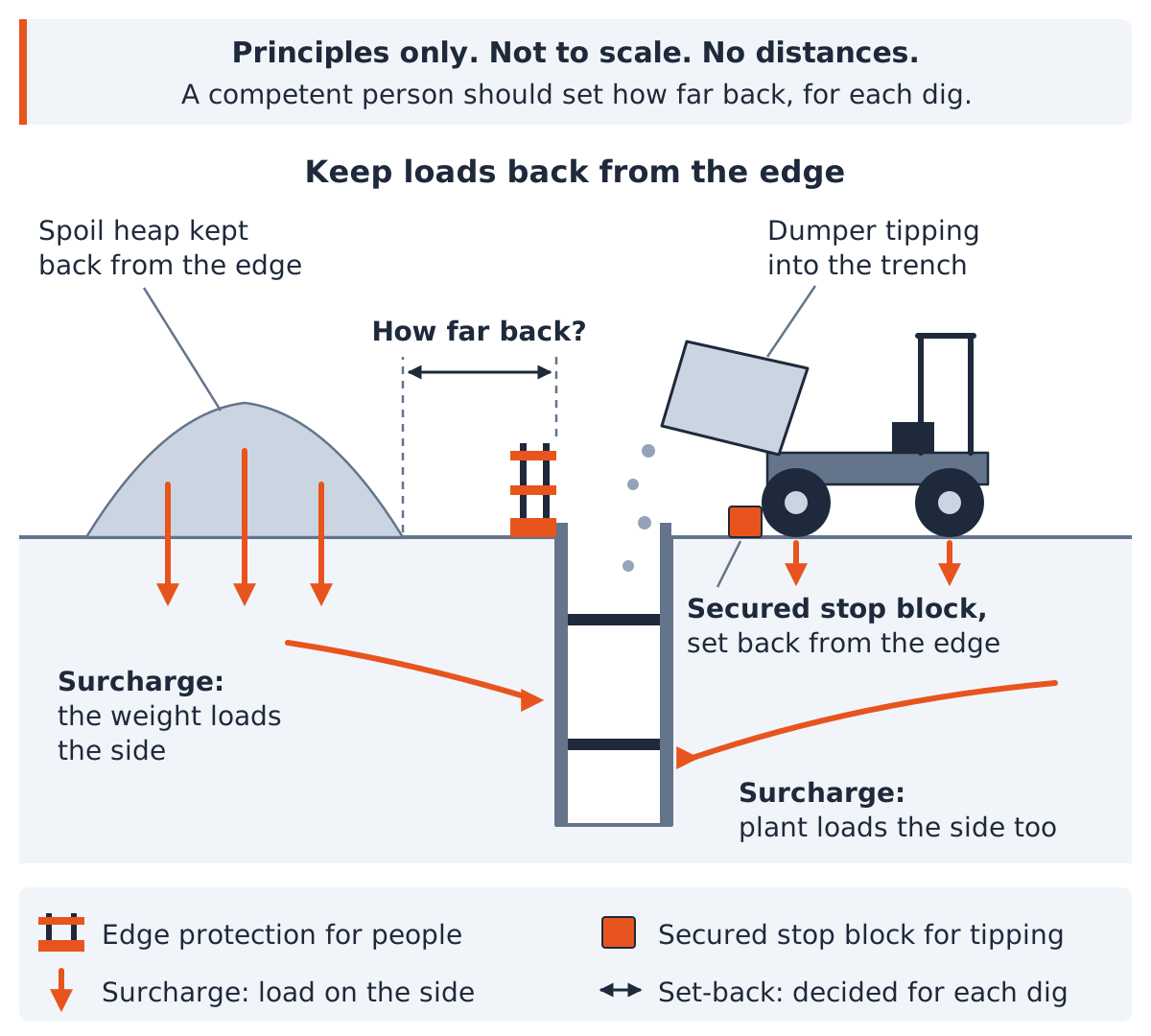
No. Regulation 22 of CDM 2015 sets duties, not distances: stop people, equipment and material falling in, and, where necessary, stop the ground next to the excavation being overloaded. A spoil heap is caught twice, as material that can fall in and as a load beside the edge.
HSE's guidance doesn't give a figure either. HSG150, Health and safety in construction, says don't park plant and vehicles or store spoil and other materials close to the sides of excavations, but doesn't define "close".
You will find fixed figures elsewhere. Raising the bar 13 is a 2013 Highways Agency document setting minimum standards for contractors on its major road schemes. It says spoil or plant should be 1.5 m away from the edge of an excavation. Treat that as one client's rule of thumb for its own road schemes, not the law and not a safe distance for every dig. Some figures quoted online come from overseas rules, which don't apply in Great Britain.
Why does a spoil heap near the edge matter?
Weight, and falling material. Spoil, stacked blocks, a skip or a loaded dumper beside an excavation all add load to the ground next to the side. That is surcharge. HSE says a cubic metre of soil can weigh more than 1.5 tonnes, depending on conditions, and HSG150 says the extra loadings from spoil and vehicles can make the sides more likely to collapse.
HSE also warns that loose materials may fall from spoil heaps into the excavation, so edge protection should include toe boards or other means, such as projecting trench sheets, and head protection should be worn.
What decides how far back spoil, materials and plant should go?
- The ground and water. HSG150 says the need for support depends on the type of excavation, the nature of the ground and the groundwater conditions. HSE adds that supports should be designed to take any additional water loading into account.
- Depth. The deeper the excavation, the more is at stake if a side goes.
- The weight, and how long it stays. A few bags for a morning are not a fortnight's spoil, or a loaded dumper tipping at the edge.
- The support. Battered, stepped or supported, and what it was designed for. For domestic basements, HSE says to appoint a competent temporary works engineer to design the support.
- The space. On a tight plot, the answer may be loading spoil away as you dig, or support that allows for the load, not piling it at the edge and hoping.
If you can't keep a load back, settle it with whoever is choosing or designing the support before the machine arrives. For a more complicated excavation, HSE's busy builder sheet says to speak to an expert such as a structural engineer. Our free batter, step or support selector asks whether loads will be near the edge and lists points to raise. It doesn't give distances.
How far back should plant and vehicles stay, and when do you need stop blocks?
HSG150 says keep vehicles out of the area; vehicles passing close to the edge can also overload the sides. Where necessary, use baulks or barriers, painted or marked so drivers can see them. Where a vehicle tips into an excavation, use properly secured stop blocks, placed far enough back that the edge won't break away under the vehicle's weight; the sides may also need extra support. The Highways Agency document adds a rule of thumb: plant edge protection at least half the height of the wheel of a vehicle that may approach.
In July 2026 HSE reported that a Warrington groundworks company had been fined £20,000, with £4,824 costs, after a reversing one-tonne dumper entered an unprotected excavation on a housing site near Wigan in 2022 and overturned. The driver, told by the company not to wear a seatbelt on one-tonne dumpers, was thrown out. The inspector said suitable edge protection and a worn seatbelt could have avoided the injuries. Our mobile plant toolbox talk covers reversing, segregation and ROPS. Add this case's seatbelt and edge-protection points when you brief drivers.
What edge protection stops people and kit falling in?
HSE says edges should be protected with substantial barriers where people are liable to fall in, using guard rails and toe boards set into the ground right next to the supported side, guard-rail assemblies that connect to a trench box, or the support system itself, such as trench sheets longer than the trench is deep. HSE's busy builder sheet adds that barriers should be strong enough not to collapse if someone falls against them. Fence off excavations in public places.
What the law says
Regulation 22 of CDM 2015 covers excavations:
- 22(1): all practicable steps, including supports or battering where necessary, to stop collapse, falling material and anyone being buried or trapped.
- 22(2): suitable and sufficient steps must be taken to prevent any person, work equipment or accumulation of material from falling into any excavation.
- 22(3): suitable and sufficient steps must be taken, where necessary, to prevent any part of an excavation or ground adjacent to it from being overloaded by work equipment or material.
- 22(4): where supports or battering are provided, no work in the excavation until a competent person has inspected it, and any work equipment and materials which may affect its safety, at the start of the shift, after any event likely to have affected its strength or stability, and after any material unintentionally falls or is dislodged, and is satisfied it is safe.
So where supports or battering are in place, the inspection covers any spoil, materials and plant that could affect the excavation's safety, not just the hole. Regulation 28(6) requires suitable and sufficient measures to prevent a vehicle falling into any excavation or pit. None of it gives a distance: you decide one for the ground in front of you, and stick to it.
How to record spoil and plant set-back in your RAMS
Write it down before anyone digs. Your method statement should say:
- Where spoil goes: which side, how far back (as the competent person decided), or that it's loaded away as you dig.
- Where deliveries and materials are stacked, and where they must not go.
- Plant and vehicle routes, standing positions, and the baulks or barriers that keep them back.
- Stop blocks for any tipping: what they are, how they're secured and who places them.
- Edge protection for people, plus fencing, lighting and safe crossings where needed.
- Who inspects, when, and what stops the work.
The Site Book's RAMS generator turns your job description and selected hazards into a structured first draft that you review and adapt for the site. Brief the crew with our excavation toolbox talk, and use the excavation inspection checklist to check loads are kept far enough from the edge.
The bottom line
UK law doesn't set a spoil heap distance. It makes you stop people, kit and material going in, and stop the edge being overloaded. Keep loads back by a distance a competent person has set for that ground, depth and support, with stop blocks where vehicles tip and barriers where people could fall.
This article is general guidance, not legal advice or a guarantee of compliance.
Sources
- HSE press release, 26 June 2026: construction company director sentenced after collapsing excavation wall leaves worker with life-changing injuries
- HSE press release, 21 July 2026: groundworks company fined after worker seriously injured when dumper truck overturned
- CDM 2015, regulation 22 (Excavations)
- CDM 2015, regulation 28 (Vehicles)
- CDM 2015, regulation 15 (Duties of contractors)
- HSE, Excavations
- HSE, HSG150 Health and safety in construction
- HSE, CIS64 Excavation: what you need to know as a busy builder
- HSE, CIS66 Domestic basement construction projects
- Highways Agency, Raising the bar 13: excavations protection, access and egress (2013)
- GOV.UK, Health and safety for major road schemes: excavations protection
Spoil or plant near the edge? Plan it before you dig
Answer six questions about your excavation, including whether loads will sit near the edge. See the points to raise with a competent person and print a record.
Open the free selector →